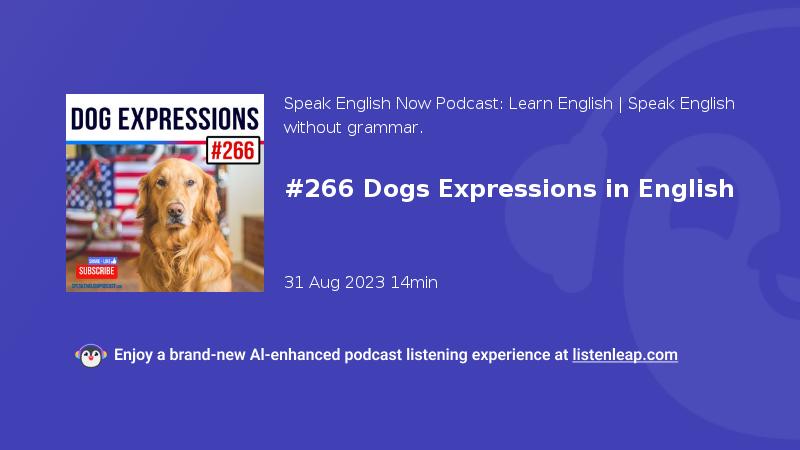
Do you love dogs?
That's wonderful, because today we're going to learn some new idioms in English about dogs.
And, with a mini-story, you will learn about Mark's success and challenges in the workplace, while using these dogs' expressions.
It's gonna be fun.
You'll see.
Before we start, get the transcript of this episode.
Visit speakenglishpodcast.com slash podcast.
Let's start.
Our first idiom is barking up the wrong tree.
Imagine you're trying to find your lost keys.
And you start looking under the couch.
But, whoops, the keys were actually on the kitchen counter.
That's when you've been barking up the wrong tree.
You've been focusing your efforts in the wrong direction.
So remember, when you're searching for something, make sure you're not barking up the wrong tree.
Now let's continue with the expression, let sleeping dogs lie.
Imagine you have a sleepy dog who's all cozy on the couch.
You know, if you wake them up, they might get grumpy.
This idiom means sometimes it's best to leave things as they are and not stir up trouble.
Just like you wouldn't want to wake a sleeping dog, it's often better to let certain situation be.
Every dog has its day.
It's our following idiom.
This means that everyone gets a chance to shine or succeed.
Just like even the quietest dog might have a day when they're the center of attention, you too will have your moment to succeed and be recognized.
Moving on, we have Dog Eat Dog World.
This expression paints a picture of a competitive and ruthless environment where everyone tries to get ahead.
It's like a pack of dogs all fighting for the same bone.
Let's continue.
If you're in the doghouse, it means you're in trouble or someone's upset with you.
Imagine you forgot your friend's birthday.
You might be in the doghouse for a while.
But with a little effort, you can always mend fences and get out of that doghouse.
Have you ever been sick as a dog?
This idiom describes feeling extremely ill.
Maybe you've caught a cold that makes you feel just as miserable as a sick pup.
Rest and medicine are your best friends when you're sick as a dog.
Dog days is up next.
This expression refers to the hottest summer days, when it's so hot that even dogs prefer to stay indoors.
So, during the dog days, make sure to stay hydrated and keep cool.
Ah, here comes the top dog.
No, I'm not talking about an actual dog.
This idiom refers to the person or thing that's the best or most important in a certain situation.
Like the leader of a pack of dogs.
Being the top dog means you're at the head of the pack.
Our last idiom for today is work like a dog.
This means working extremely hard, like a dog who tirelessly chases after a ball.
Whether studying for exams or managing a big project, remember that hard work pays off.
And there you have it.
Today you have learned some new idioms with the word dog.
I hope you enjoyed it.
Let's listen to them one more time.
Barking up the wrong tree.
Every dog has its day.
Let sleeping dogs lie.
Dog eat dog world.
In the dog house.
Sick as a dog.
Dog days, top dog, and work like a dog.
Great!
Now let's practice these expressions in context with a fun mini story.
I will tell a story by asking simple questions.
I use this technique extensively in my premium courses as it is highly effective.
First, I say a phrase with information.
Next, I ask some questions.
After each question, there is a pause.
It's your turn to answer.
After each pause, I will give a correct answer.
That's how I build a story.
And if you want to improve your fluency much faster, check out my premium courses at speakenglishpodcastcom slash courses.
There are several levels.
Okay, let's start.
Mark told his colleague that he had been barking up the wrong tree with his project proposal.
He had been working long hours like a dog to make it successful.
Did Mark tell his colleague that he had been relaxing and enjoying a peaceful day at the park?
No, no.
Mark told his colleague that he had been barking up the wrong tree with his project proposal.
He said he was wrong about his project idea.
Had Mark been working like a cat?
No no, Mark had been working like a dog.
He worked really hard to make the project successful.
Mark's colleague described the office environment as a dog-eat-dog world.
And mentioned that Mark's dedication set him apart as the top dog.
He also encouraged Mark by saying that every dog has its day.
Who described the office environment?
Mark's colleague.
He described it as a dog-eat-dog world where everyone competes a lot.
Did Mark's colleagues say that the office environment was relaxed and laid-back?
No, no.
He described the workplace as a dog-eat-dog world, where it's really competitive and everyone is trying to do better than others.
How did the colleague view Mark's position in the office?
He saw that Mark worked really hard and was the top dog, making him stand out as the top performer.
How did the colleague encourage Mark?
He told Mark that every dog has its day.
This means everyone gets a chance to shine or succeed.
Despite his hard work, Mark's supervisor was displeased with his recent performance review, leaving Mark feeling like he was in the doghouse.
Was Mark praised for his recent performance review?
No, he received negative feedback.
Mark's supervisor was unhappy with his performance review, leaving Mark feeling like he was in the doghouse.
Did Mark feel good about his performance review?
No, no.
He didn't feel good.
He felt like he was in the doghouse, implying he was in trouble.
Sadly, Mark got ill and couldn't come to work.
His colleagues mentioned he looked really sick when he left the office.
He looked as a sick dog.
Did Mark leave work looking energetic and healthy?
No, he left work looking sick.
His colleagues commented that he looked as sick as a dog.
What was the state of Mark's health when he left the office?
He looked unwell, as sick as a dog.
On very hot summer days, the air conditioning in the office stopped working.
Mark made a joke that they were having the hottest days of the year, often called the dog days.
Was Mark saying that the office was at a comfortable temperature during the summer?
No, no.
He joked that they were experiencing the hot and uncomfortable summer days, often called the dog days.
What did Mark mean when he mentioned dog days?
Was he referring to the cold days of winter?
No, no.
When he mentioned dog days, Mark referred to the hot and uncomfortable summer days.
Despite the challenges, Mark's hard work eventually paid off and he emerged as the top dog in his department.
Was Mark's hard work in vain?
No, no.
Mark's dedication eventually led him to become the top dog in his department.
Who became the top dog in his department?
Mark's colleague?
No, no.
Mark became the top dog, not his colleague.
Mark's hard work and determination led him to this achievement.
Well, this is the end of this short exercise.
As you can see, answering many simple questions can improve your speaking, just like in a real-life conversation.
So, if you are serious about learning English, I recommend my premium courses.
Visit speakenglishpodcast.com slash courses.
That's all for today.
I'll be back next week.
Bye-bye.