I suppose I'm what they call a rich man.
They tell me so. I'm not particularly conscious of it.
I don't use money for myself.
I don't spend much on myself.
I have always just worked, done what needed to be done in business.
I didn't try to make money especially.
I'm not interested in money.
Welcome to The Knowledge Project.
I'm your host, Shane Parrish.
This podcast helps you master the best of what other people have already figured out.
If you want to take your learning to the next level, consider joining our membership program at fs .blog .com.
As a member, you'll get my personal reflections at the end of every episode, early access to episodes, no ads including this, exclusive content, hand -edited transcripts, and so much more.
Check out the link in the show notes for more.
This episode is part of our new series, Lessons from Outliers, where we study extraordinary people to extract timeless principles about business, leadership, and life.
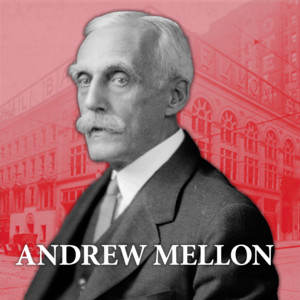
Today's episode is on Andrew Mellon.
The wealthiest member of America's cabinet built his fortune by staying invisible.
While Carnegie and Rockefeller dominated headlines and built empires of steel and oil, Andrew Mellon created something far more powerful, a system for spotting opportunities that others missed and overlooked and turning promising ventures into industrial giants.
His secret? Staying in the shadows.
The Mellon system transformed American industry.
Identify promising ventures, provide capital at precisely the right moment and integrate them into a growing ecosystem of mutually reinforcing businesses.
This deceptively simple approach created industrial giants like Alcoa, Gulf Oil, and Copers, companies that still shape American industry today.
More importantly, his systematic approach to spotting and seizing opportunities offers a blueprint we can apply to our own ventures.
It's time to listen and learn.
This podcast is for entertainment and informational purposes only, and you should do all of your own research.
Don hadn't yet broken over Washington, D .C.
when Andrew Mellon first walked into the Treasury Building on March 5th, 1921.
At age 65, when most men were settling into retirement, America's most successful and visible billionaire, at least in today's terms, stepped into one of the most public roles possible, Secretary of the United States Treasury.
On the surface, it seemed like a bizarre choice.
How could someone who'd spent decades amassing a fortune while avoiding attention succeed in one of the most public roles in government?
But Mellon's story suggests something counterintuitive.
There's immense power in silence and standing apart and observing while others shout.
One of my good friends, Peter Kaufman, has a saying that I think about often.
He says, the whale that surfaces gets harpooned.
There's a lot of wisdom in this statement.
It means staying out of the headlines.
It means moving in silence.
It means not bragging.
It means not trying to be seen.
It means not chasing attention.
Mellon lived his life in a way not to surface.
In fact, he built a fortune in silence.
Even at his home in Pittsburgh, Mellon was a ghost.
Dinner guests would watch him sit silently at the head of the table, lost in thought, barely touching his food, rarely speaking, almost never laughing.
He turned that silence, however, into a superpower, his natural introversion into a weapon of wealth creation.
Those who knew him as a young man painted a strange picture.
Solitary, but not melancholy.
Seclusive, but not moody.
Achieving, but never boasting.
Timid, but not fearful.
Silent, but never stupid.
But to understand how this ghost of Pittsburgh built one of America's great fortunes while barely raising his voice above a whisper, we need to start with his father, Thomas Mellon, and the distinctive world of 19th century Pittsburgh.
Part 1, The Judge's Son Most great American fortunes of the 1800s were built by bold risk -takers, charismatic empire builders, but the Mellons were different.
They moved with the patience of farmers watching crops grow, which makes sense because that's exactly where they started.
In 1823, a nine -year -old farm boy set out at dawn to walk 21 miles to Pittsburgh.
His family's farm was on Poverty Point, a name that said everything about their circumstances.
That boy was Thomas Mellon, and what he saw that day would transform not just his life, but American financial history.
The local farmer walking beside young Thomas Mellon made a prediction.
The boy would see more in that single day in Pittsburgh than in a lifetime back on the farm.
And he was right, but not in the way he imagined.
What caught Thomas's eye wasn't the roaring factories or bustling streets.
Instead, he found himself transfixed by a vast estate overlooking the city.
1 ,500 acres with a mansion that seemed to command Pittsburgh itself.
The whole scene, he would later write, impressed me with an idea of wealth and magnificence.
I had before no conception of it.
Suddenly, everything was possible.
Silently, he asked himself whether I might not one day attain such wealth, and the answer to that question would launch a multi -generational journey from farming on Poverty Point to one of the richest and most powerful families in America.
While most great American fortunes of the era were built by bold gamblers and charismatic empire builders, the Melons took a different approach.
Thomas, and later his son Andrew, would build their dynasty the way they'd learn to grow crops, by planting carefully, watching patiently, and waiting for the harvest.
They understood something that modern investors like Warren Buffett and Charlie Munger would later teach so simply.
The big money isn't in the buying or the selling, it's in the waiting.
The Mellons had discovered this truth decades earlier, quietly building their empire while others chased quick riches.
The farm boy who dreamed of mansions found his roadmap in an unlikely place, Benjamin Franklin's autobiography.
While other teenagers worked the field, 17 -year -old Thomas Mellon was studying Franklin's story as if it were a manual for success.
This wasn't just inspiration, it was instruction.
And it's worth pointing out that Thomas Mellon isn't the only one who found this book and loved it.
Charlie Munger also had a similar experience with Ben Franklin's autobiography.
Franklin's influence on Thomas Mellon would prove so profound that decades later, when establishing his bank in Pittsburgh, he placed Franklin's statue above the entrance.
It wasn't decoration, it was a bronze reminder of the principles that guided him.
The autobiography became his secular gospel, one that he would later preach relentlessly to his sons, none more so than Andrew.
Thanks in large part to Ben Franklin's book, Thomas saw education as a way out of farming and poverty point.
Not everyone agreed.
Against his father's wishes, but supported by his mother and uncle, Thomas set out to pursue what he saw as the essential trinity of success, knowledge, wealth, and distinction.
When choosing a college, he rejected the popular Jefferson College because its students lacked what he called earnestness of purpose.
At Western University of Pennsylvania, he captured his emerging philosophy, writing, money is to society what the element of fire is to matter, diffusing warmth and vigor through all of its parts.
This wasn't just clever wordplay.
Thomas was developing a theory of wealth in real time that would guide the Mellon empire for generations.
While other ambitious young men rushed into business, Thomas took a longer view.
He chose law as his path into the business world, seeing it as Franklin had, not as an end in itself, but as a systematic way to understand how money moved through society.
Though when he would later claim in the professions and business management certificates of either ability or learning are valueless, at the early stages Thomas saw education as a tactical step, indeed the first such step toward his greater ambitions.
While Pittsburgh's other lawyers chased headlines and high -profile cases, Thomas Mellon took a different approach.
He kept his fees reasonable, built fierce client loyalty, and stayed in the background.
Despising display and notoriety, Mellon preferred to make money quietly.
Law became a means to spot opportunities in real estate, foreclosures, and property development.
Every foreclosure case, every property dispute, every business deal that crossed his dust wasn't just legal work.
It was intelligence about where money was flowing in Pittsburgh's booming economy.
His law practice became an observation post, letting him spot opportunities others missed.
While other lawyers collected fees, Thomas collected assets, real estate, stocks, stakes in growing businesses.
By age 29, this quiet approach had already made him relatively wealthy.
But Thomas saw his law practice the way a chess player sees the opening moves of a game.
It wasn't just about winning quickly.
It was about positioning for the real opportunities ahead.
This pattern, using a profession to spot investment opportunities, would become a classic wealth building strategy.
A century later, Charlie Munger would follow the same path, practice law by day, but use that knowledge to build lasting wealth through investments.
Both men understood that true wealth rarely comes from a salary.
It comes from owning things that grow in value while you sleep.
This systematic mindset extended to every aspect of Thomas's life, even marriage.
Just as he'd approach education and career as systems to be mastered, he viewed matrimony through the same cold analytical lens.
It wasn't looking for passion and romance as much as a partner evaluating potential wives with what he called an impartial assessment of their favorable and unfavorable qualities.
He found his helpmate in Sarah Jane Negley.
Her high status and connections expanded his network of opportunities even further.
Over the next 16 years, the Mellons would have eight children with Andrew arriving in 1855 as the sixth child and fourth son.
From the beginning, Andrew stood apart.
From his earliest days, he seemed to be his father's son incarnate, showing an innate understanding of money and business that delighted Thomas.
While other children played in Pittsburgh's dirty streets, young Andrew Mellon was learning to count money.
At an age when most kids were trading marbles, he was selling bundles of grass to passing farmers at five cents each.
When that business proved successful, he recruited his brothers to sell produce from the family garden.
That enterprise was so profitable and so successful that his mother sometimes had to buy back her own vegetables just to have something for dinner.
This wasn't normal childhood behavior, but the Mellon household was anything but normal.
Thomas raised his children, according to philosopher Herbert Spencer's maxim, that life was a struggle, which only the fittest survived.
Outside their windows, Pittsburgh was transforming into hell with the lid taken off.
500 factories belching smoke into the sky, forging two -fifths of America's iron, Thomas saw this industrial battlefield and determined his sons would be prepared.
He built on their own schoolhouse where poetry and fiction were banned as useless distraction.
Only what's necessary and useful in business was Thomas's motto.
The curriculum was ruthlessly practical, reading, writing, and arithmetic, nothing else.
The studies Thomas later explained were such as would be most necessary and useful in the subsequent business of life.
Years later, Thomas would express surprise that all of his sons spontaneously chose business careers as if he hadn't engineered precisely that outcome.
But Andrew's path took an unexpected turn.
When Andrew's brother Selwyn died, something softened in Thomas's iron philosophy.
The judge closed his schoolhouse and enrolled Andrew in public school and began commuting with him on the way to school every day, which was by his office.
Their daily commutes became kind of an apprenticeship.
As one relative observed, Thomas spoke to Andrew not as a little boy, but as one with a mature intellect.
These conversations, repeatedly daily walking through Pittsburgh's smoky streets, transformed a father's systematic approach to wealth into a son's natural instinct.
They weren't just talks, they were downloading knowledge.
We're so done with new year, new you.
This year, it's more you on Bumble.
More of you shamelessly sending playlists, especially that one filled with show tunes.
More of you finding Geminis because you know you always like them.
More of you dating with intention because you know what you want.
And you know what? We love that for you.
Someone else will too.
Be more you this year and find them on Bumble.
Imagine what's possible when learning doesn't get in the way of life.
At Capella University, our game -changing FlexPath learning format lets you set your own deadlines so you can learn at a time and pace that works for you.
It's an education you can tailor to your schedule.
That means you don't have to put your life on hold to pursue your professional goals.
Instead, enjoy learning your way and earn your degree without missing a beat.
A different future is closer than you think with Capella University.
Learn more at capella .edu.
Part two, building the system.
When Judge Thomas Mellon's eyesight began to fail, he turned even this setback into a teaching opportunity.
He would pay his children 50 cents for two to three hours of reading.
Of course, not fairy tales or novels, but rather business reports, financial news, and economic theory.
It was through this seemingly tedious task that Andrew gained unique access to his father's intellectual life.
The judge was, as biographer David Canadai notes, far from a passive audience.
This exact pattern, children reading business material to parents and learning to think critically through discussion, appears repeatedly in the stories of 19th century financial success.
Hedy Green, who would go on to become America's richest woman, developed her legendary financial acumen by reading market reports to her father and grandfather.
In both cases, these weren't just reading sessions, they were apprenticeships in analytical thinking.
It's a fascinating approach to learning.
You're not just absorbing information, you're learning how to think about it, how to argue about it, how to engage with ideas critically, and with a person that you probably inherently trust and respect.
As Thomas Mellon's influence on his children grew, he began laying the foundations for what would become the Mellon family's financial empire through two key institutions.
The first was East Liberty Savings and Deposit Bank.
On the surface, a simple investment, but a machine for creating wealth.
The East Liberty Savings and Deposit Bank looks simple from the outside, but it was actually the hub of an intricate system.
The Melons would vertically integrate everything.
Here's how author David Kashkoff described it.
The melon boys subdivided acreage into home sites sold at a profit, sold their buyers lumber with which to construct their humble dwellings at a profit, financed the transactions through the bank profitably, and then sold the coal to heat the houses, again, at a profit.
This interlocking system of businesses, all reinforcing one another would become known later as the Mellon system once Andrew perfected it.
The integration would give them unprecedented influence and advantage over competition.
When Thomas opened his second bank, Team Mellon and Sons, he placed Ben Franklin's statue above the door.
The same mentor who had guided him from farm boy to financier would now watch over his sons.
Thomas approached banking with characteristic confidence.
He said, there is nothing in banking but what you ought to be able to learn in a week or two.
As to bank books, keeping them is the simplest of all kinds.
He wasn't alone in this optimism.
Over 20 new banks opened in booming Pittsburgh during this period, which may explain why there were so many financial panics.
Andrew proved to be a reliable study.
Judge Mellon's trust in young Andrew was so complete that at just 19, Andrew became the only person beside his father with the bank safe combination.
The 1860s proved remarkably fertile ground for the Mellon's ambitions.
Pittsburgh was transforming into the industrial capital of America.
The nation's railway network doubled, and Pittsburgh stood at the center of American industrial revolution.
The city neared 300 ,000 residents producing half the nation's glass and iron, while new industries sprouted like wildflowers, Heinz food processing, Westinghouse's air brakes, and soon Carnegie's revolutionary Bessemer Steel process, which would help him create his own empire.
Thomas called it an easy -to -grow -rich decade, watching with satisfaction as his system worked exactly as designed.
For the judge, though, the greatest satisfaction came not from the profits themselves, but from seeing his son succeed in the system that he had created.
Yet this golden age wouldn't last.
In 1873, a financial hurricane, in what came to be known at the time as the Great Depression, swept from Europe to America, destroying nearly half of Pittsburgh's banks and its path.
Even the mighty Mellon Banks barely survived.
Thomas had to turn away desperate customers, Shaken and humbled, he closed the East Liberty Savings and Deposit Bank and debated going out of the banking business entirely.
The judge and Andrew learned something profound from the Panic of 1873, something that would shape not just their fortune, but a pattern repeated by history's greatest wealth builders.
They realize that financial storms don't just destroy, they create opportunity.
This goes back to one of the key lessons Thomas Mellon tried to instill in his children.
Life is competition and only the fittest survive.
While most tried to simply survive panics, great fortunes were built by those who understood a crucial truth.
Downturns are inevitable, and when they happen, only those positioned to take advantage of them can thrive.
The Panic of 1873, like the panics of 1857, 1884, and 1907 that would follow, wasn't just a crisis.
It was a chance to acquire valuable assets at fire sale prices.
In an era where banks went out of business quickly, the Melons always kept a surplus and never needed the kindness of strangers to survive.
It got pretty close one time, but they survived, and it was never, ever that close again.
That's more a testament to just how bad the downturn was than from them not having enough capital.
Being well positioned to take advantage of opportunities continues to build great fortunes.
When others retreated, when weak competition failed, when solid businesses were selling for pennies on the dollar, that's when the prepared few expanded their empires.
As John D. Rockefeller would later observe, the strong feed during depressions.
And you can think of the 2008 financial crisis and how Buffett was able to deploy billions of dollars with really high rates of returns in a matter of weeks.
While everyone else was paralyzed, he provided liquidity, of course, at a price.
Well, you can't predict when the next crisis will hit.
You know there will be one.
when it does those who borrowed too much or expanded too fast fight for survival while those who stayed strong and liquid pounce on opportunities the melons understood this truth early the goal isn't just to be strong enough to survive the storm it's to be strong enough to capitalize on it while others
pray for endless summer the wise prepare for winter knowing that fortunes are built when the assets are cheap and competition is weak this is really the idea behind positioning.
And it combined with patience would really build and fuel the Mellon fortune.
The Panic of 1873 was Andrew Mellon's first, but far from his last, and marked his true entry into banking.
At 19, Andrew didn't look like a banking titan in the making.
He was thin -voiced, shy, and uncommunicative.
But something remarkable was happening at T.
Mellon and Sons. This quiet teenager was becoming the family's center of gravity.
He didn't demand authority, he simply exercised it naturally.
Soon, everyone from his father down was asking the same question.
What would Andy think?
While other Pittsburgh titans roared and dominated, like Carnegie and Steele or Frick and Cole, Andrew moved like a shadow through the financial world.
His quietness wasn't just personality, it was strategy.
He moved in silence so as not to attract attention.
he was building something different.
Not a visible empire of smokestacks and railroads, but an invisible web of financial power.
He began methodically acquiring local banks, each piece carefully chosen to expand his reach.
But his masterstroke came in 1886 when he established just the second trust company in Pittsburgh.
While regular banks faced tight restrictions, trust companies, on the other hand, could do almost anything.
They could lend against real estate, deal in stocks and bonds, even act as venture capital firms of their day.
Andrew ventured far beyond his father's bread and butter of mortgages and real estate.
By his early 30s, Andrew had built his family's fortune to the modern equivalent of $50 million.
But he was just getting started.
His true genius would emerge late one day in 1889 when three men walked into T Melons and Sons, seeking a modest $4 ,000 loan, a moment that would transform not just the melons, but American industry itself.
The three men who walked in that day were Captain Elford Hunt, an MIT -trained metallurgist, George Clapp, a young chemist, and Arthur Davis, fresh from Amherst College.
Their company, named the Pittsburgh Reduction Company, had developed something revolutionary, a practical method of producing aluminum through electrolysis.
It was a classic startup, a breakthrough technology, promising early results, but a desperate need for capital to expand.
On paper, it looked incredibly risky.
They were producing just 475 pounds of aluminum daily and selling it for about $2 a pound, and they were struggling to convince anyone to abandon trusted metals like iron and copper for this expensive new material.
But where others saw shabby accounts and a lot of problems, Andrew Mellon saw opportunity.
Instead of just the $4 ,000 they requested, he offered them $25 ,000, more than six times what they asked for.
Not just enough to clear the debts, it was enough to grow.
It wasn't just a loan, it was the beginning of a system.
The Mellon approach was methodical.
First, help the company move to New Kensington, where the Mellon -owned real estate provided room to grow.
Then engineer a crucial expansion to Niagara Falls, where cheap hydroelectric power could drive costs down.
Lower costs meant lower prices, and lower prices meant explosive growth.
Within five years, the price of aluminum had dropped by 75 % and sales had skyrocketed from a few hundred pounds to 600 ,000 pounds annually in 1895.
This small company, the Pittsburgh Reduction Company, would later become Alcoa.
Still a 10 billion dollar giant today, but more importantly it revealed what would become known as the melon touch.
The ability to spot not just promising technologies but the right people to build them into empires.
The Mellon system that emerged wasn't just a collection of investments.
It was a wealth building machine that got smarter with every deal.
While its foundations were simple, identify promising technologies, back exceptional operators, provide capital at crucial moments, its real power lay in flexibility.
The Mellons didn't have one playbook.
They had many. With aluminum and the Pittsburgh Reduction Company, they were content being minority investors, taking about 12%, while letting the founders run the show.
But in oil, they seized majority control and installed family leadership.
This flexibility made them one of the few who could ever successfully compete against John D.
Rockefeller. When Standard Oil tried to squeeze them out by manipulating railroad rates and trying to block them at every turn, they didn't fight directly.
They simply built their own 271 mile pipeline to the coast.
By 1894, they controlled 10 % of America's oil exports, prompting Andrew to confidently tell one associate, we have every facility possessed by the Standard Oil Company and receive and deliver oil under as favorable conditions in every way.
Rockefeller would eventually buy them out.
But not because the Millons were weak, but because they were strong.
They had built something he couldn't crush into submission.
This wasn't just their father's system anymore.
Like Thomas Millen, they believed in vertical integration and backing capable operators.
But where the judge had stuck to familiar territory, coal, iron, and real estate, Andrew and Dick ventured into cutting -edge industries like hydroelectric power and aluminum manufacturing.
As one historian noted, Andrew may habitually have asked, what would father do?
But his answers wouldn't always have convinced the judge.
The system wasn't perfect.
In 1890, they missed a golden opportunity with George Westinghouse, who was demanding too much equity for a $500 ,000 loan.
Westinghouse turned to New York financers instead, a decision Andrew would later regret as he watched a major Pittsburgh industry slip away.
But even failures Fed the learning machine.
By 1912, their banks controlled half of Pittsburgh's banking resources.
But more importantly, they built something that looked more like a modern venture capital firm than a traditional bank.
Each new venture made their network stronger and their intelligence deeper.
Every adventure they backed, every operator they partnered with, didn't just bring one opportunity.
They brought access to entire networks of knowledge, relationships, and new opportunities.
It was a system that learned from itself.
Success breeds relationships.
Relationships breed intelligence.
Intelligence breeds opportunity and opportunity bred more success.
The Melons had created something rare in business history, a wealth building machine that grew smarter and stronger with every deal decade after decade.
At the core of the Melons system was Andrew's genius for invisibility.
While living modestly in his parents' house, he quietly built a network that included not just industrialists like Carnegie and Frick, but senators, judges, and future presidents.
His power grew precisely because he seemed to want none of its trappings.
In fact, he came off as a modest Pittsburgh businessman who still lived in his parents' house.
Reality was anything but that.
The invisible influence let him solve one of the industrial age's greatest challenges, how to scale human expertise.
Mellon built a cadre of operators, tough, competent men who became his eyes and ears across industries.
He would deploy them whenever and wherever opportunity arose, and they'd report back intelligence that led to even more opportunities.
In an era before computers, it was a human algorithm for spotting and seizing opportunity with better information.
But Mellon understood something profound.
The system would only work if his operators got rich too.
He wanted a real win -win.
Real success, he observed, comes from making others successful.
It wasn't just philosophy, it was pragmatism.
When Alfred Hall, who Mellon had backed in Pittsburgh Reduction Company, died worth $30 million, it wasn't an accident.
It was the system working as designed.
This was Mellon's real innovation.
He didn't need to master aluminum manufacturing or oil refining or pipeline construction.
What he built instead was a machine that could identify talent, deploy capital, be a good partner, and maintain control without much direct investment.
All while learning without drawing too much attention to himself.
Like its creator, the system worked best when few could see how powerful it had become.
The numbers tell the story of Mellon's success.
His companies regularly paid dividends of 20, 30, even 100 % annually.
Gulf Oil once declared a staggering 500 % dividend, so large that it attracted the attention of the regulators.
But the real genius wasn't just in generating these returns, it was how Mellon recycled them.
Each successful venture became fuel for the next, creating an ever -expanding web of opportunity.
In this way, Andrew Mellon built something far more durable than just a company.
He created a perpetual capital deployment machine, a system that could transform promising businesses into empires quietly, methodically, and with remarkable consistency.
While others were building individual enterprises, Mellon built a machine that fed companies.
The blueprint Mellon created would later be refined by Warren Buffett and Charlie Munger with Berkshire Hathaway.
There's a lot of parallels here.
Both could spot opportunities others missed, deploy capital decisively when others needed it most, recognize, attract, and retain talent, and wait patiently for returns.
Most importantly, both created companies that were really learning machines.
Each acquisition gave them more and more information that made them smarter and smarter about the next opportunity.
Even their philosophy of management was similar.
Mellon's observation that real success comes from making others successful could have come straight from Buffett's annual letters, its reciprocation in action.
Go positive, go first, and the world will do most of the work for you.
Both Buffett and Mellon understood that a fundamental truth is that if you find exceptional operators, you pay them well, you give them autonomy, and you let the system just work its magic with patience.
Andrew Mellon wielded influence from the shadows.
Pennsylvania's legislature was known as the best that money could buy, and Mellon saw this as simply efficient business, ensuring for instance that import duties protected his aluminum interests.
He wanted policies that made businesses prosper and he quietly funded politicians who shared that vision.
His personal style reflected invisible power.
In Pittsburgh they said if you wanted $5 ,000 you saw Dick, but if you needed $25 ,000 you saw Andrew.
Those who did would find a slight man in an expensive yet understated suit.
His blue eyes could be described either as dreamy or as sharp blue daggers, and they were always fixed on a balance sheet.
His weapon of choice in these conversations was silence.
While his brother Dick chatted easily, Andrew would sit sphinx -like, breaking his silence only for a laser -precise question.
What makes you think so?
Can this thing be owned?
Whom have you done work for?
Most people left his office disappointed.
Some got a brief, here's the trouble with the whole scheme.
Others received detailed explanations of why their ventures would fail, but a select few heard the magic words, I may be able to help.
By 1907, the system Mellon had built was staggering in its reach.
From his position at Union Trust Company, he held 41 corporate directorships, more than anyone else in Pittsburgh.
His brother Dick held 31, but these numbers only hinted at their true influence.
Consider golf oil. Its tankers were built by Mellon New York shipbuilding company, using steel from Mellon -controlled mills, all financed through Mellon banks and insured by Mellon companies.
At Alcoa, workers lived in houses financed by Mellon's Union Trust, built on Mellon lots, heated by Mellon coal, lit by Mellon utilities.
They rode to work on Mellon streetcars and deposited their paychecks in Mellon banks.
What's remarkable is how quickly this empire emerged from the shadows.
In less than a decade after 1898, Mellon had transformed himself from a successful banker into something entirely new, an architect of industrial ecosystems.
Having made crucial moves during the Depression of 1893, took advantage of it, he rode the subsequent boom years with extraordinary precision.
By 1907, the framework was complete.
What remained was simply to let the system grow, each part strengthening and reinforcing the others.
This episode is brought to you by Global X.
Since 2008, GlobalX ETFs has been committed to empowering investors with unexplored intelligence solutions.
GlobalX specializes in exchange -traded funds that offer exposure to the artificial intelligence ecosystem, including themes like data centers, robotics, semiconductors, and cloud computing.
To learn more about GlobalX's entire suite of ETFs, from covered calls, fixed income, emerging markets, and more, visit GlobalXETFs .com.
I can say to my new Samsung Galaxy S25 Ultra, hey, find a keto -friendly restaurant nearby and text it to Beth and Steve.
And it does without me lifting a finger, so I can get in more squats anywhere I can.
One, two, three. Will that be cash or credit?
Credit for Galaxy S25 Ultra, the AI companion that does the heavy lifting so you can do you.
Get yours at Samsung .com.
Compatible with select apps, requires Google Gemini account, results may vary based on and put check responses for accuracy.
The system that had built Mellon's business empire met its match in matters of the heart.
In 1900, at age 45, Andrew approached marriage the only way he knew how, coldly, as another strategic partnership to be carefully structured and managed.
On paper, his marriage to 21 -year -old Norm McMullen had all the hallmarks of a classic McMullen venture.
It was carefully constructed, strategically sound, and had clear benefits for both parties.
He, on one hand, brought wealth and stability.
She, on the other, brought youth and vitality.
To Andrew's methodical mind, it was another example of identifying complementary strengths.
Exactly the kind of thinking that had built his fortune.
But Nora McMullen was not a business proposition to be optimized, and love is not cold and rational.
She was raised in London society, the daughter of a British brewing family.
She found Pittsburgh suffocating.
Her first glimpse of her new home prompted a horrified question.
We don't get off here, do we?
You don't live here.
To her, Pittsburgh must have felt like exile, a gray industrial city dominated by what one observer called a dour, philistine, insular male culture, where men like her husband made fortunes.
The very qualities that made Mellon a financial genius, his reserve, his patience, his ability to wait silently while others revealed themselves, his cold, rational, emotionless approach to decisions, proved disastrous in marriage.
While he orchestrated the quiet accumulation of power, Nora felt the walls closing in.
She had married into what was becoming the most powerful financial ecosystem in western Pennsylvania, only to find herself starved of the one commodity Andrew Mellon couldn't control, joy.
What followed was a collision between two forces, Mellon's need for order and control and Nora's desperate grasp at vitality.
The divorce was public and nasty.
The details, her affairs, his retreats into work, the public scandals, matter less than what they reveal about the limits of pure rationality.
Here was a man who could orchestrate entire industries and bend the world to his will, but he couldn't bridge the gap across his own dinner table.
The divorce in 1913, like everything else in Mellon's life, was handled with meticulous attention to detail.
The settlement was one of the largest at his time.
The timing was ironic, just as his business system was really reaching its apex of efficiency.
His personal life demonstrated that not everything could be managed like a balance sheet or an income statement.
You couldn't integrate a marriage the same way that you could integrate an industry or a company.
In the aftermath, Mellon retreated further into his work, where the rules made sense, where the silence was an asset, not a liability.
A conversation with Robert Kennedy Duncan, the scientist who would go on to help establish the Mellon Institute, captures the poignant reality of Mellon's life.
Duncan, Andrew asked one day, are you happy at home?
When Duncan confirmed that he was most happy, Mellon's response was revealing, then you're a far richer man than I am.
The divorce marked a turning point.
While personal happiness eluded him, Mellon found a new challenge worthy of his methodical mind.
Pittsburgh itself was reaching its limits.
At age 60, while many of his wealthy peers had moved to New York, Mellon saw what others missed.
The region's traditional industries were plateauing, and its future growth would depend on something that had always fascinated him, the marriage of science and industry.
He had witnessed firsthand how his most successful ventures like Alcoa or Carborundum and Gulf Oil increasingly relied on what we would now call research and development.
But true to his nature, Mellon didn't rush in to solve this problem.
He watched and he waited.
The solution arrived in 1911 through an unlikely partnership with a Canadian professor named Robert Kennedy Duncan.
Duncan approached Mellon with a radical idea.
industrial fellowships that would bridge the gap between academic research and commercial application.
He had tested this concept at the University of Kansas with projects ranging from extending the life of laundered fabric to finding new uses for waste buttermilk.
In Duncan's systematic approach to innovation, Mellon recognized something familiar, his own methodical style applied to scientific discovery.
Following the same patient pattern that he'd used to build his business empire, Mellon started small, a wooden building and a two -year trial period.
When early projects showed promise, including the conversion of petroleum to gasoline and tackling Pittsburgh's chronic smoke pollution, Mellon and his brother Dick committed fully.
By 1913, they had funded a permanent structure in brick and granite, pledging $325 ,000 for construction and $40 ,000 annually for maintenance.
The Mellon Institute of Industrial Research wasn't charity in any conventional sense.
It was strategic investment in Pittsburgh's future.
Once again, Mellon's patience had paid off.
The Institute would later merge with the Carnegie Institute of Technology to form Carnegie Mellon University, now one of the world's premier research institutes.
In characteristic silence, Mellon had orchestrated another masterpiece of systematic thinking.
He had solved multiple problems at once, advancing American industrial research, securing Pittsburgh's economic future, and creating a lasting memorial to his family's interest in applied science.
This same instinct for strategic opportunity would serve him exceptionally well as Europe descended into war in 1914.
Months before the conflict, Mellon had quietly orchestrated what seemed like just another industrial investment, but it would prove to be a masterstroke.
The story centered on coke, the high carbon fuel essential to steelmaking.
For decades, Pittsburgh's landscape had been dominated by dome -shaped beehive ovens.
More than 50 ,000 of them belching toxic gases into the air as they converted coal into Coke.
It was cheap, dirty, and outdated, one of the many reasons Pittsburgh had earned its nickname, Hell with the Lid Taken Off.
Europe, particularly Germany, had moved on to something far more sophisticated, the byproduct method.
The key player here was Heinrich Koppers, a German industrialist who had perfected his new approach and was working with United States Steel to install 300 of these new ovens.
Instead of wasting valuable gases, his ovens captured these byproducts, converting them into essential chemicals.
The building blocks of modern industry and as it would turn out, modern warfare.
In 1913, while others saw just another industrial investment, Mellon saw the future.
With his characteristic thoroughness, he consulted his network in the coal and steel industries, including Thomas Lynch of the Frick Coal Company and Henry Clay Frick himself before committing $1 million for a 37 .5 % stake in Copper's American Company.
Then he orchestrated his familiar pattern of integration.
Within months, the H.
Copper's Company relocated to Pittsburgh, established a fellowship at the new Mellon Institute, and began interweaving itself with the other Mellon companies.
What looked like routine business development was actually preparation for a war that wouldn't start for another year.
Once again, Mellon's patience and systematic thinking had positioned him well ahead of events.
When World War I erupted in Europe, Mellon's decades of patient positioning suddenly paid off with explosive force.
What looked like a collection of separate businesses revealed itself as an interconnected empire perfectly positioned for wartime production.
The conflict proved to be as much a battle of chemicals as man and steel and Pittsburgh, thanks to Mellon's foresight, was at the center of it all.
The numbers tell the story.
Alcoa's pre -tax earnings nearly tripled from $8 .9 million in 1915 to $25 million in 1916.
Golf oil's assets ballooned from $142 million to $254 million between 1917 and 1920.
Even the cyclical coal business thrived with the Pittsburgh Coal Company's profits surging from $104 million to $160 million.
At the heart of this empire, Millen's banks grew even faster.
Union trust became so profitable it raised its quarterly dividend from 25 % to 35 % in 1916 on top of its traditional 6 % bonus.
By 1918, its assets matched those of all other Pittsburgh trust companies combined.
This was the most dominant institution in Pittsburgh.
Mellon's personal fortune exploded from $55 million in 1913 to $80 million by 1921, but these were merely book values.
They really understated how much he was worth.
His Gulf oil holdings alone were valued at $17 .4 million on paper, but they were worth close to $100 million at market prices.
The true extent of his wealth was almost impossible to calculate, and that's how he liked it.
Contemporary estimates put his fortune at about 135 million or a billion or so in today's money.
The quiet banker from Pittsburgh had become one of America's wealthiest men while barely raising his voice above a whisper.
By late 1920, at age 65, Andrew Mellon had reached what should have been a natural stopping point.
He had built a financial and industrial empire, amassed one of America's great fortunes, and established a research institute that would transform American industry well beyond his own lifetime.
Most men would have been content to retire to a life of quiet luxury, but Andrew Mellon wasn't most men.
Part 4, Washington's Banker.
In 1921, a nation exhausted by war and progressive reform sought normalcy.
The Republicans, led by Warren G.
Harding, swept back into power, promising exactly that.
But their choice for treasury secretary would prove anything but normal.
Mellon, who had emerged from his characteristic reserve to throw himself into the campaign, raised $400 ,000 from Pittsburgh alone and personally donated $56 ,000.
He now faced an unexpected challenge.
The very qualities that had made him successful in private, his silence, his patience, his ability to operate in the shadows, his cold, logical approach to things, suddenly made him irresistible as a public servant.
Pennsylvania's powerful senators, Penrose and Knox, saw in Mellon exactly what the administration needed, a financial genius who had built his fortune not through Wall Street manipulation, but through decades of patient observation and systematic thinking.
Knox's endorsement letter called him the greatest constructive economist of his generation.
But Mellon, true to form, recoiled from the spotlight.
I could not contemplate taking the job, he told associates.
His diary from the period reads like a methodical list of reasons to decline.
I'm too old. There's too many business conflicts.
I'm too private. I don't want the light.
Perhaps the most revealing was his worry about his daughter, Elza, becoming prey to Washington's fortune hunters.
Yet the forces pulling him toward Washington proved irresistible.
Elza was eager for the move.
Anders' life in Pittsburgh with his children scattered and his friends moving away or dying had grown lonely.
When Knox called on late February 1st to say the treasury position was his, Mellon's diary recorded his characteristically understated response.
Tell him I am not sure that news is pleasing to me.
The United States treasury that Andrew Mellon inherited looked remarkably like a troubled company in need of restructuring.
The government's debt had ballooned 20 -fold during the war years, from $1 .2 billion in 1916 to $25 .5 billion by war's end.
The top marginal tax rate had soared from 15 % to 77%.
Most pressing was the $7 .5 billion in short -term debt accumulated at rates up to 6%, with some coming due in just a few years.
Mellon approached the nation's finances as he approached his business empire, with systematic precision.
His solution was pure banking elegance.
Refinance the loans at lower rates, saving the treasury $200 million annually while extending and staggering repayment terms from $23 to $28.
It was the same methodical thinking that had built his fortune now applied to the nation's balance sheet.
The contrast with his cabinet peers was striking.
His personal fortune exceeded that of all the entire cabinet combined.
Herbert Hoover, the self -made Secretary of Commerce, was worth a mere $4 million compared to Mellon's understated $100 million plus.
But what truly set him apart wasn't his wealth.
It was his obsession with detail and an industrialist focus on relentless execution.
The Treasury Department, he insisted, must be conducted on business principles and kept free at all times from detrimental influences.
On his first day, Mellon demonstrated that his habits wouldn't change with his title.
Just as he had for decades in Pittsburgh, he arrived before everyone else.
He knew the details better than anyone else.
The ghost of Pittsburgh was about to reshape America's financial architecture, and he would do it in only the way that he knew how, quietly, methodically, and with a relentless attention to detail.
Here was a puzzle worthy of Andrew Mellon's systematic mind.
When tax rates rose too high, wealthy people didn't simply pay more, they found creative ways to pay less.
Most rich Americans were avoiding the 77 % federal rate entirely by investing in tax -exempt state and municipal bonds.
His solution revealed the same counterintuitive thinking that had built his fortune, lower the top rate to 25%.
The logic was pure melon.
If federal taxes dropped significantly, the wealthy would rationally move their money from low -yield tax -exempt securities into higher -returning industrial stocks.
Just as he had learned in business, sometimes you have to lower prices to increase total revenue.
This wasn't about helping his fellow millionaires.
It was about creating a system where they would choose to pay taxes rather than avoid them entirely.
His approach carried all the hallmarks of his business career.
It was methodical, pragmatic, and indifferent to public opinion.
He insisted on taxing more lately incomes from wages and salaries than incomes from investments.
Why? Because earned income was uncertain and limited in duration, sickness, or death destroys it and old age diminishes it while investment income descends to errors.
By 1927, his reforms meant most Americans paid no federal income tax at all.
The tax reforms were not the only reforms.
Mellon favored high tariffs as a way to stock the government coffers and shield domestic manufacturers from foreign competition.
He also favored reduced government spending.
The results validated his systematic approach.
The roaring 20s saw tax revenues remain stable or increase even as tax rates dropped, while federal debt shrank considerably.
Critics argued that his policies favored the wealthy who received the largest rate reductions, but Mellon pointed to the data which said the rich actually paid a larger share of total income taxes because the lower rates encouraged honest reporting rather than tax avoidance.
What fascinates me about this chapter in Mellon's life is how perfectly it demonstrates his core strengths.
Here was the wealthiest member of the cabinet proposing policies that would obviously bring him intense criticism from all sides.
Yet just as he had done in Pittsburgh, he treated public opinion as irrelevant noise.
In his mind, optics didn't matter, only results did.
The Treasury was just another enterprise to run efficiently, regardless of how it might look to have a millionaire advocating for tax cuts.
For a man who had built his fortune through silence, Andrew Mellon now faced his greatest challenge.
He had to talk. Imagine 40 impatient reporters crammed into a Treasury conference room while Mellon, avoiding eye contact, responds with, I don't know.
No man can answer that.
There's a great deal I have to learn.
But listen to what he did after this.
He handled this like he approached every other business problem.
The press conferences had become an education to me, he later observed.
The newspaper men, they come in here and they ask me a lot of questions about things I know nothing about.
And when they leave, I send for somebody who knows and find out all about them.
And the next time they come, I know.
Think about that approach, compounded over a long life.
That's insane. He's just a constant learning machine.
It reminds me of Charlie Munger's observation about people who go to bed every night a little wiser than when they grow up.
We see this pattern in great minds like Munger and Buffett and guests that we've had on the show.
This relentless drive to learn regardless of age or achievement.
Always learning. Constantly.
A little bit extra every day applied over a long life.
Perhaps it's not surprising that of all the presidents Mellon served under, Kelvin Coolridge provided his most natural ally.
Both men were of few works.
They often conversed entirely in pauses.
They shared not just an aversion to ostentation, but a deep belief that systematic thinking could solve problems.
Coolridge's famous declaration that the business of America is business could have been written by Mellon himself.
Part 5. The Fall While Mellon was quietly restructuring the nation's finances, a perfect storm of forces was transforming American society.
The changes were so profound that they would reshape not just the economy, but the very fabric of American life.
The foundations were laid by war and demographics.
Soldiers returning from World War I started families, creating enormous pent -up demand for consumer goods.
Meanwhile, Europe, devastated by conflict, turned to America for both manufactured goods and capital.
The result was an unprecedented economic opportunity, one that would be amplified by three massive waves of change.
First came the technological revolution.
Henry Ford's assembly line completely transformed manufacturing, dramatically increasing productivity.
The telephone and radio compressed time and space, spreading information and speculation faster than ever.
Second was the financial transformation.
Banks and retailers began and offering installment plans, making major purchases accessible to average Americans for the first time.
Meanwhile, growing confidence led many Americans to invest in stocks using easily available margin, creating both opportunity and risk.
Finally, there was a profound social shift.
Advertising and mass media exploded, encouraging a culture of consumerism.
The continuing migration from rural areas to cities accelerated social change.
The quiet, methodical world of Andrew Mellon's Pittsburgh was giving way to something louder, faster, more dynamic, and potentially more dangerous.
The government's role in all of this, Mellon's domain, was to reduce friction, lower taxes, increase tariffs, and generally stay out of the way.
But as the roaring 20s gained momentum, a question lurked beneath the surface.
Could a system built on such dramatic change maintain its stability forever?
When Herbert Hoover won the presidency in 1928, the architect of America's prosperity faced a fateful choice.
Mellon, now 73, could have retired at his peak, acclaimed as the genius behind the roaring 20s.
Instead, he chose to stay, a decision that would test whether his systematic approach could handle a system spinning out of control.
By 1929, the banker's careful eye saw what others missed.
Growth was no longer driven by the productive investment he understood, but by the kind of speculation he always avoided.
As a Federal Reserve board member, he repeatedly voted to raise interest rates in order to curb the frenzy, but was consistently outvoted.
His diary from this period reveals mounting frustration.
Meeting Federal Reserve board, he wrote March, I vote with board, but stayed I think increase in the discount rate to be inevitable.
By May, he was openly criticizing the board to President Hoover for their refusal to act and raise rates.
True to his nature, Mellon tried to warn the public in his characteristically understated way.
For prudent investors, he told reporters, now is the time to buy good bonds, he added carefully, that while many stocks remain sound investments, some are too high of a price to be good buys.
It was classic Mellon, measured, precise, and systematic.
But in a market gripped by speculative fever, his quiet voice went unheard.
The crash when it came was unprecedented in its severity.
October 23rd saw what papers called a hurricane of liquidation.
More than six million shares changed hands, wiping out over four billion in paper value.
The next day, dubbed Black Thursday, nearly 13 million shares traded.
By October 29th, 16 million shares changed hands, a record that would stand for 39 years.
What made the crash particularly devastating wasn't just the falling prices, it's that so many people had borrowed heavily to invest, turning paper losses into real bankruptcy.
While others panicked, Mellon displayed the same quiet observation that had built his fortune.
His diary entry for that fateful Tuesday simply noted stock market panic.
RBM telephones from Pittsburgh asking conditions as to money.
Duveen comes to lunch.
While Wall Street was in meltdown, he calmly discussed art acquisitions over lunch with Duveen, a famous art dealer.
This calm wasn't just personality, it was positioning.
One of the things that seems underappreciated about many outliers is that they're never forced by circumstances into bad decisions.
Mellon's decades of systematic thinking had created a fortress of wealth that no market panic could breach.
He simply did not have to sell.
In fact, he could take advantage of the dislocation.
His composure was cold, melon rationality.
Only 2 .5 % of Americans owned stocks in 1929, and his own wealth remained largely insulated, tied up in mostly private enterprises like Gulf Oil and Alcoa, rather than publicly traded securities.
In fact, while the market crashed around him, his personal income actually increased from $5 .2 million in 1928 to $7 .8 million in 1929.
However, the coming crisis would demand more than just cool analysis.
it would require a kind of public leadership that had never been his strength.
The qualities that had made Andrew Mellon a financial genius, patience, detachment, systematic thinking, were about to become his fatal flaws.
By January 1932, more than 10 million Americans were underemployed.
In industrial cities like Pittsburgh, his Pittsburgh, unemployment approached 50%.
The crisis came to a head in September 1931 when Britain abandoned the gold standard, triggering another cascade of bank failures across America.
Among the victims was the Bank of Pittsburgh, the city's oldest financial institution.
It was the only major bank in Pittsburgh outside of the Mellon Reach.
It was particularly hard hit when Britain abandoned the gold standard.
In contrast, the Mellon Banks were exceptionally well capitalized throughout the Depression.
The Bank of Pittsburgh needed $1 million to remain solvent, a trivial sum for a man of Mellon's wealth.
A late -night meeting at his Fifth Avenue mansion could have saved it.
Instead, Mellon imposed a condition he knew would be rejected.
He wanted control. The directors refused, effectively ensuring the bank's collapse.
Mellon knew exactly what he was doing, for by imposing such conditions, he would either obtain the Bank of Pittsburgh for nothing or terminate it for nothing.
Mathematically, it was pure win -win.
Remember, to Andrew Mellon, who was brought to believe that only the strongest survived, recessions were nothing more than an opportunity for the strong to get stronger and acquire the weak.
And these opportunities don't come around very often, so you have to take advantage of them.
Reputationally, Mellon's approach was a disaster.
It was the act of a man who coldly pressed his advantage too far.
This reminds me of something Warren Buffett said.
It takes 20 years to build a reputation and five minutes to ruin it.
If you think about that, you'll do things differently.
The mistake Mellon made was reputation, not his balance sheet, was actually his biggest asset.
His prescription for the depression remained equally cold and rational.
Liquidate labor, liquidate stocks, liquidate the farmers, liquidate real estate, he advised President Hoover.
The depression in Mellon's view was just another problem to be solved.
A necessary wind that cleared away economic excesses just as the panics of 1873 and 1907 had done before.
As Mellon's reputation started to sour, a Pittsburgh newspaper captured the public's verdict.
The Mellon family is in disrepute.
The worship has ended.
The glamour has utterly disappeared.
The ghost of Pittsburgh, who had built an empire through patient observation, now found himself unable to adapt to a world that had fundamentally changed.
The ghost of Pittsburgh was about to meet his opposite, A man who believed that silence and patience was part of the problem, not the solution.
When Franklin Delano Roosevelt emerged as the voice of new American capitalism, it set up more than a political dispute.
It was a clash between two fundamentally different ideologies.
Roosevelt articulated this divide in a September 1932 speech to the San Francisco Commonwealth Club, where he directly challenged everything Mellon represented.
The last half -century, Roosevelt declared, had been, in large measure, a history of a group of financial titans.
Society had given these men free play and unlimited reward based on the belief that the business of government was not to interfere but to assist in the development of industry.
But now, Roosevelt insisted, there was need for a reappraisal of values.
He wanted a new deal.
Under the harsh light of the Depression, FDR argued the very qualities that Mellon embodied, the patient accumulator of wealth, a mere builder of more industrial plants, a creator of more railroad systems, an organizer of more corporations, was as likely to be a dagger as a help.
The era of the great promoter and financial titan to whom America had granted everything if only he would build and develop and employ was over.
The philosophical divide cut to the heart of how each person viewed human suffering.
For Roosevelt, the Depression wasn't just an economic event, it was a human catastrophe requiring immediate government intervention.
But for Mellon, the downturn, however severe, remained part of the natural economic order.
Like a fever breaking, the suffering must be endured until the system purged itself of excess.
It was the same lessons his father had taught him growing up.
Survival of the fittest.
Always be prepared.
Never put yourself in a position where circumstances can force you into poor decisions.
Never reach too far.
Be prudent and ride it out.
No one is coming to save you.
You must save yourself.
The contrast in FDR and Mellon's approaches could not have been starker.
While Mellon advocated patience and calm, Roosevelt mobilized every tool of government power.
Where Mellon saw the crashes of 1873 and 1907 as precedent, Roosevelt saw an unprecedented crisis requiring unprecedented solutions.
Yet here was the ultimate irony.
Both men were trying to save American capitalism.
They just differed profoundly on how to go about it.
Roosevelt believed that capitalism needed strong regulatory framework and a social safety net to survive.
Mellon and his peers believed in the same principles that had built their fortunes, individual liberty, self -help, and minimal government intervention.
But the world had changed and the principles that had once built their empires now threatened to destroy them.
For a man who had spent his life avoiding attention, Andrew Mellon now found himself at the center of a national storm.
By early 1932, letters poured in from across the country denouncing him as everything from a robber to America's Mussolini.
When his picture appeared on a movie theater screen in Pittsburgh, his Pittsburgh, the crowd reportedly shouted, robber!
The architect of the Roaring Twenties had become the villain of the Great Depression.
The people needed an enemy, and naturally, the unrelatable Mellon would make a great one.
On January 6, 1932, a freshman Democratic congressman from Texas, Wright Patman, stood before a packed house of representatives and declared, On my own responsibility as a member of the House, I impeach Andrew William Mellon, Secretary of the Treasury of the United States for High Crimes and Misdemeanors.
The charges ranged from illegal ownership of bank stock to profiting from companies doing business with the Soviet Union.
But the legal accusations were merely a vehicle for something deeper, a nation's fury at what they saw as Mellon's cold indifference to their suffering.
The systematic thinking that had built his fortune now seemed like a callous detachment in the face of human misery.
President Hoover himself politically wounded saw an elegant solution to this.
He offered Mellon the position of ambassador to Great Britain, a golden parachute that would remove him from the treasury while preserving his dignity.
Mellon accepted, though without enthusiasm.
It was he told reporters like a divorce.
And given his personal experience with the divorce, this didn't suggest a pleasant thing.
Mellon's departure marked more than just another political casualty.
It signaled the end of an era in American economic thinking.
The banker's faith in eventual market self -correction, impatience, and systematic thinking gave way to Roosevelt's vision of active government management.
The debate between these two competing philosophies, the government saving people or the people being fully responsible, continues to shape American economic policy today and policy all around the globe.
In the summer of 1933, Andrew Mellon made what would prove to be a fateful visit to the White House.
The meeting with Roosevelt seemed cordal.
They discussed banking reform, and Mellon left remarking, what a charming man Mr.
Roosevelt is. The very next day, Roosevelt signed into law the very bill they discussed, completely contrary to their conversation.
What Mellon didn't know, what he couldn't know, was that he'd already been marked for destruction.
Him and every other industrialist and banker.
Within a week of Roosevelt's inauguration before Mellon had even returned from his ambassadorship in London, the government had begun investigating his tax returns.
This wasn't routine tax enforcement, it was lawfare.
The use of the legal system as a weapon of political warfare.
The man who had built his empire through patient observation now found himself under hostile observation.
The focus was peculiar.
a single ARC purchase, the Raphael Madonna, which Mellon had donated to his charitable trust.
This specific charge, Mellon had sold stocks at a loss to reduce his taxes, then repurchased them through companies he controlled after the legally required waiting period.
Everything he did was perfectly legal, but that didn't matter.
True to his systematic nature, Mellon responded with cool and cold precision.
He opened his books, completely putting his entire staff at the investigator's disposal.
After three weeks of examination with people going over everything this guy had done, trying to find something, the Justice Department agents found that nothing was irregular.
The Bureau of Internal Revenue actually recommended he receive a small refund.
But lawfare never lets facts get in the way.
As the incoming Treasury Secretary Henry Morintho Jr.
spelled out, I consider that Mr.
Mellon is not on trial, but democracy in the privileged rich, and I want to see who will win.
In a final twist of irony, when the grand jury, composed of laborers, mechanics, farmers, and craftsmen, voted on Mellon's indictment, they decided 11 to 10 against.
As one newspaper observed, the large outstanding fact is that a grand jury of such men as have little reason to love the rich tossed the government's complaint into the discard.
Mellon was completely cleared, but his reputation was damaged forever.
The trial's real significance went beyond mere tax.
As Fortune magazine would later observe, the plain fact of the matter was that Mr.
Mellon had made out his tax return in one economic era and was being prosecuted for it in another.
The systematic thinker who had mastered one era found himself a stranger in the next.
Let's pause here just to appreciate the full irony of Mellon's story here.
Here was one of history's most successful bankers and investors, a man who could have spent the 1920s quietly compounding his wealth, choosing instead to dedicate a decade to public service.
The cost to him was enormous, hundreds of millions of dollars and foregone opportunities to focus on serving and saving his country.
His reward, he left the nation's finances in the best shape they had ever been in.
But that wasn't enough.
He saw the speculative bubble building and tried to stop it.
Voting repeatedly to raise interest rates, he was ignored.
Then, hold on, before this, then he goes to the public and he says to reporters that you should basically sell stocks, but he does it in a very understated way.
And then, finally, his warnings proved correct, and he became the target of the very excesses he tried to prevent.
The final twist of the knife.
After a politically motivated investigation tore through his life, the verdict was clear.
He had done nothing wrong.
The ghost of Pittsburgh, it seemed, was guilty of only being out of step with his times.
There's a larger lesson here about power, public service, and reputation.
Mellon's cold rational mind had built one of history's greatest fortunes, but rationality, it turns out, can't protect you from politics.
The tax trial was never really about taxes.
What Roosevelt's administration put on trial was the entire way of thinking about American capitalism, and Andrew Mellon was its perfect poster child.
As Ogden Mills, Mellon's successor at Treasury, observed, the administration was entirely lacking in elementary sense of decency.
The goal wasn't to win in court.
It was to destroy everything that Mellon represented.
In this, Roosevelt succeeded.
The man, once hailed as the greatest Secretary of Treasury since Alexander Hamilton, found himself transformed from financial genius to public villain.
The ghost of Pittsburgh, who had built his fortune through patience and systematic thinking, became a symbol of everything wrong with American capitalism.
The transformation revealed something profound about American society.
Mellon's core belief, that government should stay out of business affairs, had once seemed like common sense.
Now, thanks to FDR, that approach appeared not just wrong, but morally repugnant.
His fall from grace wasn't merely personal.
It forever changed how Americans viewed the relationship between business and government.
Epilogue, The Final Gift In December 1936, as Roosevelt celebrated his landslide re -election and the New Deal reached its zenith, Andrew Mellon demonstrated one final time the power of systematic thinking.
Despite years of political persecution, despite a tax trial that had sought to destroy his reputation, he would give the American people a gift unprecedented in the nation's history.
But what truly revealed Mellon's genius wasn't just the magnitude of the gift, it was how he structured it.
In creating the National Gallery of Art in Washington, he applied the same precise and strategic thinking that had built his business empire.
The key insight came from careful observation.
Mellon watched as other great art collections, the Huntington Gallery, the Carnegie Institute, the Frick Collection, struggled to grow after their founder's deaths.
Other collectors he noticed were reluctant to donate their treasures to the buildings that bore another person's name.
His solution was characteristic Mellon.
Maximize the outcome by minimizing ego.
He explicitly refused to put his name on the building, instead insisting on calling it the National Gallery of Art.
His collection would serve not as a monument to himself, but as a nucleus around which something far greater could grow.
It was the Mellon system in its final, perhaps most perfect form.
Provide the initial capital, establish the right conditions for growth, and then let the enterprise build its own momentum.
Even in his final act, Andrew Mellon thought like a system builder.
The governance structure for his national gallery revealed the same careful planning he applied to every venture.
He created a board of nine trustees with five private citizens forming a controlling majority.
Each trustee was selected with characteristic precision.
His son -in -law, David Bruce, his lawyer, Donald Shepard, and others he knew would protect the institution's independence and standards.
The design was pure Mellon, a private institution operating in the public interest subject to no review by any federal officer or agency other than a court of law.
Works could only be added if they met the high standards set by his initial collection.
It was exactly the model he had always believed in, private initiative creating public good.
Some cynics suggest the gallery was merely an attempt to win favor during his tax trial, but Mellon's systematic mind had been quietly working on the gallery for years before his troubles began.
In fact, you're not even going to believe this.
This is going to blow your mind.
You can't make this up.
The education and charitable trust he created to fund the gallery became one of the very things prosecutors tried to use against him.
In the final months of his life, a different Andrew Mellon emerged.
The banker who had spent decades accumulating wealth now worked with unprecedented urgency to create something lasting for the American people.
When asked why he persisted despite continued opposition from the administration, he replied, eventually the people now in power in Washington will be dead and I will be dead.
But the National Gallery, I hope, will be there.
And that is something the country needs.
Time has vindicated his vision.
Today, the National Gallery stands as one of the world's great museums, its collection far larger than what Mellon initially provided.
Other collectors, just as he had predicted, have added their own treasures to this truly national institution.
The ghost of Pittsburgh had created something that would outlive not just his reputation, but the very era that had tried to destroy it.
Perhaps that's the final lesson of Andrew Mellon's Remarkable Life.
True legacy isn't about putting your name on buildings, it's about creating something that outlasts you.
Conditions that allow something greater than yourself to grow and flourish long after you're gone.
In giving his art to the nation, Mellon didn't just build a museum, he created an institution that continues to enrich American cultural life nearly a century later.
Thanks for listening and learning with us.
The Farnham Street blog is where you can learn more about my new book, Clear Thinking, turning ordinary moments into extraordinary results.
It's a transformative guide that hands you the tools to master your fate, sharpen your decision -making, and set yourself up for unparalleled success.
Learn more at fs .blog slash clear.
Until next time.