

[Mastering English Time Prepositions Through Contextual Learning]-[#211 Time Prepositions in English]
📋 Summary
Mastering English Time Prepositions Through Contextual Learning
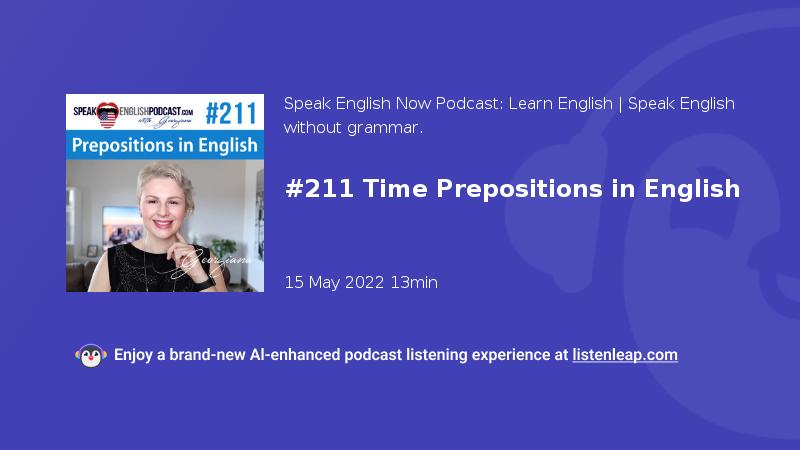
In this episode, Georgiana, the founder of SpeakEnglishPodcast.com, provides a comprehensive guide to understanding English time prepositions. Moving away from traditional, ineffective memorization techniques, she emphasizes the importance of learning grammar in context through repeated listening.
The Function of Prepositions
Prepositions are defined as "short words" such as "on," "in," "to," or "of" that typically precede nouns or pronouns. Their primary role is to establish relationships—whether in "space or time" or to denote a "logical relationship between two or more people, places or things."
Breakdown of Essential Time Prepositions
Georgiana categorizes time prepositions based on their specific usage:
- On: Used specifically before "days of the week." Examples include "on Monday" or "on Sundays."
- In: Applied to broader timeframes, including "months, seasons, time of the day, year" or "a certain time period." Examples include "in September," "in winter," "in 2010," or "in an hour."
- At: Reserved for specific points in time, such as "night," "the weekend," or a precise clock time, like "at 9 p.m." or "at Christmas."
- Since vs. For: These are distinguished by their reference to the start of an event versus the duration. "Since" is used with "days or dates" (e.g., "since yesterday"), while "for" indicates the "length of time" (e.g., "for two years").
- Ago: Used to pinpoint "a specific time in the past," such as "two months ago."
- Before and After: Used to situate events relative to a "specific time, days, years or months," such as "before 5 p.m." or "after the summer arrives."
Learning Through Context: The Point-of-View Story
To reinforce these grammatical concepts without tedious drills, Georgiana employs a "point-of-view story." She shares the tale of Nick, an expert in "business value propositions"—a "simple statement that summarizes why a customer would choose a product or service."
In the story, a humorous "mix-up" occurs due to a "typo" in a newspaper ad. Students expecting a course on "prepositions" mistakenly sign up for a course on "value propositions." By retelling this story in different tenses, Georgiana demonstrates how grammar changes subtly. She notes that "changes between grammar points are subtle, but important," and encourages listeners to observe these shifts naturally rather than trying to "memorize grammar rules."
Final Recommendations
Georgiana concludes by reiterating her core teaching philosophy: grammar is best absorbed through immersion. By listening to the podcast "several times," learners can internalize these prepositions effectively. She invites listeners to visit her website for transcripts and further resources, including a video course designed to help students "learn English three times faster."
Deep Learning with ListenLeap


