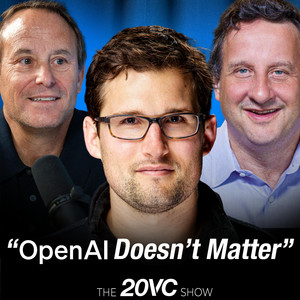
Will we look back in 20 years and say OpenAI was a fundamentally important company?
Maybe.
Every company's market share is up for grabs when there's a platform shift.
The hyperscalers have taken very good cash, efficient businesses, and they would break Mr Buffett's heart because they've turned them into CapEx hogs.
Public company investors are just mean VCs on steroids.
This is 20 VC with me, Harry Stebbings.
Now it is my favorite show of the week Jason Lampkin, Rory O'Driscoll and we have a guest joining us for the first half of this show Sam Lesson.
The discussion, I mean, oh my gosh, it got a little bit spicy on what companies actually matter.
Does open AI even matter is one of the questions we discussed today.
And then we break down IPOs, we break down Chime, we break down Circle, we break down Mary Meeker's AI report.
It is a fantastic discussion.
I so enjoyed doing this.
I would love to hear your thoughts on what you think of this style of show.
Let me know by emailing me harry at 20vc.com.
But before we dive in today, here are two fun facts about our newest brand sponsor, Kajabi.
First, their customers just crossed a collective $8 billion in total revenue.
Wow.
Second, Kajabi's users keep 100 of their earnings, with the average Kajabi creator bringing in over 30000 per year.
In case you didn't know, Kajabi is the leading creator commerce platform, with an all-in-one suite of tools, including websites, email marketing, digital products, payment processing and analytics, for as low as 69 per month.
Whether you are looking to build a private community, write a paid newsletter or launch a course, Kajabi is the only platform that will enable you to build and grow your online business without taking a cut of your revenue.
20 VC listeners can try Kajabi for free for 30 days by going to Kajabi.com forward slash 20VC.
That's Kajabi.com K-A-J-A-B-I.com forward slash 20VC.
And once you've found the next great startup, you're going to need the tools to help them scale.
That's why AWS is the perfect partner for startups and why they're proud to sponsor this week's episode of 20VC.
The AWS Startups team comprises former founders and CTOs, venture capitalists, angel investors and mentors ready to help you prove what's possible.
Since 2013, AWS has supported over 280000 startups across the globe and provided 7 billion in credits through the AWS Activate program.
Big ideas feel at home on AWS and, with access to cutting edge technologies like generative AI, you can quickly turn those ideas into marketable products.
Want your own AI powered assistant?
Try Amazon Q. Want to build your own AI products?
Privately customize leading foundation models on Amazon Bedrock.
Want to reduce the cost of AI workloads?
AWS Tranium is the silicon you're looking for.
Whatever your ambitions, you've already had the idea.
Now prove it's possible on AWS.
Visit aws.amazon.com forward slash startups to get started.
Now let's switch gears from cloud innovation to the future of mobile and how one company is turning your screen into real returns.
We spend nearly half our waking hours glued to our phones, upwards of 50 hours every week.
Recently, one company transforming this reality stood out so much I personally became a shareholder Mode Mobile.
Mode Mobile created the Earn Phone, the smartphone that pays you for daily activities.
Instead of big tech profiting billions from our attention Mode returns over 325 million directly to users through earnings and savings.
Mode's revenues surged an incredible 32481 in three years, recognized by Deloitte as 2023's fastest growing software company in North America.
And here's why I'm excited.
Mode's equity offerings have raised over 30 million from 20000 plus retail investors one of 2025's standout public raises.
And you can now join me as a shareholder with as little as 1000 at investmodemobilecom.
Forward slash 20 VC.
For a limited time, unlock up to 100% bonus shares and a free earned phone.
Email us for the investor brief at 20 VC at modemobilecom or check out investmodemobilecom forward slash 20 VC.
You have now arrived at your destination.
Guys, I am so excited for this.
We had so many interesting things that we want to dive into this week.
I just want to start with diving in actually on the deep end on a series of Chamath tweets.
And Chamath basically said, hey, TVPI is bullshit vanity metric.
You can't eat IRR.
You can only eat net DPI.
When you read this and when you read his quite opinionated stance, how did we feel?
I mean, I hate agreeing with Chamath on principle, but I agree with him.
Well, you know what's interesting?
If you read the Wall Street Journal article on Tom O'Bravo, they just raised a 34 billion fund, right.
Harry, your buddy.
What the Wall Street Journal said, that's a record fund for PE, $34 billion.
It's a record.
But Q1 was a low point.
No one raised a $5 billion PE fund because of lack of liquidity.
So it's kind of ties to Chamath's point, which is, if you have the liquidity in today's world, you're going to get the capital right.
Tom O'Bravo had $30 billion in distributions last year, $30 billion.
I think that exceeds most guests, right?
$30 billion in distributions, not paper markups, but distributions.
Look, from my perspective, this is simple, right?
Which is there's two very different games that are called venture capital or even private capital in general.
One game is actually making people money finding companies early, making the right bets, paying the right prices and selling.
And that is a DPI game.
And all that matters is DPI.
And that's the game I like to play.
That's the game I think I value and I respect.
There's also an asset gathering game.
And the asset gathering game does exist.
And here's the thing.
I say this as a seed investor with full transparency.
As a business, the asset gathering game is actually a better business.
If you're just in it to make money, you're an asset gatherer.
That's what the market wants.
And we can talk about why in the whole nine yards.
The public market wants that.
They care about fees, etc.
The problem is I just am an intellectual snob and I have no respect for asset gatherers.
I think it's a stupid game.
I think they're just two very different things that are called the same thing.
And you just should be really sober about what game you're in and what you're trying to do.
I think it's really fun that we had this conversation and we ended up thinking that Chamath's on the side of good.
Nice job, Sam.
I'm the first to say I think that's wild that I agree with Chamath.
My default instinct is to completely disagree with him on whatever he says.
But in this case, I happen to agree with him.
I'm comfortable disagreeing with him.
I honestly thought it was kind of a trite comment.
It's a very typical traumatic comment.
On first glance, it sounds smart, but on deeper analysis, it's vaguely right, but not useful.
He cited his 2013 and 2015 vintage funds.
Obviously, at that point, DPI is the only thing that counts.
If you're 10 years in and you're still selling promises, then you're in trouble.
That's a trivially obvious comment.
But to say TVPI doesn't count.
The truth is, venture is investing in illiquid assets for five to seven years, with the expectation of remaining a greater return.
That means that for five to seven years, you don't have DPI.
You've consciously undepied yourself.
You've taken money and you've given it to the tide on the ground.
In that period of time, you have two choices.
As an investor gauging these guys, you can say TVPI means nothing.
I'll stick my head up my ass and I'll look in seven years.
I'll see how they're doing.
Or you can use TVPI for what it is, a proxy, a loose proxy for performance.
I'll be more direct.
We don't know each other.
Here's the upshot.
You have to understand that LPs are just incentive driven.
And from an LP, what you should do as a rational human being.
If it was me investing in a fund, You say yeah, the money's in the ground for five years.
And after that, we'll see where we're at.
And that's all that matters, what you deliver.
I know full well I know this as an investor that the marks that you made up or the marks of SoftBank listed something somewhere completely irrelevant.
In fact, the negative signal in a lot of cases.
The marks are irrelevant and stupid.
Now, here's the reality.
Institutional LPs are people too.
There's some junior guy who wrote the check and he wants to get promoted.
And he exists in an organization that's trying to deliver something.
He doesn't want to wait seven years to get promoted, right, for making a good call or a bad call.
And so it really is just a marketing thing, where you're saying hey, I'm going to give the person who wrote me the check some marketing thing they can then use for their own internal purposes.
Because everything in life is about get laid or get paid.
If you had two funds three years in and one of them had no markups and one of them was a 2x TVPI, would you regard those two funds as exactly identical?
No, what I would regard them as though and this is how I actually do regard them when I look at my own portfolio or things like that is very simple, which is how many credible things do you have that are going to be fund returners?
Just give me the list of four things.
I don't care where they're marked.
Like you, either have a set of true, legitimate shots on goal for important companies and important outcomes, or you don't.
If a company is marked at 2x where it went in, SoftBank, some crazy person marked it up.
Same with Sequoia.
But my point about the Chamath comment is to say it means nothing.
To say it means nothing is a gross exaggeration.
There almost certainly is some signal in that data.
Let's kind of take it.
Let's go right down into it.
TVPI means nothing.
I am willing to bet if you got some kind of machine learning algorithm and looked at all the funds three or four years in had a TVPI of 2x and all the funds that four years in had a TVPI of 08x, and then correlated that to the ultimate outcomes, I bet you there would be data in that signal that says it has some value.
It's not the only source of data.
You're right.
There are better source of data if you're in a position to evaluate better data.
But, as an LP, in the absence of anything better, there is signal in the data, which means the comment is wrong.
It would be fun to look at.
I actually bet that firms that hold positions at zero or cost, or even are willing to mark down positions that are more honest about it, in reality might actually I don't know.
We can look at it.
But the reality is, I think there's... I mean, as an LP in many funds, You have funds, you get their statements and you laugh because they hold everything at ridiculous value.
The high watermark they can possibly come up with are these numbers that make no sense.
And you look at it, you're like this is like kind of funny, but you're like this is not real right.
And I just think that like, it's because everyone has methodologies all over the board.
It's all marketing.
I kind of, unfortunately, I hate being with Chamath.
I hate it.
Like I've known Chamath a long time, not well, but casually.
And I got to say, it drives me nuts that I have to be, but with him-
All I care about early is give me five names that matter.
And all I care about after you've had enough time is did you make me money or not?
Okay.
But I get your point.
Zero is an extreme statement, but we live in an age of memes.
We said we're living in this kind of two dichotomy world or this kind of binary world of venture.
In the middle.
SVB did this great analysis and they were saying that middle of VC funds is getting really hollowed out.
In other words, your kind of mid-tier firms in terms of size are really falling apart.
What happens to them?
Is it a game of the very small and the very large, do we think, when we look at this report?
Yes.
There's no middle.
You can't be a billion-dollar venture fund.
It's a billion middle.
Well, we target, call it, $200 million early-stage funds.
That's what we do every few years.
I'm very confident we know how to deploy that.
I believe there's a market where you can, from a DPI perspective, make money on that.
It's not a great fee business, but it's a great DPI business.
I don't know how you make multiples on a billion dollars consistently in VC.
I think once you're doing 10, you're playing a completely different game of asset gathering and asset deployment, where you no longer have the same goals.
So I personally think that the billion dollar zone is like the death zone.
Gotcha.
Good to know as a $900 million fund.
Yeah.
That's a tough one.
I did actually look at the SVB data.
First of all, I was thinking, are they throwing me under the bus too?
I checked the data and they were actually saying the two to 500 was the middle zone.
So then I felt even more depressed.
Now I'm a small behemoth, which is even more degrading.
I'm kind of a low rent conglomerate.
I think in the end you have to be sized for the stage you're playing at to achieve the portfolio construction you want to achieve.
And I'm pretty confident that our typical check size is 20 to 30 million and you have 30 to 40 million rounds.
We want to get 30 checks.
The math works.
30 kind of deals total.
So I think you have to be sized for the game you're at.
It still doesn't mean you can't get it wrong.
And I do think to your point.
One of the things I've, Jason and I have been batting this around over the last eight weeks is, I do believe the impact of the conglomerates has made everything harder, including it's harder for us to make money.
I totally buy that.
The existence of people with 10 billion to spend makes it very hard for people with 900 or 500 or 600 million to spend to do that rationally, in a way that probably and I'd love to hear from Jason on this in a way that if you're putting out 100 or 200 million, you're probably a little more inured to it.
Maybe the more interesting question is for founders.
I think the SUV report which I wrote up I don't think it was really saying 800 to a billion was the hollowed out middle, but I guess it is part of the analysis, right.
That they're not raising funds.
If that is true, then every founder wants to raise 20 or 30 million in their A now.
No one wants to raise an eight, the $8 million series A is now three safe notes.
So does that mean in a couple of years your candidates outside of some scales are going to be limited to mega funds?
Like are they the only people that can't be able to write series HX?
And because 20 or 30 million isn't even a large series A today.
It's a normal one.
So if there is no one in the middle, then we're all stuck with mega funds to fund the seed companies, right?
I mean, I guess it's an obvious point, but founders, just they better get to know folks with five or 10 billion funds before demo day.
Or they're all going bankrupt and these are all bad companies.
Like I think that's the other way to look at this is, like you know, I know a lot of people are pulling out of series A's entirely because these are completely mispriced and, like these, make no sense.
I think that the other possibility right is that we're in an era where there are good companies to be built and there are places to make money.
And if you are going into corners of the economy or funding things that other people won't, and so you're an N of one or an N of a few.
Looking at spaces that are kind of really novel, there are places to make lots of money.
But I think we also have to look at the other way, which is like there's just a massive amount of capital being massively misallocated right now.
It's always funny when people simultaneously have the worldview that you know the big funds are going to win everything, but all the money is being wasted.
I mean, at some point.
Well, I think the thing that with human mind is, I don't even know the big funds need to make that much money because they're asset gatherers.
They need to make enough money to generate gathering more assets, and they need to justify their own existence.
And it's a good business.
That's different than saying you're trying to make a lot of money in venture capital.
Broadly agreed.
But I actually think, Jason, I want to go back to what you said, because I thought it was spot on.
It's like, if there's only $200 million funds and billion dollar funds, then you're exactly right.
Logically, those 20 30 40, 50 million checks are going to come from only 10 names who are writing 40 of them a year, not eight like us.
That's possible, but it's just a weird fund construction, because those people are then going to be writing 40 50, 60 checks of this size.
You're going to have a very spread out partner base.
I don't know if they'll be able to meet the founder needs where it is.
Is that not what your insights have today though?
I mean we've mentioned before kind of the outcomes that they have with your Hinge Health is returning 400 million on a 6 billion fund and them having like hundreds of positions and actually that being the construction they have.
Yes, it is the construction they have.
But at some point it gets easier, when you're running big sums, to put big money in a smaller number of companies than try and diversify away.
If we're trying, with 900 million, to have 30 A's or B's, someone who's running 9 billion, if they were trying to do the same thing, would have 300 A's and B's in three years.
It would be silly.
So at some point, it becomes a part of their business, but not all their business.
And then I think Jason's right.
I mean, it's so funny.
We're going to talk in a few minutes about, and Sam mentioned earlier this idea of a lot of A's are struggling to be raised.
The only way that worldview makes sense is actually what Sam said is that if you have a world where people can I call them midsize funds quote unquote, can't survive because of the big guys, and the big guys are quote stealing all the good deals.
And at the same time we're also saying many companies are struggling to make a series A, get a series A raised.
Those things are common, almost opposite. to each other.
One says capital is scarce and one says capital is plenty.
And the big guys- I would say actually, the way you resolve that illogical seeming statement is quite simple, which is every generation.
There's only a few companies that matter.
Yes.
Most of the money at Series A is completely wasted and they might want it in larger quantums.
That just is like kind of, it's kind of a war of attrition, right?
It's just more money being lit on fire.
Now the mega funds can win because they can say okay look, I'm going to plow a gajillion dollars at almost any price in.
And because of AI or whatever argument they want to make, there's no upper bound, right?
And so they say, we make lots of money just on lots of money being deployed.
And that can logically make sense.
Seed funds are fine because you still have to be in winners, but it's just a multiple scheme, right?
Which is if you're in it at zero, right?
Then you can make a hundred checks and make the math work from a DPI perspective.
You also have a nice benefit which I very much appreciate, which is, I really strongly believe private to private is an important future.
And I love being early and small.
And first because I actually can sell into the private markets in a way that you can't if you've written a 30, 40 million check into the series that you're too big.
Right?
So I think those two things survive.
What do you think about, so for selling, if selling early, right?
Selling in secondaries, unicorn secondaries.
How do you think about the goals?
Is it one extra fund, two extra fund half is, is it just risk allocation?
I think if you have a smaller fund, it's really, it's interesting.
It is interesting.
Because you get, like, just the other day, I had a 1X exit opportunity to return the fund once.
And one of my anchors was.
I also brought them in as part of the deal and we talked about it right.
They followed me, so it was less for them.
But for them, it would have been very high IRR and me a 1X, right?
That sounds good on the internet.
But then it's gone.
Yeah.
It's all gone.
There's no more returns.
In the end of the day, there's a few things that matter.
The number one rule as a fund and allocator, you cannot sell the things that matter.
Rule two is because we were one of the first investors in Allbirds or Astro Rockets or plenty of things that got out and people were excited about, but thesis broke.
And so I think you have to be really honest with yourself and honest and you're going to make mistakes.
I think one of the things I always say is, as an early stage investor, you get hundreds of shots to buy.
You get really good at buying.
You have so fewer shots at learning to sell that it actually takes much longer to learn to sell well.
But it's still as important as learning to buy well.
And I think you just have to be really honest with yourself.
Which is like is this an infinity shot, or is it not?
And the second.
The thesis is broken and it's not if there's a buyer at a price that makes sense, because someone else has different fund dynamics.
Maybe they already own a lot.
And for them, it's like about rounding down their average in cost.
Maybe it's their net capital allocator, and they don't care as much about the negative return.
They have different goals.
There are opportunities that work for everyone.
Roy, can I ask you, if it's not one of the companies that matter, is it lighting money on fire in the kind of binary way that No?
I'm glad you came back to that because I would say again respectfully, I disagree.
And it's a matter of degree.
But no, I don't think that's a correct statement.
It is true.
In every decade.
You look back and you go.
The vast bulk of the value is driven by one or two companies.
It's a power law.
We all understand the math.
To a rounding error, there was a decade where it was Google and then everything else, right?
And that's true.
And it's intellectually absolutely true.
So you could say to yourself, if I didn't do Google, I must have lit the money on fire.
But then when you make that sentence a few times, then you go and you look at your Schwab account and go oh, I have money in there.
So I mustn't have lit it on fire.
There are more wins than the biggest win.
It is a power law.
I would prefer to have done it on Google than any whatever I made money on in 2000 to 2010.
But I'm damn glad I did that one too.
And the over-extrapolation of the only three deals make money.
So therefore, everything else at Series A is burning money.
It's true in that you prefer to be in Google, but it's not the only way to make money.
I mean, just in the last couple of weeks, we've had, as you mentioned, a couple of decent IPOs, Hinge Health.
We're going to have Chime, Mountain last week.
We have another one this week.
Take Hinge Health.
Someone made $400 million for their investors.
20% of $400 million is $80 million.
I say this every time when someone at the office says, oh, it's just a 3X.
Every single one of you will cash the fucking check.
Every single one of you.
If I left them on the counter there, you'd all take them home with you.
$80 million is still real money in America.
And Roy, that's almost my point.
But just to put you on Chime, like Chime's a great example of this, right?
Like if you're an early stage investor, you're very sad you didn't sell last round in Chime, right?
And I would argue at 25 billion or whatever the last round was done.
When you look at that rationally you'd say look, it's a gold company.
Is it an infinity company?
Or is this a really great place where I did my job, which was to fund it early, to find it early, to fund it when money was scarce?
And now we have capital allocators who are making a different assessment.
I think the answer is you clearly would have wanted to sell last round.
And I think it's incumbent on investors.
I only know it's in the S1, but I didn't see any of the early shareholders make the cut on the principal stockholders.
When I look at principal stockholders, there's dilution, but I don't see any of the seed guys on the table.
So that says to me they probably sold the 20, some amount of 25 billion, when I literally only see DST, Crosslink and Menlo.
They did their job.
That did their job.
Well, not if it's a $250 billion company.
There's two separate things floating around, and I wanted to disaggregate them.
First is I'm going to fight in defense of mid-tier.
Did the mid-tier investors who didn't do the seed but didn't do the 25 billion round.
Are they happy they did that round?
The round that Menlo did, I think, was out of the BRC.
It was a couple hundred million.
Can't remember what the pre was.
They're damn happy they did that round.
And that's a classic example of a mid-sized venture firm making a savvy bet, doing good stock picking long after the seed, but still making good coin.
To me that's the first point, which is the validation that you can, at that fund size probably it was a four or 500 million fund then make really good coin and move the needle at the fund level.
Second comment to your point, Sam and Jason, you're right.
You look back and go hmm, I might have been marginally smarter if I had bought at 200, 300 and then sold at 25 billion, rather than holding and selling at 12.
But the big advantage they have is they'll still book probably 10 or 20x.
Now, 40x is better than 20x, right?
So they've made good coin in a situation where, as we discussed before, the kind of 25 billion dollar bond is going to lose money.
So that's proof that you can make perfectly shrewd A to C bets sub a billion pre and make very good money in a non quote unquote generational company.
Chime is an extremely good company.
I agree with all that, Roy.
And again, I'm obviously trying to be provocative on purpose, but I think we directly.
Here's my point.
To bring it full circle to DPI though, which is when you think about how I relatively value DPI versus TVPI or any other metric, if I'm an early stage funder really anyone and you said hey, I sold my time stock at 25 billion for American dollars, like for cash, and I gave it to you years ago, right?
Like from an IRR perspective and a cash perspective, that is a great move.
And so that's.
I think the thing to keep in mind when we go back to all of this is like we're talking pretty deep cuts on the game of VC right now, right.
As opposed to the game of company building.
But like, I do think, like when you come back to this, like this is why I believe the Chamath line unfortunately, and it's going to get clipped and I'll be upset about it, but like, whatever is like right.
It's like.
It's like, in the end of the day, like good investors, good capitalists, make people money, if that's the game they're playing and they're not asset gatherers.
In the end, it's true.
In the end, checking the bank counts.
Sometimes even, as you correctly say, it's often even true.
I like what you said about Facebook.
Sometimes it's even true that a smaller check earlier has more value than a bigger check later, just for a whole bunch of life reasons.
I mean, that's why we have interest rates.
There's the time value of money.
A friend of mine, we sold this company.
I was giving him grief.
And then, five or six years later, another company in the same space went public at two or three times the market cap.
And I foolishly gave him shit about it.
And he called bullshit on me.
He said, look, I'd been at the thing 10 years.
I made a lot of money.
I got married.
I have a life.
I have a lovely house in Spain.
And I started another company.
Yeah, I'd have more money if I'd held.
But that was my life choice.
And he was exactly right.
Just on Menlo Ventures.
So obviously, I don't know what their basis is, Rory.
Obviously, they'll make a ton of money on Chime, right?
A classic great bet.
They said they did the Series B, right?
They win.
So they did the Series B at 200, 300.
Maybe we can figure it out on the fly.
This will be a nine.
There'll be some dilution.
They'll 10 or 15x their money, right?
That'll be a fun returner or more than a fun returner probably.
Plus or minus, maybe a little under, but yeah.
And I do like that team.
And back in 2021 they wanted to invest, like in all of my companies, are very high, very high alignment.
Right.
For better or worse.
Right.
What's interesting to me today, from the start of the conversation, is all they talk about is anthropic.
And this is a smart team.
It's every, they have an anthropic fund.
Cause I follow all the guys and on LinkedIn, nothing, but they're serious.
They didn't do the seed and they're going to make a lot of money off this, right?
Because anthropic is one to 3 billion in revenue in five months.
Right.
But it's a sign of the times, isn't it?
Probably.
I don't see them trumpeting their coming DPI from Chime, which is epic but Anthropic is, on their social media 11 times a day, as perhaps it should be.
But I don't think they're taking any DPI on that one.
They're marketing to entrepreneurs.
They're not marketing to LPs.
Here's the way I look at it, honestly.
I think in venture capital, it is unbelievably difficult to know what anything is worth.
And if you're Menlo or you're anyone in the middle, my God, you have to price things properly.
If you're plowing enormous amounts of money and staying late on the infinity dream, prices really matter, which is how you get these ridiculous prices.
And like, the reason is it's very simple.
It's like, what is open AI worth?
Who the hell knows?
It's like one of those things where people can dream, right?
You can have a trillion dollar dream.
And that means that like, there's very little pricing discipline.
It's basically a game of pissing of who can pay more or who's willing to go further.
And at seed, nothing's worth anything, right?
And so you just have to have pricing discipline and remember that.
The problem with Menlo is I don't know how you know.
I said this as someone who started my career at Bain & Company.
I think, with these private companies, catching the right price and the right dynamic and being right at Series A B is like the hardest game.
I think some parts of that are true.
I think you are right that the seed investor, I mean, I always say, we can do A's and B's.
And I always say we're at the first point where you can start to do some analysis versus just people and market, which is why you have to live on a broad directionality right.
You've got at least some pitiful facts to look at and try.
I have no facts.
I exist in a fact-free zone.
Yes, absolutely.
And we live in a fact thin zone.
So I do agree.
I don't agree that pricing for us is, quote, harder than pricing for the late stage.
I think late stage on average.
I think it's much harder to price at that late stage because on average you'll be wrong.
And we're seeing a whole bunch of down rounds where the last round loses money and every other round prior to that makes money.
So I actually think price discipline is even more important the closer you get to an exit.
They don't lose money.
They just get their Well, we've trashed that one to that.
In China's case, they're going to lose money because they don't have .
That's a fair eye roll, Jason.
But I think the more important thing is.
So come to that in a second.
I think it's a genius move too.
Totally.
I think, look, there's always some deals.
And it's very surprising that even at that 2 3, 5 billion valuation level, there's still another 10x from there.
Now, there's not many of them.
There's literally one maybe every second year.
But if you do that one, you can price like it's an A or a B, but deploy money like it's an F and make a return 10x plus return as if it's an A or B.
It's an awesome deal.
As I say one of them every couple of years Entropic was one, OpenAI was one.
Probably Android was one.
But the average late stage deal isn't that.
And there's just less degrees of freedom on the average late stage deal to compound.
So I think you have to be a little.
When I look at the people who do it well, like the Meritex, like the IVPs, there's a fair amount of shrewd price discipline in what they bring to the table.
Or what the product they're selling is, you know, just a different product.
The product they're selling is access to this pool of companies that are late for people with too much money or that need private access with a cherry on top of infinity.
And they're actually not in the business.
I think that's probably not as true for the names I cited, but I think you're right.
There are people who are, there are funds, who are playing that game where it gets back to the whole, when all the cute sexy stuff is private, there are eventually going to be entities whose sole goal in life is to put public investors in contact with those sexy private companies.
The one thing I will say on Chime and the 25 billion is every single round in the billions for Revolut, everyone was saying well, how much more can it be?
How much more can it be?
I think everyone is realizing now that Revolut will quite likely be at least 100 billion company and likely 150 billion.
If you sold at 25 billion, you would be grossly underestimated, missing 125 billion of gains in a European neobank.
But it also just depends what business you think you're in.
Aren't you in the business of making as much money for your investors as possible?
No.
There's another real debate, I think, which is a tough one, which is, I would argue, that there's a strong case to be made that, as a venture capitalist, you should not have an opinion about the public markets, that you're not paid to have an opinion about public markets.
People don't have their own opinions about public markets.
And you're paid, your job is to manage the private markets or private pricing.
And once things public, it's like, look, the game should be over.
Now there's all sorts of people that juice that or decide they do have opinions about the public markets.
But I don't know.
It's something I've gone back and forth on, to be totally honest with you about whether VCs just thematically should be doing that, or whether you say look, we can turn over shares.
You guys figure out what to do.
But I would probably sell Revolut and Chime right now.
Right now.
Both of them have about 15% market share.
TrueTAM.
If you're trying to decide when to sell, right?
Or whether they have infinity runway, market share is a limiter, right?
There are folks that can get to 100 market share, but for a lot of apps 15 I find is a little bit of headwind.
Like you start to see, and a lot of times in B2B, when the market's smaller, it's even before 100 million in revenue.
You start to get to double digit market share.
And just when it gets good because everyone's heard about you and all the leads come in, it's like ah.
All the easy, 15% market share is a lot.
It's a lot if it's not a monopoly.
That is the classic thing.
Everyone comes as an early stage investor.
People come to me like well, the CAC is blank, but it's going to go down.
I'm like, nope, CAC only goes up.
People just consistently get this wrong.
Almost always up at scale, right?
It's like, this is how the world works.
I'm like you know.
The kind of argument that you're going to get good at something and all of a sudden it's going to get cheaper is just wrong.
So is Chime an important company?
I just don't see it.
You know, it's a good company.
Like they provided some banking products to unbanked people or underbanked people.
I get it.
It's not bad.
They did a good job.
They built a good app.
But like, is it important?
If the 14 billion market cap was in my bank account, I would think it was a very important company indeed.
It's like, fine.
It's fine.
It's not a bad thing, right?
It's just If that is the case.
If Chime is not an important company at all, then I've never done anything important in my life.
I've been a decent founder.
I've seeded multiple.
My team has gone on to help run multiple DecaCorns.
I've had $5 billion cash exits, but I really don't matter.
I think I've helped thousands of founders build companies from scratch, but I probably don't matter if Chime doesn't matter.
I think the default is that most of us don't matter and most of the companies in the world don't matter.
But the things that matter really matter, right?
And I think the job is to find the things that really matter.
Do you think Salesforce or Oracle matter?
Arthur Balfour, Prime Minister of England in the 1900s, a very languid, relaxed man, used to say nothing matters a lot and very little matters at all.
And that's really what you're saying, Sam.
And it's true, but the correct response is, what am I meant to do with that?
I think an angel can matter.
I think you can tell a story about it.
It can.
I'm not saying it will.
I do think killing people matters.
It's very impactful.
I think that...
I think that OpenAI could matter.
Microsoft, Facebook, Google, these are companies that matter.
I think Bitcoin matters.
I personally think Solana matters.
I think Venmo might matter.
We can go down the line of things that are actually paradigm shifting and have an impact.
And then everything else is not that you can't build good businesses.
You can.
So you're not sure OpenAI will matter?
You just think it's possible it could matter?
I'm not sure it will matter.
I think it might matter.
I mean, that's a pretty arrogant thing to say, isn't it?
Why?
The game is young.
They clearly push the ball forward.
But will we look back in 20 years and say OpenAI was a fundamentally important company?
Maybe.
I think the truth is most companies fail.
Some companies compound to a billion in value.
A few each year compound to $5 billion.
One every year to $10 billion.
And one or two every decade to $100 billion.
So taking away that, quote, matter, and I think market cap is a rough proxy for mattering.
I say that pretty confidently because I believe the capitalist system works.
And the things that matter the most are valued the most.
What I'm disconnecting with a little bit is, and I love what Jason said.
I just want to come back.
I love what he said.
I'm at peace with the fact that if the definition of mattering is 100 billion, I may well complete another 10 years in venture, do it for 40 years and quote never matter.
I'm actually okay with that.
I'll take it up with my therapist.
I'll be fine, but I know I'll have invested in perfectly good companies that have built real value, that create perfectly good businesses that in some cases are worth 5 10 billion, and that's okay.
The problem with the only do the things that matter is, in the end it tends to some nihilism, which is that nothing else does matter.
I do think that people should wake up every day and have the opinion that they want to do things that are going to matter in the world.
I'd say the most insulting thing you could ever call me is a market participant.
I find that an incredibly insulting kind of like, yeah, yeah.
It's pretty efficient market.
Capitalism pretty efficient.
You pay 150 billion, 120 million.
Who cares?
Like it's fine.
You have a company that's like a billion dollar company that does some stuff.
Fine, I'm glad that happened.
That's capitalism working.
But then you're really just a cog in the system, right?
And I think that's not a recipe for outsized returns, but it is a recipe for doing fine.
It's just not my goal.
I am a cog in the system.
I might want to be more than that, but I think- No, but you're a hollowed out fund.
That doesn't matter.
Harry, you should have asked Aaron Levy when you interviewed him yesterday if he mattered.
I don't think he matters.
I don't think Box, I don't think he matters.
Aaron Levy?
Oh, Box, I love Aaron.
It's nowhere near.
I don't think Aaron Levy would say Box is more important than OpenAI.
I'm confident he would.
For what it's worth, I love Aaron.
He's like a good buddy.
But his company doesn't matter.
It's only 4, 5, 6 billion.
It's irrelevant, right?
I completely agree.
This company doesn't matter.
And in fact, one of the things I told him when it went public is- Should he just shut it down tomorrow, his 55 billion company?
Absolutely not, but it does actually-.
Should he leave the keys for some random person to come run it from some hedge fund?
Aaron is very excited about AI, if you didn't know, right?
And I think part of that is there's an opportunity for him and for Box to matter.
Right.
Because Box, again, he's done an incredible job.
I'm like very pro Aaron Levy.
And what I said to him when the company went public.
I said I'm like look, one of the things I most respect about you is you just worked this to make it happen.
Right.
Like this was not from a first principles, like an important company.
Right.
This is not like a sexy company, but you just ground it out.
And like, I really respect that.
I'm like, I think that's like an incredible thing to have done.
But I think part of the excitement about a lot of founders.
But he's wasted his life.
I mean, Aaron and I started together.
So he was 20.
If his company doesn't matter.
When he started, he was a wonder kid.
Now he's the grayest CEO I know.
He's wasted his whole fucking life is basically what you're saying because it doesn't matter.
He's not wasted his life.
Rory was there.
He could have sold his company to Citrix and made $100 million with retention payments in 2008.
According to you, he wasted the last 16 years of his life.
Fucking flushed it down the toilet by doing a B2B company.
He made less money at the IPO than he would have.
Flushed it down the toilet.
But look, I do think there's this thing going on right now.
Wasted his life.
Wasted his life in Citrix.
Wasted his fucking life, the poor guy.
For what it's worth, I think A, I don't know.
I think you probably know the math, but my sense is that he actually probably would have made more in that deal than ultimately going public.
I don't know where he is now, but from that perspective.
Cash in 2008, plus his shares in Stripe and Gusto and others.
Yeah, he should have just found it in Allbirds instead of doing Box.
If he were a fund manager, he definitely should have sold that.
He's not.
He's a person and he wants to run it.
That's fine.
The second thing I say is I do think there's a lot of exuberance about AI right now from a lot of people who are kind of in these positions.
Like this is a company that's kind of been meh, but maybe there's an angle to not be meh, right?
And that's exciting to people.
Like I think that's awesome for orgs to try that, but I think it is the race to matter that becomes interesting.
And that's what I think the AI stuff is so interesting in so many cases is some of it's real, some of it's not?
But like there is this new opening where people are like, oh my God, does this now matter?
That's kind of the big game to play.
Anyway, guys, with that, I'm actually holding my partner meeting.
So I'm going to drop.
But that was fun.
I hope I have my therapy session set up for tomorrow.
I don't matter.
I'm hollowed out.
But I'll get through it somehow.
I'm sure you will.
As my wife says sometimes, go get some Allbirds, Rory.
You'll feel better.
Go to the mall at Stanford and get a few pair of Allbirds and you'll feel like a winner.
Crying to your bucket of money.
Okay.
The thing that I do want to go to though now, is actually, I thought, a phenomenal report which Jason, you did brilliant work on, which was Mary Mika's AI report.
So I want to go to it though.
You posted an incredible thread with 10 fantastic takeaways.
I want to hand over to you on which takeaways you found most striking and why, and just start there.
Some of it was obvious.
The one I first started off which is obvious, but I'll tell you why I put it in there anyway was that chat GPT is the fastest, even though it was Sam lesson said he's not sure it's important.
It's the fastest gain of users in the history of the world.
Zero to 800 million in 17 months.
Okay.
It took Netflix 15 times longer.
It took TikTok five times longer.
The rate of adoption.
I talked to so many folks, especially in B2B here.
They're like, you know, I don't know.
I don't know that AI can really replace a good hardworking marketing manager or a good PR person.
Or they say there's too many.
You know what they say, Rory?
There's too many hallucinations.
To me, it was a reminder of the rate of change.
I don't think as humans we can process the rate of change of AI.
It's so fast that we don't understand almost how quickly it's changing.
Whatever you think AI could do three months ago, it's like super dated.
The second, Mary Meeker one, was showing that the infrastructure spend is unprecedented in the history of internet.
Right that the big six spent 212 billion on CapEx.
And yeah, the top line's great, but the spend here is insane.
I'm just still a little confused where it's going because it's early at the application level.
At the application level, is this all going to coding and support?
Is it all going to custom data analysis?
Is it all going to subsidizing our chat GPT 20 bucks a month?
I just don't know where all this infrastructure.
I think it's laying a foundation that is transformational, but I just it feels so far ahead of the application level.
I think you're right.
And my takeaway from her thing was the hyperscalers have taken very good cash, efficient businesses, and they would break Mr Buffett's heart because they've turned them into CapEx hogs.
Microsoft Amazon Google, Facebook all have had capex as a percentage of free cash flow go up significantly.
Now, as she pointed out, the good news is, in the last four or five years, free cash flow themselves have grown.
So your cash flow hit hasn't been enormous.
It's only been about a 10% decline in free cash flow.
It hasn't been horrific.
In a less generous economic environment.
The shareholders of Microsoft might well be screaming and saying wow, 60 billion, or nothing to show for it, guys.
Come on here.
It's been perfect timing.
It's a little, actually, in that respect, like 98, 99.
The overall economy has been favorable.
The performance of the hyperscalers' existing businesses, not their AI businesses have been pretty damn amazing.
And, as a result of that, the market's been able to say guys, knock yourself out, spend 260 billion.
I'm sure something will come of it soon.
The $600 billion question is, where are the apps?
And obviously, since then, there hasn't been.
Everyone is just plowing on.
They're investing the capital, and the revenue is coming.
But relative to the spend.
If someone said to you you can finance a 600 billion CapEx business four or five years in you'd have 10 billion, 15 billion in revenue and 400 billion And 585 billion in losses.
You'd probably say no, I don't need that right now.
But that's where we're at.
We say that on the revenue side.
But then, you know, I think end of year next year, OpenAI is going to be at $25 to $30 billion.
We saw Anthropic cross $3 billion in revenue up from $1 billion just five months ago.
3x from $1 billion in five months.
It always takes time when we're laying infrastructure.
Revenue comes later.
The variable that we're missing in this discussion, in my view, is time.
I totally believe that all the apps will come to fill the space available for it with all this capex.
I believe the LLM guys will make amazing shit.
It'll be impressive and businesses will find a way to use it.
But to Jason's point.
I think if businesses adopt in two years and then the revenue comes quickly, it'll all be fine.
If businesses take four or five years to get there, You could be looking at a more extended period of.
You know you're having the costs but not yet the revenues.
I think that's the as yet unknown.
How quickly will apps revenue fill the gap?
When you look at percent of free cash flow you said that 10 and actually investors being okay with that.
There's a ceiling to what they are okay with.
If it is five years out and that is now 30 40, is there a ceiling to what investors are okay with?
Satya Larry Sergey, you name it spending.
Yes, there is, is the answer.
And it seems inconceivable today, because everyone's like, rah, rah, go for it.
But public company investors are just mean VCs on steroids.
We turn on a dime from.
I can't believe you're not spending more to what the frick do you mean you're spending so much money?
And we've lived through it in 99, where you'd call the team in and say, double the burn.
And without blushing.
You'd call them in six months later and say why are you spending so much money?
Let's cut.
If the economy slows down, if your core growth rate starts to decline or slow down significantly, I think you'd see mild to reasonable level pressure on all the hyperscalers.
An interesting example would be in a different market, Meta changed its name and wanted to go all in on VR.
They're two years in, there's no return.
There was a little bit of pressure.
And I think Zuckerberg heard the pressure and pivoted nicely too.
I mean, still spending a lot on virtual reality, but not as much.
And it was kind of a little bit of a belt tightening there.
So when the pressure comes on, I think, yeah, I think CEOs respond.
And you know, when he started talking about Stargate, that he alone needed 500 billion just to get going and up to 5 trillion right.
We got, I'm like, what's Stargate?
What do you mean $500 billion?
But he's socializing the whole market that it's going to be an order of magnitude bigger, right?
He's socializing the market here.
This isn't Amazon.
Not only is the size bigger than the classic Amazon investment losses, but you need everyone to go all in on this.
You need all the big participants to say we're going all in on this, on this big bet.
It's not just one company making a, making a big bet.
This is all the big companies making a massive bet.
I think the interesting question is there was a time when Amazon stock was perilously low and a whole bunch of banking analysts were sneering and saying they'll go bust.
Obviously, in retrospect, they didn't and all those banks did.
Jeff Bezos got to say, neener, neener.
Intuitively.
You just know when you're spending half a trillion dollars in advance of revenue.
At some point in the next two or three years, there'll be at least one scary moment.
And that could be actually an interesting opportunity to invest, but it's hard to believe it's up and to the right from here.
What is a scary moment?
Can you just help me visualize that?
When we see the commoditization of models.
They're all becoming very efficient, they're all becoming really bloody good.
What is a scary moment?
Maybe if OpenAI just misses a growth plan, right?
If it's just 30 or 40%, if they have two rough quarters for whatever reason, right?
Some sort of saturation we're not anticipating.
That would set off a mini panic, I think.
Agreed.
And I was just looking at their numbers.
It's interesting.
They're exactly 20 years apart.
Their numbers versus Google's numbers from 20 years ago.
So literally, 2002 is the same as OpenAI as 2022.
2003 I think I'm doing it from memory is about 13 billion for OpenAI, 14 billion for Google.
20 years ago.
This year, 2004, 3 billion and 3 billion, so roughly the same.
Now what's interesting is the projections for OpenAI now start to as yet unrealized projections start to pull way ahead of Google.
In other words, OpenAI was the Google of its day until now, and it's projecting to become twice the Google of its day for the next four years.
Now, maybe it will, because I think it is a more impressive piece of technology when you use it, but maybe it won't.
That makes the statement clear.
If all open AI is is just as good as Google, then it's going to miss its number next year by about 40.
That would be a scary moment.
I'm simply saying that the expectations are so high that anything less than freaking amazing could feel like a fail, even though in any logical terms it isn't.
Just as Amazon wasn't a fail in 2001 2002, it was just in retrospect, minor growing pains that a panicky market interpreted in oh my God, they're going bust.
No, they're just building a business where it's going to take 3 to 4 billion of losses to get the cash flow breakeven.
And then you're going to make...
Billions every year.
Jason, just to be clear, we're going to do a visual of Rory looking mean with open AI, doesn't matter.
No one else in the frame.
No one else in the frame.
You're such a dick with your captions, Harry.
I just want to say that and you get me into trouble, but I've given up.
You got to do it.
You want to do the third point?
Because it's kind of interesting that I brought up.
Keep going.
No, keep going.
You could have opinions on Elon Musk, right?
But now that he's out of government, man, the guy is direct, right?
He was direct today.
He said this spending bill is ridiculous for all parties.
And he's been talking about China with AI, right?
And Mary Meeker's number three point was we're missing what's happening in China, which is natural.
We're not even connected to them on the internet.
We have different internet.
Her point was, It was X months ago we thought DeepSeq was going to change the world.
It didn't.
But 93% performance at the time of open AI's O3 Mini for a fraction of the cost.
Alibaba, which we can't even use here, right, outperforms both.
Baidu Ernie, which I don't even know, 0.2% the cost of GPT 4.5.
People smarter than me are worried about China and AI.
That was kind of her third point.
And we've stopped talking about safety, and I think we've stopped talking about China.
I mean, the simpler point is probably some version of, I think Chachi Pete Hill will be the Apple-level quality product.
But there'll be a whole bunch of Android-type quality products that are out there that will just keep pricing honest if they're commercially available and universally.
And I don't think Jason, to your point.
Obviously, if the models are built in China, we won't be accessing them here, even if we were legally allowed.
My guess is corporate America wouldn't want to.
The meta point about Deep Seek was that it was possible to get quite close quite cheaply.
And you're going to see that independent of China just in terms of competition here.
But I think the undeniable fact is we ain't a monopoly anymore.
It's not two or three companies monopolistically producing LLNs.
There are four or five companies the other side of the pond cranking them out.
Jason, were there any others that you think were specifically relevant for B2B?
Maybe just two more and you can shut me up.
The second one, which we all know, but I think it's very useful to see it simplified and compressed into a chart, which is?
Folks still get this wrong in B2B today.
Token costs collapsed 99.7% in two years.
Now, if you're a developer, if you're sitting in Windsurf or lovable all day, you get this.
And it's not this simple because you're consuming many more tokens, right?
But all these ill-fitting blazer and jeans, SaaS guys who are saying it's too expensive, or the mediocre VP of engineering that don't code anymore, who haven't coded in five years, that are constantly telling me why AI is too expensive and don't work like find a new job right.
If tokens collapse 997 in the next two years, you can tell me Rory, but I don't know where they're going to be in two years.
But it's at least going to be exponential decrease in absolute cost per token right.
We'll use more, right?
Training costs will go up.
But even today in June, if I want to just jump off the roof when I hear a VP of engineering that doesn't code anymore saying it's too expensive to do enough AI in the product like we'd like to do this Rory at our B2B workflow company, but we can't, it's too expensive.
Mr. Board of Director.
Like, I just want to tell, I tell the CEO to fire that guy.
Yeah, you should pummel him to death because you're exactly right.
Because there's some things I'm angsty about in terms of the road ahead, in terms of the economics of it.
But just from a raw knowledge.
Intelligence for lack of a better word is just going to get cheaper and cheaper, faster and faster.
Intelligence is available at a price that's declining by log orders of magnitude every freaking year.
That's just huge.
As I say, one of my boards, who I have a wildly smart core AI model as a fellow board member.
So you can't do it today.
Build a product.
By the time you've built it, the stuff will be cheaper.
It'll work.
And if it doesn't work, then it'll work six months from now.
That's the big trend that you're all leaning into.
The price of a unit of intelligence is plummeting every month.
Therefore, anything that you control intelligence at will get cheaper every month.
Just lean into it.
The models will make it happen.
I call it the AI slow roll.
And I think it's the number one thing killing B2B companies is the AI slow roll.
Yes.
We're talking about it.
We're going to roll something out in Q4.
We're going to do a limited release in Q4, Rory.
And then next year, if it goes well, we're going to roll it out to a little bit more of our base.
We're just going to be slaughtered.
That's actually a fun discussion because it is so hard to watch companies turn on a dime and push towards the new thing.
We're talking when Sam was on early.
I give Aaron huge credit.
He's like, we're going to do this.
It's going to be top-down.
Quintessential example is Facebook just after the IPO, deciding mobile is it.
Strap ourselves into the office.
We're just going to get it done.
It takes top-down leadership.
I agree.
If you don't do that, and if you don't do it well, you're just going to be slow toast over the next two years.
And it's just hard to do.
It's just hard to shake companies out of their inertia because you'll always feel that doing a little means at least you're trying, so that gives you points.
That's the problem with startups, thinking they get points for doing a little right here.
Yeah.
I thought it was fantastic.
I had Varun, the founder of Windsurf on the show, released on Monday.
And he said, listen, startups beat incumbents because of existential dread.
If you're in a startup and you don't ship great products and it converts to sales, you lose.
If you are in an incumbent and you don't ship great product that converts and you're a great engineer, you're definitely getting reassigned and reallocated.
You're not going to lose great engineers.
You're just going to put them on different products.
See it all the time.
You know, that's the problem with B2B today versus where Varun is.
I don't see enough existential dread in most B2B startups.
I don't see it.
Aaron has it.
Yamini had it when she was on stage.
She's Aaron and Yamini at Sasser this year.
I mean, Rory scales investor boat.
They both said the same thing.
We're so excited and we're scared.
I don't see enough existential dread in B2B startups.
I don't see it.
I see, you know, a little bit of some discussion.
I want to walk into a board meeting and see a little bit of shaking, because there's so much going on in the world.
And they just had yet another hackathon this last weekend.
And they're rolling out AI voice agents on Wednesday.
If that's not you, I honestly think you're going to fail.
You want dread.
Varun's right because Varun, he's had three different companies in 18 months, right?
And every month he's at risk of being displaced.
Every month, right?
And he's honest about it.
He was honest on 20 VC, right?
We need more of that in B2B, not this slow roll.
So the other point she made, which we knew, if you want, but I really think for B2B, this is super interesting because a lot of stuff she said like pricing and, But this is one to slow down on and Harry sometimes jokes that he's old, but this is where Harry is old for real.
Her point was the next 32% of the world is just coming online right now.
They will all be AI first.
She says they'll use voice agents, agent driven interfaces and national language interactions.
I think that is to 2025.
What I do know. is that this generation will not use the internet remotely like we do.
They will not use lead contacts and opportunities.
They will not use files.
Files are disappearing overnight.
Kids do not know what a file is.
It does not matter.
Everything will be MCP'd or AI'd And this is an existential threat.
Like if I'm Aaron or Yamini, like these are S tier SaaS CEOs, I got to worry about AI today, right?
I got to worry about agents.
I got to worry about automation.
And then I got to worry about what happens when no one uses these applications remotely like they use them today.
You really think that the next iteration is going to like even understand what a Salesforce UI is?
It won't even make sense to them.
They'll never use it.
My son helped us at SaaS Duranual this year.
We have a SaaS platform we use for like tickets and stuff.
And he's like, wow, this is the first time I've seen software like this.
And he codes every day.
I do think that is true.
I think in front of every system of record, there's going to be some system of work that does it.
And it'll sit on top of the system of record for now.
And if it does a good job, it will gradually displace software, make irrelevant or replace the system of record, if they allow that to happen.
The AI that's closest to you is the worker.
If I'm the worker, if the thing that I interact with every day that helps me do my job, over time, that just becomes the most important thing in my life.
And anything back behind that doesn't matter.
That's just going to become mentally my model of what a CRM is.
And back behind that, yeah, there might be some database called Salesforce, but I just won't care.
Yeah.
And there might even be multiple ones you won't care.
You won't care if the company's using Salesforce and HubSpot and Adio and its own database.
No.
I think smart companies can reimagine what those workflows look like and build to it, and that's obviously what they're trying to do.
But if you fail, if you're not relevant in terms of how your next generation of workers use AI, you will eventually be displaced.
It might take a long time.
As I've always said, I think Salesforce instances will be there at scale long after I'm dead, but the value accretion will all go to the technology that's helping me do my job, not the technology that's keeping score on how well my job has been done.
The one I'm really struggling with today, and I have asked Aaron and others this, right?
It's early, but I think MCP is an existential threat to almost every SaaS app.
And now you can MCP into Notion.
You can MCP a little bit into HubSpot, but it's very limited, right?
You can MCP into Google Calendar.
I just don't know why, if I can just talk to my AI, my cloud or chat GP and do everything I want to do at HubSpot elegantly, I don't know why I would ever log into HubSpot or ever even learn what HubSpot is.
That's Satya's perspective though, isn't it really?
Yeah.
Yeah.
I thought it was too nerdy when he started saying it, right?
And too technical, too Microsofty.
I thought it was too Microsofty.
But time goes by and now that I can see MCP applications just starting and the problem today is you need to listen.
I'm not an expert, but everything I've tried you need to keep it.
So a key is annoying, right?
I got to go to some website.
I got to get a secret key and I got to add it to my thing.
But when those keys go away and I can just talk to all my apps through my chat, GPT or Claude man, I just don't think we're ready for this world.
And I'll give you a personal example.
Like Harry knows there's a company I invested in that I love called Mango Mint.
It's next generation SaaS for spas, doctor's offices and the like.
Okay.
They're coming up on 25 million.
Love the CEO to death, would do anything with them.
He was all over MCP the day he could use it.
And he's like, here's the problem for me.
Let me be clear.
And he's the best in his space.
That's why they were able to do it.
Not a huge TAM, lots of issues.
Now let's say I want an appointment at Watercourse Way in Palo Alto, where Rory goes to decompress after a tough pod.
But right now he might have to figure out which application they use.
Do they use Mango Mint?
What do they use?
MCP, it can just abstract away and you'll have no more relationship with this application.
And he's like I could become a pipe overnight and he's already completely change the value proposition because of that.
Because it's like if I don't change what I'm doing today, no one will even know which of these applications and Harry's invested in some adjacent companies not in this space, but you might not know.
You might not know which restaurant application it is, which spa application.
It might not matter.
It's very difficult for me to imagine you can increase your prices in that world.
Maybe you can increase your prices.
I can tell you one thing, dude if you're doing sass for spas yeah, you definitely don't matter.
According to sam lesson no no no no, i mean, i wouldn't even restaurants.
You are just not even in the conversation, dude.
We're both doctors offices, spas.
But he was, he was, he was in a good way, he was.
It was an instant wake-up call.
He's like if i don't address, if i don't add even more value, i will be partially obsolete, because people won't even know who i am anymore.
They'll just use AI to just go out and pick it for them.
And anytime everyone starts talking about agentic this and that, I start to roll my eyes.
It's too nerdy.
The real world doesn't think about agentic this, but the world does think.
Can I go to chat GPT and get my haircut?
I mean, Rory's upgraded his haircut for the show.
It looks good, right?
Thank you.
But why can't my chat GPT?
Just figure out where's the best haircut in the mid peninsula and do it for me.
Why do I have to like do these apps?
The closer you are to what the customer or the user wants to do, the more right you have to swallow anything that's behind that.
And that's really what you're saying.
Do you want to be the person who keeps track of who's coming to the spa?
Or do you want to be the software that helps decide who's coming to the spa?
I want to be the decider.
I don't want to be the tracker.
Because tracking on its own is inherently just not as valuable as a thing to bring to market.
The long-term trend is clear here.
It's very interesting that Dharmesh is on the bleeding edge of this for HubSpot.
And I think HubSpot is threatened by MCP.
You know, HubSpot is a system of record too.
It's a very valuable one.
And does HubSpot really want everybody abstracting away all their structured data and using it however they want in their own applications and their own CRMs and their own marketing applications?
The incumbents will last a long time, but that doesn't matter, because what matters to us is where the next new dollar goes.
We're all about the next 100 million of new ARR coming on.
And that could comfortably go to these next generation products.
While at the same time, SAP can compound for the next decade happily.
But they won't be getting the new money.
Our job is to find the companies that get the new dollar.
And you don't have to have a world.
One of the big ahas for me has been quote unquote last generation companies can compound happily for years on their existing base, on expanding within those customers, while at the same time effectively, you're signing new customers who are saying that that old thing is not where the world is going anymore.
But it just has such momentum, it just keeps on compounding.
But that's okay for that as a public company.
For you as a venture investor trying to find the new thing, it's all about the much smaller dollars in budgets that are available for the new stuff, because that's the only money we can live off.
We can't take the SAP budget for our new product for the next 10 years.
We got to take the new companies or the new functionality that sits on top of those apps, be it SAP Salesforce Oracle, et cetera.
And it's hard to imagine in 2025, knowing what we do about AI, to say, I've been thinking we really should build a screen, just like the other SAP screens.
That's not where it's going to go.
Every company's market share is up for grabs when there's a platform shift.
The very biggest ones don't go to zero.
They just slow down.
But you're right.
The mid-tier ones can really hit a wall.
And if you're running one of these companies and you're not afraid, and you're not 110 focused, you're almost certainly going to fail.
And the only question is over what period of time.
Turns out making money is hard.
Keeping money is harder.
Guys, can I just roll to one thing we said about not being a public markets investor?
Everyone loves the analysis we do on your chimes of the world that we have done in the past.
There's been a lot coming out in terms of M&As and IPOs.
There's Chime, obviously, this week.
There's Grow filed for an IPO.
It's an Indian IPO.
Shein moving IPO from London to Hong Kong, maybe finally getting that one out.
Amada Health coming out for a $1.1 billion referral. price.
Circle files for IPO at $8 billion.
Salesforce acquires Informatica at $8 billion.
Of those, free for all, which one do you think is most interesting?
I'll hit two.
I do think Circle is interesting just because it's a fun business model.
Basically, it's a Bitcoin-enabled money market fund.
And they get your money.
They're able to invest it in treasuries.
They get a nice yield.
They have to share some of that money with customers, with distribution partners.
And they build a perfectly nice business there, right?
And valuation at around 18 plus or minus reasonable.
It's an interesting business.
It's like a 43 44 billion money market fund where they're getting roughly 4 or 5, so just under 2 billion in revenue.
And then they have to share a lot of that with distribution partners and they have a net interest margin.
It's just like a little mini bank type thing.
And then they have OPEX and they make a couple hundred million bucks a year.
Perfectly good business.
It's the boring version of crypto.
Crypto, but safe.
I think it'll be an interesting IPO.
I think it's bounded in terms of value because there's no magic explosion.
It's very clear how the model works.
Anyone financial can figure it out and value it.
But I think it's interesting.
To me that was the most interesting although I'm still trying to fully understand it was that Snowflake bought probably an almost pre-revenue startup called Crunchy Data, which is a Postgres implementation, right after Databricks bought its own Postgres database company Neon, for a billion.
I assume Neon had some real revenue, right?
$250 million for Snowflake suggests to me they're buying some distribution data.
But the fact that trying to understand to this conversation how AI shifts the battles that Snowflake and Databricks now need to be database companies to some level in a year or two could be like fundamental change and all these lines blurring.
Instead of Snowflake figuring out how to work with all these different Postgres providers and open sourced and forked versions and all the different databases now they're database companies.
Yes, they need their own custom databases so their agents can efficiently work on all the data that's been laked and stored here.
But pretty interesting within 60 days, including one yesterday, they both became database companies.
It's a big change.
What it really is is feeling the need to support all the different types of data structures and, As you say, morphing from a world where the typical snowflakes data with data warehouse type data to now the kind of data used for AI.
So feeling the need to support a wider variety of data types and data structures.
Yeah, those are the two.
I nearly said, this is funny, I nearly said, those are the two publicly traded companies.
And then I remember Databricks isn't publicly traded.
It's just as if it was a public company, and it should be, of course, and it will be.
But you've got Snowflake as public, you've got Databricks.
And then Harry, you're going to ask about it in a second but companies like ClickHouse, which are an exploding company in the kind of database space, columnar database that's really seeing explosive growth and just raised a big late stage round, I think around 6 billion from a host of who's who.
The AI plumbing business is a great place to be.
If you're even adjacent to it, I would argue five or six years ago Snowflake wasn't in it.
They were adjacent to it, so they're trying to fearlessly move into it.
I think the Databricks advantage was they were in it from the start.
It was their thing, moving data and then ultimately using moving data, which enabled for AI.
Venture guys make really good thematic bets about the next 10 years and are pretty horrible at assessing how the market's going to react to the next quarter's data.
Hedge fund guys are the exact opposite.
They, literally some of them, the overnight traders don't even want to think about the big picture trend.
It's just like, is this EPS number over or under estimate, and will the stock go up or down?
And that's just a different skill set.
I'm no good at that.
Proof that we're all no good at it.
It's a fun thing you can do when you have a public company.
You're on the board of a company.
You have some interesting results you're about to announce.
Some things are better than expected.
Some things are worse.
I've seen this over and over again.
You can go around the boardroom and ask people, here's what we said.
Here's what we're going to announce tomorrow.
Will the stock go up or down?
At best, 50% accuracy.
I've seen it over and over again.
It's like, hmm, we think these things are great.
And then you go out and everyone gloms on to the other thing.
Sometimes the stock goes down and you thought it was going up and you want to cry.
Other times it goes up and you're like, hmm, okay.
It's kind of like two worlds talking past each other sometimes.
Can I ask one more final one for Kaoshi Quickfire, which is just YC obviously, new batches out this week and they're raising and everyone's doing 10 dilution for the round total.
You guys are much more experienced than me.
I'm very lucky to learn from you.
I appreciate our relationships, really.
How do we play in a world where the total round is 10%?
Our fund sizes are bigger.
Really, you've got seven and a half for a lead and two and a half for angels.
Jason, how would you advise me?
You do YC very well.
Well, first, I think at YC, it's not 20.
I think the new deal they're trying to do with a lot of startups is at least 50 to 60 post for even pre-revenue.
There's a ton of deals in this batch at that level.
So that's what they're pushing toward.
And no criticism.
Like you gotta, you gotta see YC as a business or this stuff will drive you nuts.
Have to admire the game that's being played on the field, right?
Which is, you know, when YC went to 15, people thought it was crazy and then 20.
And now it's they're trying to get everyone to 50 to 60.
That are AI, that just have AI, which is 70 of the batch.
That's the goal.
Plenty of folks raising at 50 to 60 or more with essentially no revenue.
So that doesn't change the ownership question, but it does make it all even harder, right?
Because then the A has to be at like, you know, 200 for the math to really pencil out.
This is what I taught investing is like.
For seed investing to really make sense, the next round should be 3X to justify the risk.
And for A or B, it's got to be 2X or you should just wait.
You should just wait for the next round, because not that it's that simple, but intellectually it seems about right.
You can either play that game and buy as much as you can, or you can cry on it on the internet.
All I can tell you, my little analysis of YC is I've ended up owning about a little less than half of what I would have.
That's one guy's analysis.
Because I bought more.
I bought more in Revenue Cat.
I bought a lot more in Revenue Cat.
I bought more in Algole.
I bought more in others that have done reasonably well.
You can buy more in the next round, but it only works unless you have a massive fund.
There's only so much you can buy in the next round, right?
I mean, you run out of money, don't you?
So you're going to end up owning maybe half.
But Gary would tell you since 30% of the batch is unicorns, it don't matter.
Jason, first of all, interesting, could not agree more.
I think it's what you said right at the start about they're doing their job and they're doing it well.
It's one of the best businesses.
Their value proposition to founders is we'll take you to unknown guys or gals from unknown place and we'll turn you into something that God bless these people in Silicon Valley.
They'll value at 20 to 40 to 50 million pre.
And their success is a function of the more they can do that, the more people are going to want to come in, the higher quality people they're going to be able to attract.
They're doing their job and they're doing it well.
So you're right, bitching and moaning is a waste of time.
All you can do is do your job well in response.
And it's obviously not the state we play at.
We typically play at around round and a half later.
But the only weapon you have on your side of the table if you're going to pursue those deals is picking.
You obviously have to be way better at picking, or you have to find other sources of deals.
By definition, I mean, what's happening is as the pricing goes up, they will be correct.
On the winner deals, it won't matter, because it never matters on the winner deals.
But if your advice is only do good deals, it's not really that actionable.
I mean, I'm trying to only do good deals, but it's really hard in practice.
The truth is, when you're paying significantly more per unit, it's just a lot harder to make money.
Your picking has to be much more fine-grained.
They've done a great job representing their side, which is the Paul Graham stated intent make it easier to found companies.
He's making it easier and more profitable and more attractive for entrepreneurs to found companies.
More companies will be founded.
I guess it's the same math, right?
But there's plenty of ways to justify paying 60 million in a seed round, okay?
If it's a generational company.
What's harder, even though you can do it on a spreadsheet, if you have a fixed fund size, it's harder to take the low ownership.
The low ownership crushes you, right?
And so you can say, listen, this is low risk and this is the best team ever.
But when you end up with 3 ownership with a large fund, that's where I think there's the slight fallacy in the YC data.
And I love Gary and I love the team.
But that's a model that for folks that either are angels or have tiny funds or don't need to have a fund returner or a material impact, right.
It's just the math works better if it don't tie that to fund size, I think.
I don't know how you do it to make return a lot of funds with 3% though.
At the end of the day, Until the only thing that makes this whole process work and kind of normalizes errors and kind of corrects for overvaluation, is ultimately returns.
Correction on this kind of issue is a lagging indicator.
If these in fact are, on average overpriced, then five or seven years from now, the people invest in them will slowly realize they've made a mistake and pricing will come down.
But the weird thing about venture is it just takes a long time.
It'll take 10 years to discover if the $8 billion funds work and deliver an acceptable return.
It'll take eight years to figure out.
Can you pay 60 pre for an AI Y Combinator startup and make money on average?
Along the way, there'll be an anecdote of one company that worked.
But the real test is, does the overall asset class work for those prices and deals?
And so far, Gary's exactly right.
He cites the data.
The data from the earlier batches has been obviously amazing.
But the cynic in me says if it worked at 20 and gave you a 3x and then you pay 60, you do the math here, people.
Your return's going to go down by the same amount.
But not for YC.
And the founders get 6 million instead of 2 million.
There's a lot of conceits for venture.
And so many VCs are like, hey, guys, Take less money at a lower valuation.
It's less risk.
There's a VC conceit in that.
One, a third of the money is riskier if you don't burn it.
Assuming you don't burn it three times as much money for the same.
Dilution de-risks your life as a founder right.
The second thing that the grouchy people miss is one of the other things that YC has quietly normalized is if you do this round next week at 60 or last week right at 60 post and you have to do the next round at 20, it's okay.
It's actually, they're all, this safes are a beautiful vehicle.
Every time safes convert, there's 11,000 different prices, right?
There's my best friend that invested three weeks before the batch.
Then there's the alumni price.
Then there's the price Harry paid.
Then there's the price Lemkin had to pay on demo day.
And then there's the poor price Rory had to pay two weeks later, right?
So when these notes convert at 11 team prices and then there's another set of notes at 14 other prices, nobody cares.
Nobody cares that one was at 60 or one was at 20, as long as Rory gets his ownership in the Series B.
Listen, guys.
Is there any other IPOs?
Anything that we've missed that we should discuss?
Honestly, I think the most salient fact is that they're happening.
Normal IPOs are taking place, yet normal service has been resumed.
I know we glossed over it in the beginning, but I do think Tom O'Bravo raising a record fund this week is a good sign too.
That's $35 billion to buy B2B companies, almost entirely B2B.
Something a friend of mine used to say years ago and it's always struck me.
It's just so true price clears all markets.
In other words, you can't get your deal done at 25, which is the price you billion, which is the price you paid for the last one.
But there is a price at which most decent companies can get public at above a certain critical mass.
Price clears all markets.
That's what price is meant to do.
And what you're seeing now is a degree of realism creeping in.
And as a result of that, transactions taking place.
It's totally healthy.
Alrighty, we're going to do a Kaoshi quickfire.
As I said, this is like the prediction marketplace my team adores.
So we're going to go with the first one.
Will OpenAI Johnny Ive device have a screen?
Yes or no?
Well, your team didn't ask when, right?
Yes.
Thank you, Jason.
You got it.
So here's my thesis.
Listen, if you read the internet, it says it'll be a pendant on your neck and it'll have no screen.
And even Sam's alluded to that, right?
It's going to be a voice interaction device.
I think the only thing that makes sense, and this is why you buy Johnny Ive, is it's everything.
So it's a pendant on your neck.
It's an app in your phone.
It is listening on our computers.
It is listening on our laptops.
It is a ring like Aura.
And importantly, it's an AirPod, right?
Because AirPod is great.
AirPod already does all this.
And if you build all of them and the sunglasses, like Meta, if you build all of them, eventually some combine and a watch.
You got to have a watch.
So you just, people do watch.
If you do all of them and they're all Johnny Ive level, you solve this problem.
Because we're not all guys sitting in a coffee shop with three things on the bar and our triple espressos.
You know, my son wears AirPods 12 hours a day.
Rory probably will do the necklace because he likes that kind of open the button shirt hang out with the necklace, gold chain kind of look right.
The Hawaiian shirt.
Harry will have the sunglasses, the Polaroid sunglasses with his AI.
In the land of no sun.
So yeah, yours will have AI.
Now there may be a screen in it.
So I think the first thing that comes out will be no, but ultimately it will be all of it.
It'll be yes.
It'll have audio, it'll have screen, it'll be everything.
It'll be in those sunglasses because I don't think anyone's going to figure out a new paradigm.
He's just going to figure out how it's all elegant.
You're saying yes.
The family of devices will have a screen.
Rory?
Yeah, I'd probably go with Jason's answer in an uninformed way.
I think the when question is more interesting.
And will it work?
I mean the interesting question would have been will the device sell more than 5 million units in the first full year of shipping?
And I would take the under.
It might be 50 bucks, though.
That's the thing.
We have enough money to subsidize it.
This is true.
Dude, I would take the over on that.
Okay.
See, that's a fun bet.
I'd happily do that.
You want to do that as a bet?
Yeah, fine.
Done.
What are we going to bet?
We'll figure it out.
You know what?
You can buy me the device when I beat you.
Sold.
There we go.
When they sell $5 million in the first year, I will buy you the $5 million one.
Absolutely.
Done.
Oh, that's wonderful.
And if not, you can buy me dinner at a restaurant of my choosing.
Done.
Will Meta release an AI model that isn't open source this year?
They don't appear to be able to release a lot right now.
They appear to be having some kind of gear grinding internally.
My guess is that would be a decision based on some perceived security issues around open source.
Other than that, I see no reason to change the bet they're currently on, which has been the open source bet.
So no, in the absence of DC intervention is my call.
You know, we underestimate the importance of Llama in portions of the developer community.
It's already not fully open.
We don't even know what data set it's trained on.
The one thing you know from these guys going even they're in Levy's but Zuck's on another level, hyper-competitive.
And if releasing a fully closed source model makes them more competitive, I think they will.
I think it's more than 35%.
I think it's a yes.
I think it's up.
I wouldn't bet against Zach on that.
Final one.
Elon Musk is back into Tesla and everything in between.
Will Elon be out as Tesla CEO before 2027?
To be clear, I read that as an odds bet.
They're saying it's only a one-third chance that that happens, correct?
I don't think it's likely.
I don't think it's the base case.
But you never discount the random event.
I mean, I don't know the guy's motivation from Adam, but it's been kind of painful in every dimension.
And coming back, it's probably not going to be fun.
And so you can never discount a rage quit.
I suppose would be that, especially when you have the fun of SpaceX and XAI to go to.
So you don't do it because you think it's likely.
You do it because you think the odds on the Calci bet are low enough, high enough in terms of return that it's not a crazy thing to do.
Jason?
Listen, he's not the CEO of his other companies for a reason.
I don't think he wants to be CEO of Tesla.
I just don't think he could find anybody.
He had his CTO.
I forget how you pronounce his name.
J.B.
Straubel.
Is that how you say his name?
Yeah, yeah, yeah.
I think he wanted him to be the CEO of Tesla when he was ready.
I think the problems were huge.
He needed to be the Sam Altman of Tesla.
He needed to be the face.
And the problems were to do everything, electric, AI, automation, trucks.
It just was so intense.
He had to be the CEO, but he wasn't the founder.
Before 27.
Can he in the next 18 months find someone better than him for the job?
I say actually more than 32%.
Yeah, you see, exactly.
I'll go 50%.
Yeah.
Does that means I got to say yes on this bet?
Is that how it works?
That's what it means.
You think that, yes.
I mean, he didn't even like pick someone very good for Twitter.
What's her name?
She's terrible, right?
I know.
Linda, I mean, and he could also find a nominal CEO for Tesla.
He could find someone that's better than her, right?
But he could still- run the company like he does Twitter or X.
So I think it's more than 50, because he can't scale as a human being.
CEO of Tesla and Neuralink and SpaceX and going to Mars.
You just can't do it.
So now that he's out of the administration, I think he will try to recruit somebody, just like Mark Benioff will.
Mark Benioff's tried four or five times to get out too.
He's hired three other co-CEOs.
It just hasn't worked.
It just hasn't bounced the right way from our-.
I do think just wanna throw it out that there is the complexity of the great comp package that has been held up by the Delaware judge, who clearly just has a thing about stopping him, and that's gotta be run to ground.
But yeah, there's enough complexity there that, just as a pure betting person, I'm kind of with Jason.
You look at the odds and you go it mightn't be the right thing to happen.
It mightn't be what you want, but hey, it's not a crazy outcome just given the amount of change that's going on right now.
And also, to be honest, from the Tesla brand perspective, it might allow them to put some distance between their customer base and a fairly controversial person.
So I could totally see it happening.
I also think, when you look at the time difference there 18 months now until 2027 you look at how XAI and Grok are going for him, their recent raise as well.
18 months is so long in AI.
Elon is a master of moving to the most impactful thing in the world that he has.
It could be that.
Andy, I think you see the performance issues at Twitter and the realization that he is a human still.
He's not got and that realization comes home to roost and he actually goes fuck it.
I need management teams.
I mean, he recruited Ilya to OpenAI, right?
The guy can recruit.
Let's not lose sight of that.
He's most talented CEO.
Except at Twitter.
Don't hate on Twitter.
That was an impossible job.
Gwen Shotwell appears to be one of the most amazing managers ever down there at SpaceX.
Seems to be.
I mean, you know, sending rockets up and, most of the time, having them work and building an amazing business.
That's just been stunning management.
So you have to think he wants to reproduce that if he can.
Now that he has a moment to reflect, he's like, can I have a Gwen for different company, it's public, there's drama, there's comp issues, but he's gotta have thought for a decade, and I think he did try with his CTO, but now that he can try again, I gotta find my Gwen.
I can't survive with the 58 kids and the 11 companies if I don't find one, right?
The kids is a pretty big load to be fair, yeah.
Good God.
Guys, no politics, no personalities.
Let's leave families out, okay?
Fair point.
No politics, no families.
It's just a cognitive load.
That's all.
It is a cognitive load.
Totally.
Even Elon only has 24 hours a day, turns out.
I had a Neuralink round this week.
I thought that was fascinating.
But guys, listen, I always love this.
You know, this week was a spicier week.
We made it through.
We still all love each other.
This was much cordial.
So thank you for doing this.
As always, it's the highlight of my week.
And I really appreciate you both.
All right.
To infinity and beyond.
Thank you, Harry.
Are we wrapped?
Good.
My word, I just love that discussion.
That was so much fun.
Again, I want to hear what you think of the show.
So let me know what you think.
You can find me by emailing me harry at 20vc, that's 20vc.com.
I want to hear your feedback.
But before we leave you today, here are two fun facts about our newest brand sponsor, Kajabi.
First, their customers just crossed a collective $8 billion in total revenue.
Wow!
Second, Kajabi's users keep 100 of their earnings, with the average Kajabi creator bringing in over 30000 per year.
In case you didn't know, Kajabi is the leading creator commerce platform, with an all-in-one suite of tools, including websites, email marketing, digital products, payment processing and analytics, for as low as 69 per month.
Whether you are looking to build a private community, write a paid newsletter or launch a course, Kajabi is the only platform that will enable you to build and grow your online business without taking a cut of your revenue.
20 VC listeners can try Kajabi for free for 30 days by going to kajabi.com forward slash 20VC.
That's kajabi.com, K-A-J-A-B-I.com forward slash 20VC.
And once you've found the next great startup, you're going to need the tools to help them scale.
That's why AWS is the perfect partner for startups and why they're proud to sponsor this week's episode of 20VC.
The AWS Startups team comprises former founders and CTOs, venture capitalists, angel investors and mentors ready to help you prove what's possible.
Since 2013, AWS has supported over 280000 startups across the globe and provided 7 billion in credits through the AWS Activate program.
Big ideas feel at home on AWS and, with access to cutting edge technologies like generative AI, you can quickly turn those ideas into marketable products.
Want your own AI powered assistant?
Try Amazon Q. Want to build your own AI products?
Privately customize leading foundation models on Amazon Bedrock.
Want to reduce the cost of AI workloads?
AWS Tranium is the silicon you're looking for.
Whatever your ambitions, you've already had the idea.
Now prove it's possible on AWS.
Visit aws.amazon.com forward slash startups to get started.
Now let's switch gears from cloud innovation to the future of mobile and how one company is turning your screen into real returns.
We spend nearly half our waking hours glued to our phones, upwards of 50 hours every week.
Recently, one company transforming this reality stood out so much I personally became a shareholder Mode Mobile.
Mode Mobile created the Earn Phone, the smartphone that pays you for daily activities.
Instead of big tech profiting billions from our attention Mode returns over 325 million directly to users through earnings and savings.
Mode's revenues surged an incredible 32481 in three years, recognized by Deloitte as 2023's fastest growing software company in North America.
And here's why I'm excited.
Mode's equity offerings have raised over 30 million from 20000 plus retail investors one of 2025's standout public raises.
And you can now join me as a shareholder with as little as 1000 at investmodemobilecom.
Forward slash 20 VC.
For a limited time, unlock up to 100% bonus shares and a free earned phone.
Email us for the investor brief at 20 VC at modemobilecom or check out investmodemobilecom forward slash 20 VC.