In the early stage, you're taking uncorrelated business risk.
And in the late stage, you're taking 100% correlated valuation risk.
If the growth is there for one more year, it looks cheap.
I would be nervous if I was a 27 billion pre-cursor investor.
Where we have ascribed the odds of a downturn to less than zero.
I think OpenAI has existential risk.
It is a bet that the best of times lasts at least a decade.
It's pretty interesting that Andreessen not only raised the most capital but on a two by two, I think has the strongest founder brand.
They've won, and they've won really well.
You can be promiscuous at the A if you have enough late-stage stuff to cover it up.
Can you still find a $10 billion gem outside of the boundaries of this system or not?
Now, $100 billion doesn't feel like that much, does it?
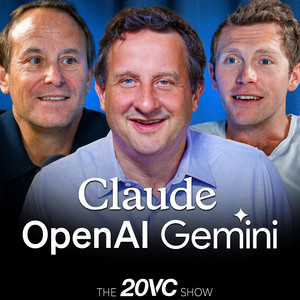
This is 20VC with me, Harry Stebbings.
Now, this week, with Jason Lemkin and Rory O'Driscoll, we have a lot to cover.
We have Anthropix $10 billion fundraise.
We have...
XAI raising an astonishing $20 billion.
We have Andreessen Horowitz raising 15 billion over 20 of the total funds raised by venture firms in 2025.
So much to unpack today.
Let me know what you think of these shows.
I always love to hear your feedback.
But before we dive into the show today, are you a founder working nonstop to raise your next round?
Are you an investor doing all you can for your portfolio companies to help them stand out?
Funding and scaling a vision is challenging.
Banking should not be.
HSBC Innovation Banking caters to tech and healthcare founders all over the world who need a really great banking partner that matches their pace, offering fast onboarding, product packages designed for your business and capital, solutions built for high-growth startups and the VCs investing in them.
With HSBC Innovation Banking's rapid onboarding, you can get access to your new accounts and facilities quickly, so your team can stay focused on building and scaling.
What's next?
You'll be paired with your own dedicated team of venture ecosystem veterans who have the network and experience to guide companies in your specific sector at your specific stage.
And behind that support is this real strength HSBC's 3 trillion balance sheet and global network that provides this stability and international reach needed to grow your operation with confidence.
To see how HSBC Innovation Banking can support you, whether you're on day one or day a thousand, visit innovationbankinghsbc to learn more and connect with an innovation banking specialist.
That's innovationbanking.hsbc.
While HSBC manages your corporate banking needs, Deal helps you build the global team behind it.
Founders scale startups faster on deal.
Grow without borders.
Deal handles the hard parts of global hiring so you can stay focused on growth.
Set up payroll for any country in minutes.
Hire anyone anywhere and get visas handled fast.
Deal takes care of onboarding, HR, IT, EOR, benefits and compliance.
Everything your startup needs to scale quickly, all done fast in one place.
And that's why 37000 fast-growing companies trust Deal to move really fast and get back to building.
Visit deal.com slash 20VC.
That's deal.com slash 20VC.
Once Deal helps you hire your global team, Framer gets them wowed on the way in.
Your marketing website sets the tone for your brand.
Let's face it, and it's the one touch point every single one of your customers has.
So if you're struggling to make small changes and simple updates, you're falling behind.
And that's why so many companies, from early stage startups to Fortune 500s, are turning to Framer.
Framer is an enterprise-grade, no-code website builder that works like your team's favorite design tool.
And it's used by companies like Perplexity, Miro, Mixpanel to move faster.
Designers and marketers can fully own the site, with real-time collaboration, a robust CMS built for SEO and advanced analytics that include integrated A-B testing.
So you're not just shipping pages, but you're maximizing what works.
And when you're ready to ship changes, go live in seconds with one click publish without relying on engineering.
Plus Framer is built for scale, with premium hosting, enterprise-grade security and 9999 uptime SLAs.
Whether you want to launch a new site, test a few landing pages or migrate your full com, Framer has programs for startups, scale-ups and large enterprises to make going from idea to live site fast.
Learn how you can get more out of your com from a Framer specialist or get started building for free today at framercom.
Slash 20VC for 30 off.
30% off a Framer Pro annual plan.
That's framer.com slash 20VC for 30% off. framer.com slash 20VC.
Rules and restrictions may apply.
You have now arrived at your destination.
Boys, we have a big, big lineup today.
We're going to start with two monster rounds.
It seems the only thing anyone's talking about right now is Anthropic.
Anthropic raising $10 billion at a $350 billion price.
Is this the last round before they go public?
How do we feel about the price?
Over to you.
Probably yes on the first question. because they've stated they want to, and it feels like they can.
And if someone says they want to do something and it feels like and that thing is doable, then logically it should get done.
So yeah, I think it probably would be the last one before the IPO.
And how do you pay with the price?
Look, when they raised at 160, I mean, I remember internalizing.
We talked about it, and frankly, we talked about it in our partnership.
You kind of go big number, wow, that's the second or third largest private cap valuation ever.
And then you look at the market traction and the revenue traction and you go on a revenue multiple basis.
It's cheaper than some of the stuff we're doing at 200 and 103.
Because this is a company that's gone from.
It's easy to remember the numbers for Anthropic because they very kindly did them in round units of 10.
They went from 100 million at the end of 23 run rate to a billion at the end of 24 run rate to allegedly about between 9 and 10 billion at the end of 25.
So let's assume those numbers are roughly correct.
They 10x-ed two years in a row.
I don't know.
Next year, let's just say they only, quote, only 3x.
So they go to 30 billion.
Now, a rule of thumb is I'm going to go now from ARR and run rate at the end to gap revenue for the year.
A rule of thumb says take the opening ARR, the closing ARR and calculate the average.
10 billion, 30 billion, average is 20 billion.
That says they do actual gap revenue of 20 billion next year.
So it's 17 times NTM revenue.
It's a much lower revenue multiple than Palantir.
It's kind of comparable with Cloudflare, for God's sake, in the public markets.
So you do that math.
If the growth is there for one more year, it looks cheap.
It's the old rule.
It turns out you really, really can pay up for anything that goes 10x year on year.
So, that's the bet.
And the guys who did it at 170 three months ago are feeling pretty smart now.
There are 2x in four months.
Calculate that IRR, Harry.
Only raising 10 billion, it's actually a sign that the unit economics are probably healthy.
That's a good point.
It's not that much dilution, right?
Anthropic's been clear that they believe that their unit economics are strong.
They own not just enterprise, but they own... code creation, they own application creation, right?
They own building everything we have spent our lives working on.
And if you're building with these tools.
I know it's the trite VC thing to say, but it's hard not to believe we're in the first inning and just getting going.
It's literally hard not to believe it.
So how that works out on a spreadsheet to how many tokens, How many trillions of revenue is complicated, but qualitatively and subjectively it feels like first inning.
Jason, do you think they have the enterprise market at this point?
Everything that I see at the API level, I mean Claude has won it and nothing is perfectly stable in AI.
We should not feel that anything's perfectly stable.
But the reality is so far, nothing's dented that.
And it's birthed Cursor and Lovable and Replit and Harvey.
I mean, even Cursor is just a derivative of it.
I mean, there's other models as well, but it's tough to stop this trend.
Yeah, I agree, and I think you should break the market up into.
I would have said two and, as of yesterday, I'm going to say three, and I'll tell you what I mean in a second the enterprise market.
There's the enterprise API market, which is basically selling your product to other ISVs who are building on top of it, or enterprise building on top of it.
They've been the premium product there for the enterprise for a long time.
Because you're, quote unquote, just an API, there's always a risk that as an ISV is building on top of your product, they might try and use cheaper open source models for some of the more commodified stuff.
But to the extent that you need the high-end part of the product.
That's been the business that Entropiq slash Claude has been able to get.
And that's where they started, obviously, at the API level.
And one of the biggest customers for that was the coding companies like Cursor and that.
So then, the second thing they've done within the last year is they've said hey, coding is probably the single largest use case for what we make.
Let's build a coding product.
So they have Cloud Code.
That's allowed them to, quote unquote, win at the... I'm taking your win at the enterprise comment.
Now they're winning not just by being the API, but being the app for coders.
And it's not 100% win.
They're kind of competing with Cursor.
They're competing with GitHub.
But you're grabbing more money.
Instead of maybe being 50 of the revenue of a coder because you've got with a gross margin of 50, you're getting 100 of the revenue because you're selling the product.
So that's the second category in which they're clearly, quote unquote, the winner.
I mean, my sense is their enterprise share of coding revenue is plus or minus comparable to Cursor and GitHub, maybe a little lower but growing nicely.
And then the third thing is they announced the product yesterday and caveat, I haven't had to use been able to use it yet, because I'm actually here on an outside but it's early in the morning.
My coffee hasn't kicked in.
The product is basically, it's clawed for non-coders.
It's the ability, it's kind of an ability, clawed workspaces, I think it's called.
Don't quote, I could be wrong on that.
But basically the idea is, if you're doing other knowledge work other than coding, Can you do it within Cloud?
And this is the idea that the world, I think, has been going in this direction.
We talked a little bit about Manus last week, companies like that.
There's a number of others.
We have one, obviously, at AI that has launched a product in that space that's just starting now.
But Cloud Workspace, obviously, the dominant one.
The idea is that if you're building PowerPoint, if you're manipulating data, if you're doing all the other knowledge work that those of us who aren't coders do, instead of bringing the AI to the Excel spreadsheet, which is what Copilot tried to do with Microsoft, you bring all these tools into the clawed space, into the workspace, and maybe it'd be more efficient.
Read some preliminary reviews.
Somebody was like, yes, this is amazing.
The people who've used it more said, yeah, it's amazing, but it's a bit janky.
But the idea is there.
And clearly the reason I mention all this is the idea is the direction of travel is hey, don't just be quote the chatbot for enterprise, the chat interface for enterprise, like chat GPT for research.
Be the place where you do knowledge work for the other knowledge workers who aren't coders.
At a high level, and this is a Zoom out comment, but it's a scary one if you're Microsoft.
It's like every single knowledge worker uses the Office suite.
You get PowerPoint, you get Excel, you get Word.
What is the AI version of the Office suite?
It's a kick-ass product for Microsoft because every knowledge worker buys it.
Can you imagine turning up for work and someone saying we're not going to give you a spreadsheet, a word processor or a PowerPoint?
You're like, what the fuck?
The idea that for every knowledge worker there can be some product like this, some bundle like this, is a huge ass idea.
And I don't think this is it yet.
But the idea is clearly, to the extent that you are doing knowledge work using AI, you probably will need some space to be in.
And that's the game they're just joining now.
My job is to ask provocative questions.
When we look at case two there you mentioned kind of Cursor and the potential impact that Clawed Code has on it.
I speak to many CPOs as part of 20 products and I ask them about tool usage internally.
Everyone that I speak to instantly states Clawed Code and the portion of people that said Cursor has gone down dramatically in the last three months.
Would you feel nervous if you were Cursor and a Cursor investor?
Depends on the price I got in at.
I mean I wouldn't feel nervous if I got in at the round of 200 million pre, because it's not going away.
I mean, again, there's an element of a horse race drama here.
We like to get caught in the... You call it provocative.
I might call it getting lost in the details.
There's no doubt that...
Cursor has got two large competitors, both of whom can bundle with adjacencies A Cloud Code, where they have a strategic dependency as well, and B GitHub.
So yeah, I would be nervous if I was a 27 billion pre-Cursor investor, but they've created something amazing.
And what I always say to my CEOs is The best way you know you've graduated from one league is when you start competing with people one league up.
It's like you know you're in division one of the English Premier League and suddenly you graduate to the top division.
It's champions.
What is it now?
Premier division?
Yeah, I'm so old I remember when that was Division 1.
But anyway, you get to play against different competitors.
I mean, Cursor is now up against Microsoft.
It's up against their own supplier, Claude.
So yeah, they're playing in the big boys leagues.
But are you a little scared?
Yeah, but you're damn glad to be playing there, because the other 10 coding agents ain't even going to get to play.
For sure.
If I were an investor in the age of AI.
I've given up on this nervousosity of competition and disruption.
Because what can you do?
I mean, none of these products even worked a year ago.
How nervous can you be holding a large position in a product that didn't work a year ago?
You can only be so nervous or quit the game.
But even little things like like anthropic cutting off xai's access to anthropic this week, it is easy for me to imagine the business model switches right now.
It's great for anthropic to get an extra billion or so a year from cursor.
It's a great deal.
It's it's free money.
They package the product.
They don't, I don't believe they have to sell it at any discount whatsoever.
And they get another distribution channel.
Should that change?
As, as Anthropic crosses a couple trillion and 10 trillion in revenue, it's easy to imagine one they could cut off access.
Like that sounds aggressive, right?
Or they just might limit access to the top models.
They just might limit access.
They just might degrade it.
And so There's no reason to believe that.
What's the expression?
That the scorpion might not sting the who's?
The scorpion taken across the river.
The fog and the scorpion.
It's in its nature.
There's no reason that the anthropic just might sting cursor just before it gets to the other side of the river.
I don't I think it would be naive to assume otherwise.
Right.
And there's many ways that the scorpion could sting the frog.
It could be.
It could be the simplest way is to limit access to models.
They've already done it on a limited scale with XAI and others.
They could simply copy the product.
I mean, how hard is it to build an IDE that's just the same as Cursor?
It's really not that hard.
They can build Replit and Lovable too.
These are not the greatest challenges of mankind.
So all of them are at risk of the scorpion stinging the frog, but I would still invest.
It is worth pointing out that when the scorpion sings the fog, the scorpion dies too, in the old Aesop's Fable and in The Crying Game, if you remember the movie.
He does die too.
Yeah.
I love it, Jason, because the first thing you said I think is just really so true.
It's very helpful for me because the comment on being scared is –
If you're going to be uncomfortable being scared, you need to just go home.
I'm scared all the time because these things change so much.
I mean, I think we said this before.
You know, in fast land you could compound for seven or eight years.
Now there's existential risk every six months.
And if you can't live with that, you probably need to find a different job.
So I think you're spot on there.
If we've got to be comfortable being scared, to what extent is Google choosing Gemini for Siri over the prior relationship with OpenAI?
A massive deal versus a temporary moment in time where Gemini is proving to outperform?
It's a big deal in that.
The big deal comments are this one Google and Apple obviously have a long standing relationship where the money moves from Google to Apple for placement of search, because search monetizes with advertising.
So therefore it's valuable to get real estate.
So they have a longstanding relation.
So it kind of makes sense that you'd go with your default relationship to make it happen.
The odd thing is for this relationship the money may.
I'm not clear on the money movement, but it kind of because there's no advertising model.
Maybe the odd thing is Apple might be paying Google for Gemini.
I don't know.
While at the same time getting paid a lot more by Google for placement on search, which is why the two products are slightly different.
That could slip.
If OpenAI had a model, for example, that had ads in the thing, then maybe the dynamics of the money move can flip.
But yeah, if you're in the distribution business, you want to be on a billion phones.
I mean the proof that it's worth something is Google pays.
I used to know the number, I don't 10 billion a year.
Some absurd sum of money just to show up on the phones because it's the best distribution on the planet.
So, yeah, at the margin, you're sad.
And that's the economics was stupid.
It's not like actually even cancel that comment because it's not like open AI blinks at bad economics.
Those guys have an economic indifference curve that would make your head hurt.
So, yeah, I think it's at the margin.
You'd be bummed not to be honest.
Certainly today, Google feels like a far more stable partner than open AI.
It's just the reality.
It's not the open AI is not the only game in town anymore for Apple.
If you're open AI, are you not slightly nervous?
You're being eaten away by Anthropic.
You have headwinds behind them, seemingly like they haven't had before, and incredible model performance.
And then, on the consumer side, you've got Gemini outperforming, you've got Nano Banana being incredible and the tailwind of Google and the machine behind Google.
It feels like you're being eaten at every angle, combined with very high SPC and high churn.
It feels precarious.
Well, luckily, you're a nonprofit, so whoever wins is great for the global economy, right?
You don't have to worry about it as a nonprofit.
It's all for the greater good.
You're not a nonprofit anymore.
Stop.
No, hang on.
Stop.
Hang on.
Hang on.
First of all, just to be precise, you're not a nonprofit anymore.
Your larger shareholder is a nonprofit.
So, to just make it even more hard if your economic value goes down, the biggest single loser is this wonderful nonprofit called OpenAI Nonprofit, which has already made some interesting donations which is very clever, by the way.
Once you've got that deal done, start dispensing some money as a charity to show it's a charity to separate the two.
So if OpenAI's value goes down, the largest loser is the charity.
The second largest loser is Microsoft will survive.
And as you pointed out, the third largest loser is Master.
So the core question is, Precarious is a little strong one.
You feel angsty and driven.
I mean, that's why they're at Code Red.
But A, to Jason's point, anyone who's not feeling nervous doesn't understand the game.
So, of course, they're feeling nervous because, you know, you got to play the game.
But look, I saw some, I mean, actually, I saw it in the New York Times this morning.
I could be wrong.
Sebastian Maltby, who I think wrote the book on venture at one time, was kind of oh, I think open AI goes to zero.
And I think that's absurd.
There's huge value here.
Like I still, we all default.
They have 800 million users.
They'll find a model.
I mean, I think that there is a model there.
They have subscriptions.
They have a business.
It's not going to zero.
The way I keep score is the relative value of Anthropic to OpenAI is kind of the ratio of let's call it management success from over the last three years.
And the truth is it's gone from 10 plus to one to much more convergent.
It's now only two to one.
So if you were in a race, the objective measure of success over the last three years is something like you were in the lead 10 to one over the other guy.
You're still in the lead, but he's now only 50% behind you and coming on fast.
So are you nervous?
Yeah.
Are you bummed?
Yeah.
You're still in the lead.
Don't blow it.
And I think you've got a differentiated business.
For all the Gemini talk, I still enjoy the chat.
GPT experience more for the kind of research I do, for example, to go on this pod.
So they've got something amazing and compelling there.
They just need to, frankly, focus, knuckle down, focus, and make it work.
Realize its potential.
A lot of them make it work.
That's a stupid statement, Rory, because it has made it work.
There is a very...
I think there is a very simple bear case for OpenAI, though.
There is a very simple bear case that it goes almost to zero, which is that shelf life of an LLM is less than 100 days.
Half life is very short.
And something happens.
There is a macro disruption and OpenAI can't raise the capital it needs.
All of its competitors, we just talked about how Anthropic has much superior margins.
Gemini, massive cashflow.
XAI, crazy, but it'll get a trillion of Trump contracts.
OpenAI is vulnerable to, you know, we joke about macro disrupt.
Every portfolio company that didn't hit its Q4 numbers blamed macro disruptions.
But it easily could, like this cap, we've never seen this amount of capital availability ever.
And it is not hard to imagine something, we've had systemic shocks in our lifetimes.
If this was 07, 08 or whenever, OpenAI could almost, like it could die, in the sense that it could not evolve when its competition could.
One caveat.
I understand your comment, which is why the old Bill Gates rule was always have two years of cash on the balance sheet, like OPEX cash.
The way you could only get into a really tough situation is if the world went to shit just when you needed to raise more money.
So they're smart people.
If you're running the CFO of that company, your mental rule of thumb should be raise like crazy you've got the world's best fundraiser and never have less than two years cash, because when two years cash, even if the world, You know world's changed.
You can tweak the thing enough to converge more quickly.
You just dial down your ambition and dial up your cash flow focus.
And in two years.
But how do you do that if Gemini and Anthropic can keep going?
How do you do that if your competitors can keep going through that?
This isn't work workday.
Spending a little bit less on on making sure that the Windows 98 integration works properly.
You die if you don't have the capital.
But I rejected your first comment, which I don't believe, that this is the kind of user base that churns at 100 days notice.
I think that there is a large degree, an increasingly large degree, of consumer behavior and stickiness.
So, yeah, can you paint a scenario?
No, hold on just one second.
Just imagine, okay, OpenAI needs $100 billion in the next two to three years.
That is more than it has spent to date, okay?
Its spend is accelerating.
Would you, let's imagine it can't raise that and it's frozen in time.
ChatGP is essentially frozen in time today.
Would you use ChatGPT from a year ago?
Would you use Claude from a year ago?
NFW, you would use these products from a year ago.
There's no way you would use them in cursor or for coding.
There's no way.
There's not a one in a million chance any developer would use a year old model.
They were so terrible.
I understand.
This company would deteriorate.
So it would be like Detroit, like it would still exist.
Right.
Or be like AOL and dial up.
You'd still hear the shrieking because some people don't.
Grandma doesn't know.
Grandma's fine with chat GBT from a year ago because it helps her with recipes in the kitchen.
But the rest of the world's moved on to broadband.
Two comments.
One is, yes, by the way, it is astonishing that someone just traded AOL and it still has cash flow.
That was the funnest fact of the year.
Like literally last year someone was like wow, that thing's worth a billion bucks still 20 years on.
I don't agree with what you're saying.
I understand the point.
But what you're saying?
Imagine a two by two, which is macro condition's good, macro condition's bad.
And then the other side of the two by two is scaling laws still working.
So improvement is vital versus scaling laws slow down.
You're right.
In a world where scaling laws are still massively working, so the next model is infinitely better than the last model, and where macro is shit so they can't access the capital, then in that corner case scenario, then you're right.
You can paint that scenario because you can always paint a bad scenario.
That's what you learn.
I think it's just the lower likelihood.
Let me just add one more point.
And I don't want to take too much time here.
You're the boss.
I think we have returned to a moment in time.
It feels like late 2020, 2021 or maybe you can pick some other times in our careers where we have ascribed the odds of a downturn to less than zero.
In venture and everything, we are raising funds.
We are deploying capital.
We are doing up rounds weeks after the last one.
And underlying that bet essentially is a 0% chance of things not.
We see it in data center use.
We see it in power use and water use and ramp.
But we are...
And that's fine.
We're not paid to mitigate downside in venture startups, but I think OpenAI has existential risk.
It is a bet that the best of times lasts at least a decade.
And I think you can tell me the history of downturns.
They're usually shorter than we think, but 10-year cycle would be a long one.
Historically, right?
10-year with no downturn.
I do think on the consumer retention element, I think you're wrong, Rory.
I think people are a lot more promiscuous than we give credit for.
Speak for yourself.
Excuse me.
Since the latest Gemini models, I definitely am.
I'm a total slut for a new model.
But since the new Gemini models came out, you've had a 22% drop in chat GPT usage.
My son dropped it.
Yeah.
He pays for cursor and he uses, and Google's free for him.
Google could, because Google's free.
He doesn't want to pay 20 bucks a month for chat GBT.
He pays for cursor out of his own pocket, out of his own pocket.
He pays for cursor, but he doesn't pay for chat GBT anymore.
And remember, invest in whatever your kids do.
This is how you get into snap and all these hot deals.
You just, just do this.
So if my son's off chat GBT, Rory, we got a short, let's get on calci and just short this baby.
Come on.
It's to Harry's point.
It is that the next generation is fickle.
If you ever read failure analysis of things like air crane crashes or anything like that, what you always discover is any crash is always multifactorial.
There's always more than one cause.
And I think what you're saying is correct.
If macro goes to shit at a point in time when they don't have a ton of capital and at that time the market for this product is still incredibly fluid at the consumer level, then if all those things happen at the same time, you have trouble.
I just argued that.
So, it's not a stupid comment to say it can happen.
It's just concatenated probabilities that I think are fairly low.
I think they're much more likely is that you have to moderate your ambitions and just execute on the consumer space and make it happen and build a world-class business on that.
I mean, speaking of moderating ambitions, there's one firm that is not moderating their ambition.
Our dear friends at Andreessen Horowitz, $15 billion for the new funds.
I believe it was 22 of all of the dollars raised from venture in 2025 going to them with this fundraise.
It's enormous.
How did we react to it?
And a subsequent, really underlying question do you have to go mega big platform or tiny boutique to play the game in 2026?
Listen, on the one hand, so what we've been talking about this since this pod started right, we've been talking about massive funds and and it's just all you have to do is just look at the data bricks and anthropic rounds and it's pretty easy to see why you'd want to do that playbook.
I would say it's pretty interesting that andres not only raised the most capital but on a two by two, I think as the strongest founder brand.
That's hard to do both.
It's hard to do both.
And it is evolved.
And Andreessen, I've been around long enough to remember vaguely when it started.
And it was cool from day one.
It was cool from day one.
It wasn't what it was today.
But I remember I had a subtenant.
Mark Andreessen came into our office to meet with them to fund them.
And it was a God moment.
Oh, my God.
God, is that Marc Andreessen in the office?
I mean, it sure looks like Marc Andreessen.
And they have invested in that in many levels on the brand.
And I don't know how they've done it in some ways.
And it's gone a little bit up and down.
I remember I had one founder that was pretty hot who was bummed that he got a term sheet from Andreessen and not Sequoia.
But that don't happen today.
That was the 08, 09 version of Andreessen.
That was a brief moment.
And you have returns.
The returns are published.
The returns are top decile.
So you have the biggest fund, the top decile returns or quartile, whatever top tier, which used to be a knock.
And founders love this brand.
You know, whoever was talking about fund versus firm or platform, it's hard to do all of those at scale.
Founders love it.
It's defensible.
So you might as well hoover up 51% of the capital and then just shut down your competitors.
Agreed.
I've thought about this a lot in terms of the question you asked and I have a lot to cover on this.
Just heads up.
And I'll give you the summary.
They've won and they've won really well.
And the only thing that might impact them at this point is mis-execution internally.
But now let's unpick this, because the first question in your little notes you said is can they make a 3X or a 5X on 15 billion?
The question you asked, right?
And everyone always starts with that question.
Oh, there's just not enough exits to justify that, is what they say.
And it's the wrong way to think about it, because I think you have to break it apart and say first of all, is the industry at a stage now whereby that amount of capital can earn a return in total?
In other words, the total capital going in.
Because remember, if the total capital going in can overall earn a decent return, it doesn't matter from the industry's perspective if that 100 billion of invested capital goes all to one firm and they invest it all, or it all goes to 100 different firms and each invest a billion dollars.
The macro question is is the overall market in equilibrium such that you can get a decent return here?
And then the second question is given that, like again going back, if it is an equilibrium, can these guys, how much of that total money can they take and profitably employ?
In other words, are there diseconomies or economies of scale and can they execute it well?
And kind of fast forward to my two comments on this is A.
I think the industry is roughly in equilibrium so they can do it.
And in fact, the numbers are moving in their favor.
And then second comment is, so the argument on employing it at scale, I think it can make it.
So let's do the first.
They raised $15 billion, but they do 20% of the total.
So it means the industry as a whole raised $75 billion.
And everyone goes, oh, there's not enough exits for that, right?
Well, rough and tough.
3x the value of exits this year which wasn't an amazing year for exits, including healthcare, by the way was around 300 billion.
So not perfect.
That's not all owned by venture, but you're kind of roughly there.
Presumably next year.
If it's 300 billion this year and Entropic alone goes public, next year is 500 billion of exits.
So the industry raised under 100 billion this year.
I mean, if they really raised 15 and they really are 20 of the total, that implies 75 billion of venture raised.
It seems to me that's a kind of number that can be digested and yield a 3X return overall.
It's not like it's stupid, the amount of money.
It's actually getting better because in the last couple of years venture has deployed a couple of hundred billion a year and only raised about 70 to 80 billion a year.
Now, some of that is because some of that capital being deployed is non-traditional venture, but it's getting harder for newer funds to raise money.
If you move on to the second question, can they deploy 20% of venture successfully?
The macro trends are moving in their favor because they're raising more money at a point in time when other people are raising less.
So they're getting in a relative, they're in a nice position provided they can deploy it.
So I think overall, the industry is getting into equilibrium.
Then the second question is, how can they put it out?
And there is 20% of the money last year, right?
But you've got to think of it over two years.
That's roughly.
If they raise every second year though interestingly they raise in 24 and then 25, but let's just say every two years that implies it's 10 of the money on a sustaining basis.
Agreed?
It's like you're putting out 10% of the capital.
So basically, they've got to get 10 of the exits, they got to get 10 of the series A's, et cetera, et cetera.
Now interestingly, that work that we talked about way back last year, that the partner from DST did, showed Over the last decade Andreessen did roughly 10 of all series A's that became 5 billion outcomes.
So it's kind of their market share.
They got to get 10% of everything.
They got to get 10% of the great series A's.
They got to get 10% of the great series B's.
And provided they could execute that all the way up the stack, they make it happen.
That's a great way to summarize it.
And what I realized when I did that Jay, it was like I just literally did it this one because I'm getting ready for our site.
So I'm looking at kind of exit data.
I mean, there are two risks and we'll talk about them in a second, but you look at it and you go.
It's not crazy.
And then, as you say, it's in part, because I mean you said it is that they've done it in the makeup.
I read the Paki McCormack article and all that.
I think a lot of us come into this business as investors.
I think they came into it as engineers and as company builders and they did a great job of solving the system.
And there's a lot of leakage along the way.
I mean, one of the things that was interesting in that article is you deal with a lot of negative knocks along the way, but it doesn't matter, provided the model works overall.
And again, I repeat, they got to get 10% of everything.
Now, there's two, maybe two or three things that go wrong.
Maybe three.
The first is when you get bigger.
If you have to do 10 of all series A's, it just becomes a lot of deals, which means a lot of people, which means is the marginal investor any good?
Can you stay good when you have 20 people writing checks versus 10?
It's just hard.
That's a management problem.
They're good managers.
The second thing is The funny thing is you say you got to get 10% of all exits, right?
And the total exits.
The total value of all private companies right now is about 36 trillion which pleasingly, by the way, if you say 3X on invested capital, that's 12 trillion over 10 years.
That kind of says it's got 100 billion a year, creating 300 billion a year of value.
If you chop off just the top three deals, you're down well north of a trillion bucks.
You go down to 2.6 trillion.
So the bigger the firm, the more capital you raise.
The math all works, but it's very top dependent.
I can make my math work and not get any top 10 exits.
You simply can't make this kind of math work without getting those top exits.
And you don't have to get in at the A.
You don't have to do the A of SpaceX, but you better show up on the cap table before they hit total, because that's a trillion dollars of value that you got to get.
That's the mission for them.
And they're doing it.
And that's why- But that part, to me, seems the easiest part, Rory.
You simplified it in a great way, which is they need to do 10% of series A's that matter each year.
That's doable if you have a top two brand, I think, and you have the right team.
You just meet with every, the job's to meet.
I don't think you can do 10% of every pre-seed deal.
I think even YC can't, like, that's a different question.
It's doable.
And then if you have one of the top three brands and you have a large enough team I mean even at Insight.
I learned this from Teddy back in the day like you get fired if we don't see every deal.
It's a different question of whether we win it.
We get fired if we don't see every deal.
If Insight can do that and Vista can do that, why can't Andreessen see every single...
They have relationships with every seed manager that matters.
They're out everywhere.
They're close to Gary Tan and the rest of the world.
Why shouldn't you see every, I mean, there'll be some from left field, right?
Of course.
But why shouldn't you see, if you're brand strong enough, you should still see them.
And then the interesting question is why can't this?
This was the question years, a couple of years ago, that I remember Andrew Bilecki from Klaviyo said is like well, why not 90 market share?
Why can't Andreessen have 40, 50%?
I mean, there's conflicts, of course.
Let's put conflicts aside though.
Why can't your math scale to 50%?
It's actually an interesting question James, because if you think about where I started, you're right.
I mean one of the things I always remind myself.
You can tell deep in their heart they believe, even if one other venture firm has a billion dollars, you're like, why are we letting them have that right?
We'd really just prefer it to be all us, right?
And going back to the total equilibrium combo provided, if every year the technology industry entrepreneurs gives the money, the venture guys, the chance to turn 100 billion into 300 billion, The entrepreneurs at some macro level don't care if that's done by one firm doing all of it or half of it, versus 100 different firms doing it all.
There's no obvious economic reason.
Especially if there's no downside to it.
If all I get is upside, I don't get any drama if I sell my company.
I don't get thrown under the bus.
They do my pro ratas.
The worst case is I'm treated well and I get to go to these cool events.
That's the worst case.
Why would I not take their money?
So you're right.
And exactly right.
Because it's an interesting question.
If they can do 10%, why can't they do 20, right?
50.
Yeah, exactly.
So I think there's really three things that could go wrong.
And it's an interesting aspect.
One is, as I say.
I think you should assume that when you have that you see all the good deals at the Series A, But remember you also see all the bad deals.
So the more pickers you have to have to do more of the deal, the harder it gets to have all those pickers be good.
Your mistake rate goes up.
But you can cover for that if you do enough of the A. So that's the first thing.
Then the second thing is, as you get later, you just have to concentrate on the winners.
You can be diversified as shit at the A.
But going back to the comment is if it's 36 trillion of total private value and the top four companies now, if SpaceX really was worth a trillion, you could argue the top three companies are now 18.
You just got to make sure you concentrate down on those.
And if you slip on missing, it just gets harder to execute.
So that's the second big risk.
You don't concentrate on the right thing.
Yeah, but you have to find every two years or every year.
I think your job is to get good at concentrate.
I think Andreessen should target Ben and Mark.
Actually did not WhatsApp me on this, but I think your math Rory, is so powerful to me.
10% of series A's.
Combine that with Andrew Bilecki own 80 of your market or you're a failure as a founder.
From CEO of Klaviyo.
Own 51% of venture.
I believe conflicts are a super solvable problem for founders.
Like law firms figure it out.
Like you just isolate it.
We have three teams.
And Andreessen becomes known as the gold standard.
There are no conflicts.
Like you can have direct competitors Andreessen and they have solved this.
Like there is no leakage.
They have solved this problem.
This is a traditional VC.
Even Sequoia has the issue.
We don't do conflicts.
Right.
I remember in the early days when we met, we referred some stuff and you guys were like no, HubSpot's our winner.
We can't have any conflicts.
But I think it's a solvable issue.
Then you get 51 percent market share.
Then you and then Sequoia and those general catalyst guys get the scraps.
If you want to build a firm and not a fund, this is what I challenge my friends to do.
51%.
Because your math just, I think you can solve all the other issues.
I genuinely think you can solve them.
And Andreessen hasn't had a fund below 4X.
Gross.
Hasn't had a fund below 3X.
What I like about doing this for you Jason, is how incredibly I can go in expecting to have to make one set of comments and end up on the total opposite side.
Because I was expecting to have the, oh, they can't make the mat work at 10%.
And clearly I convinced you they can.
So now you're like, fuck it.
If you can do 10, why not do 50?
Why not?
You're a wimp not to try it if you can access the capital.
Well, that's actually an interesting caveat.
I think there's two or three risks.
One is if you're doing series A's, the more you do, the more people you have to have.
And at some point it becomes because, the more capital you're deploying, you only have one or two moves.
You either do more small deals or fewer big deals.
If you're doing, instead of 20 series A's a year, you're doing 60 series A's a year.
You need X number of GPs.
I think quality goes down at scale.
Let me give you proof on that.
Andreessen's market share is higher than Benchmark's.
In terms of that work that I wish Rotman, the guy from DST did,
It's higher in terms of the great series A's as a market share, but the hit rate is much lower.
As you get bigger, you get more done, but the quality rate goes down.
And at some point, not only did your hit rate go down, you probably.
Therefore, you have a lot more fails.
So if you scale from 5% market share to 10%, your hit rate goes down by a couple of points.
If you go from 10 to 20, now you have the next 10% being written by less good investors.
The pressure to do deals goes up.
My guess is your hit rate goes down over time.
So that's the way it happens at the Series A side.
So I think there was a natural limit to this because, I mean, if you look at public investing Index, investing is a scale business.
Stock picking is not.
Now we can talk about in the public markets is indexing the right answer, which is why all the big money managers in the public markets are indexes.
But stock picking in general.
It gets hard to be smart in a room with more than five or seven people in it.
So I think there are inherent limits.
If you want, index in Sequoia index reduced the fund size that they went out and raised a billion and a half circa.
Sequoia actually have quite constrained fund sizes.
I think the seed fund is around 200 million.
And they don't have billions and billions per vehicle.
Do they have to embrace scale and say, fuck it.
Andreessen have set a precedent.
This is a money wall game situation.
There's no doubt that you can pursue a really great seed and series, A strategy with plus or minus 500 million, plus or minus maybe, 500 to a billion.
There's no doubt about it, right?
Enix can do it.
Sequoia can do it.
The math is clear.
You can have five partners doing deals.
So maybe another way you ask to ask the question another way is to be successful in the series A, do you also have to add this adjunct product called a shit ton of money for your growth stage, where you use that money to do two things?
One is to help you win series A deals, because you can say to people not only would I do your series A, but I have a wall of money for later right,
That's the implied thing.
And the other advantage it gives you is just you seem bigger, so you get more of everything.
That's the question.
And your benchmark has proven you don't.
And recent have proven that it can be great.
And I think the real truth is, you know, there's multiple ways to play that Series A game.
And one of the ways that wasn't true at all 15, 20 years ago, but now is clearly true, is co-attaching a big late stage fund to your Series A firm fund.
Provided you execute on both of them well, is a way to increase your profile.
It's increased your value to founders.
It increases your personal net worth enormously.
And provided you don't shank the late stage part of the business, it's one way to play it, but it's not the only way.
I don't believe.
No matter what VCs tell founders and their spiels and pitches, I don't believe founders highly value the fact that VCs can fund you through every stage.
Every, every big fund tells you that, every index, every red point.
Everyone comes in and says the good news is
If we deem you worth it, we can shovel cash into you if we believe you're one of our best companies.
I don't think founders go skipping down the street from South Park or Sand Hill when they hear that.
That they just that.
That's not my problem.
Right.
Getting help now and giving me the capital on the amount on term.
So I just don't think that is as defensible as winning all the A's.
That is just an output of a combination of pro ratas and winning winning, winning the right to do beyond your pro ratas.
Put me down for a no on that because I think there's two ways it helps, Jason.
I don't think it's dispositive for the founder, but I think it helps at the margin for a couple of reasons.
One, it helps you tell the founder a story.
Oh, look at the last two years.
Lightspeed do a really good job of that.
Look at, what is it, the van?
Oh, look how much we owned at the exit because we were there the whole way through.
Adresin tell a good story with Databricks.
Oh, look, we're there the whole way through.
I think at the margin that helps.
More money is better than less.
I don't think an average Series A founder is picking you because you diluted the founders of Navon to 5.
I don't think that's the most compelling story I've heard at a founder pitch.
Oh, that's harsh.
They're picking me because I believe Mark and Ben and team are going to help me build a 100 trillion company.
The second argument, because I think the third argument is the important one.
I'll give you this.
The second argument is one you can use all the growth stage fees to fund all the platform stuff and you can decide how much or how little you believe on that.
I think the third argument is the really compelling one.
Watch this.
It's when I have a late stage fund I can decide.
I'm not clever enough to be like Benchmark and pick just the good ones.
Fuck it.
I'll just do more of them and some of them will be great.
And even if I make errors at the A, I will be able to get so much money in my winners that I can cover for my mistakes.
And I'm not saying that's what any of these firms are doing, but it's clear on the mat the more scale you do, the more errors you make.
And therefore, the only way you can make more errors is if you have a way to come back from it.
And the easiest way to come back from it is just to know if I to get one good series A, I'm willing to get three or four of them wrong, Because in that good series A I'll do the B C, D and E and the other stuff gets lost in the noise.
That's actually the real power of the late stage fund.
It's clean up on aisle five.
Yeah, we made some whoopsies, we made some misses, but we'll just clean it up, right?
We'll go the other three series A's that went bust, cost of doing business, you're down 60 million, 20 on each, you have 20 million in the good one, you put a billion in and you just 2X it and you've covered your nut.
That's the real strength.
You can be promiscuous at the A if you have enough late stage stuff to cover it up.
That's the argument.
And it gets back to the core thing.
I think it was inside that.
I think if you approach your business as an investor and I think benchmarks are superb, like you, just I'm trying to pick the best
And I naturally gravitate to that.
Let me try and be smart and pick the best.
I think, when you approach it as an engineer, I think those guys said how do you engineer an overall system such that it works?
And you say, hmm, I can take a little loss rate here, provided the overall system can cover for it.
And it's just an approach.
Well, for me, the truth is, the ballooning of your growth assets means you have ever increasing price elasticity on your early assets.
And so for us playing the early game, they can just come in and bid 300 when we're bidding 150.
Doesn't freaking matter, because David George is going to put in a 300 million check at three or four billion.
And so the more you have here, the more elasticity you have here.
And that's the real alpha that you get from this.
And that was my point, which Alex Rampell said on the show that we released on Monday.
Very simply, the middle is dead.
Every other asset class that matures.
You see a boutique specialist and you see a very large platform play and the middle hollows out.
I mean this in the nicest and most loving way, Rory, because I think you're utterly brilliant.
Are you not the middle?
And how would you respond to that?
I think, first of all, in that context, you are the middle.
But I think if you're going to do crudely on AUM, I do think there is pressure when you have firms that can raise 15 billion.
And that definitely creates additional pressure.
And you'd be a fool not to say it.
I think you have to focus because I think the word boutique doesn't just mean small.
Given the stage we invest at, we can only do 20 to 30 deals per fund.
We can only focus on enterprise software.
We don't do consumer.
We don't do crypto.
You have to be good at something.
At the stage we invest at, we couldn't be a 250 million quote unquote boutique because series A and series B, you're going to have to be writing 20 to 30 million checks with 50 reserves.
So what you have to do at a minimum is focus on a specific set of areas and be the best at that.
So yes, let's examine what Andreessen does, right?
Enterprise, consumer, FinTech, crypto, defense, blah.
If we were trying to cover all those grounds, we'd be doomed.
It's interesting today, Alex, he says that.
But on the other hand, it's very noticeable that they've split the fund up into four funds roughly our size, to put it right at you.
American Dynamism, roughly over a billion.
FinTech and apps, about a billion and a half, in front of a billion and a half.
Because implicitly, by the way, I think it was a brilliant strategy.
Very Alfred Sloan, if you read the founding of GM,
What they're doing is saying they're recognizing you couldn't run this as a single thing, because I think you see deterioration of investment quality.
And what they've done is they've given Martin his sandbox.
They've given David Yelovich his sandbox.
They've given Alex his sandbox.
And each of those funds is a fricking boutique fund at a billion dollars, just like us.
So no, I don't buy that.
A focused billion dollar fund.
What they do have, with the 15 billion that you don't have as a 900 million fund in the same market as their one and a half billion dollar AI apps fund, is they have the air cover of the brand and they have the cleanup of the 5 billion late stage fund to cover for their misses.
So yeah, so that's the advantage they have.
But I think to just simplistically say everyone else goes away.
It's interesting as a comment, but it's belied by the way they've structured their business, because that's what they've done.
But you have to be damn good because you have to get up every morning and say you're competing against someone who will see almost everything, who can really lean into what they want, because they have it and they have the brand and the late stage money.
So you have to get there earlier.
If you wait till it's consensus or anything close to consensus, you're probably going to lose.
I mean it's the Peter Thiel question, because I always think if we look at the two biggest entrants in the last 30 years that are really since benchmark.
In 95 Andreessen Howard signed, figured it out as founders who were engineers and they systematized it.
And I think Founders Fund, even though the name is Founders figured it out as founders, who were incredible investors, and figured it out from an investor perspective.
So the lens is thinking.
They thought it through, whereas Andreessen Horowitz engineered and managed it through.
And they brought on, obviously, the two successful scale entrants.
I think the common, the Peter Thiel comment is, why do you know that no one else knows?
If you're doing as a quote unquote boutique or a focused firm, you have to know something and have an area that the more general funds don't have.
Otherwise you're toast.
Exactly.
You have to see things earlier.
It's hard.
It turns out to be hard to make money.
Did you hear that spoiler?
That was Rory saying the next fund is going to be a billion five coming soon.
Absolutely not.
I mean, it's all true, right?
Obviously, Andreessen down to YC will squeeze out a lot of players.
Like, you can't argue with that.
The meta question is, can you still find acorns?
Can you still find diamonds in the rough?
Are there any good startups that don't go through YC?
Are there any that Andreessen won't see the A?
Anthropic is on fire.
But one of the co-founders said in the very first time they tried to raise money.
22 out of 23 VCs said no.
Now, almost instantly later, everyone put money in.
Can you find that moment in time?
If the markets are so efficient in venture from the bottom end, from YC to South Park Commons to HFO to Project Europe, if those have become so efficient in discovery that the only thing left is inception.
And there are a lot of VCs that have been doing this a long time that think the only thing left is inception investing, because you can't compete with YC and Project Europe and HFO and South Park Arms because they've all locked up the market.
So Inceptions, and maybe there'll be a new fund pre-EF that locks up the pre-Inception market.
Like we'll go to middle school or grammar school.
So there is truth to that.
And here's my way of thinking about venture.
This is because this is the only thing, otherwise I would quit.
I would retire.
Can you still find a $10 billion gem outside of the boundaries of this system or not?
This is the meta question.
If you cannot find a 10 billion gem, then this is all a game or fees, or riding the downturn of industry.
If it is still possible and your fund or firm, that differentiation between fund and firm can actually still find one of those outside of the boundaries of this system, then you can make an insane amount of money.
But if not, it's all performative.
It's all little checks.
It's all 25K checks into hot YC companies, and it's all a lifestyle joke on Twitter.
That's the question.
Will this market, as it matures and it has, goodness gracious, matured a lot in the last couple of years will it ruthlessly create discovery for all asset classes to inception?
It's certainly all down the path to doing that, right?
Here's the question to Gary Tan and friends.
Can you find a great startup that won't go through YC and friends?
Can you even find one anymore?
But just to pause it in two ways, there's two founders.
There's the ones who are young and want YC.
And then there's the serial entrepreneurs who want money and a good price, and people who won't get in your way, which is Andreessen Naveen Rao Databricks.
Multiple rounds before anything came public, all swallowed by Sequoia and Andreessen.
So the question just to add your addition is can you find any founders that don't go through either YC or Sequoia and Andreessen with big money very early behind the scenes because they're in those insider networks?
I don't know.
I got in trouble last week because I tweeted the worst place to be investing is Series A.
You either need to be pre-seed or pre-IPO today to make money.
There is one segment that will always exist in venture, I think.
When I look back, this is where I've done a lot of investments.
We used to call it a second seed.
You can call it whatever.
When there's a glitch in the matrix, when they stumble a bit or when no one sees the reacceleration, it's hard right.
But there are moments in time where someone is the hottest company at YC.
It has a couple of great months.
It reboots and all of a sudden it reaccelerates. six months, 12 months down the road.
I just invested in one that because of Anthropic and Friends re-accelerated two years after YC.
It can happen.
That is a niche, but it's a narrow, I mean, it happens all the time, right?
But it's a narrow one still.
That's a hard investing ground.
I credit you and you're brilliant at it, Jason.
But doing the glitch in the matrix, I see what others don't.
That's tough.
Yeah.
Owner was a glitch in the matrix when Redpoint didn't see it and I did the seed and then they came in and put it every single round since.
There's a lot of glitches in the matrix.
They happen because the progress is not linear in the early days, right?
But if progress is linear, man, I don't think there's any hope for boutiques and buddies.
Yeah.
It's not, but it almost is today.
And that's kind of the weird thing with AI companies.
It is almost.
You know, guys, comments here.
A lot of that is true.
And just to cite some numbers, I think roughly 20-something odd percent of unicorns have gone to where a common is 80 haven't.
And then on your, is it all going to be done by, quote unquote, the good investors?
We track this by round.
I mean typically taking 10 names as being impressive, hard to beat, as I'd call them, where you kind of go.
Hmm, if I'm up against Mark and Jason, I might lose right.
We have a mental list of X hard to beats.
And at the A, it's 40, 50% of total deals.
The interesting thing, it climbs steadily.
And by the C, it's about 80%.
In other words, let's call it the Rory hard to beat mental list.
By the time you get to the C, 80% of the time, they have one of those names in the cap table.
So the market is pretty efficient, right?
As you pointed out, Venture does a stunning job of missing the turn.
If you take the two or three big turns of the last two decades.
Salesforce struggled to get a dime from Venture and didn't.
And then Tropic and OpenAI, with the amazing exception of KV, COSLA, didn't get Venture either.
The first venture round at OpenAI was 23 billion pre with Thrive and the first venture round at Antropic was 4 billion pre with Spark and Menlo.
So, we're sitting here saying, we have structurally solved all our problems.
We're amazing.
We got all this coverage.
But in the end, turns out picking matters.
And it is noteworthy and interesting how many of the dominant companies, because they were unusual, struggled to get Venture acceptance.
So it's not just a given that if you cover enough ground, you get it.
So I mean Coinbase.
I think Andreessen did either the B or the C.
Union Square did the A very thematically in 2012.
And I think Initialized and Y Combinator did the C. So there is an element of picking here.
There's only an element of picking.
If you believe that company growth is nonlinear and will continue to be.
If you believe that company growth has changed to being linear and signals are clearer than they've ever been, then picking becomes less important.
Yes.
If it's incredibly obvious to everyone and then you rank order on for lack of a better word a beauty contest basis, you're probably going to rank lower than some people who have 15 billion and the guy who invented the browser.
Oh, well.
And you're right.
There is a little bit now.
It does feel a time when it's, quote unquote, very obvious.
And generally, my observation is be very nervous when you think everything's going to work.
Just as a comment, because that's usually when you're I just look at the best in Europe, which is Lovable Eleven Labs and Lagore.
I think you'll probably say it's the three kind of breakouts right now.
And the growth has been entirely linear.
There's been no faltering in execution or growth.
And that is different to years gone by.
Which actually will segue nicely.
To remember, I said there's one other risk here about all these strategies.
Let's call it the strategies that involve excellent early stage investing as part of your overall strategy, but then a huge number maybe four or five X that number of dollars going into the growth rounds.
The risk in that strategy is that, even if the execution is good, The pricing bet is still the remaining, as yet unresolved question here.
Right.
In the sense of my comment, is when everything becomes obvious in terms of market and business opportunity, valuation expands to fill the vacuum.
Put it another way when it's obvious, people pay up because the only risk left to take is valuation risk.
So brutally, even though yes, the best firms win the beauty contest, but they're winners at the top price.
You don't get a mega discount.
Loveable is not saying I'll take 6 billion when I couldn't get 8 billion from someone else.
The best firm might win the round, but they pay the market price.
The remaining embedded risk here is in all this sentence is that all these late-stage valuations are 20 and 30 times and the growth persists.
If you do the post-mortem three or four years from now, if many of these assumptions would be wrong and I'm not saying it's going to happen, I'm simply saying what would that look like?
You said yourself, all these growth rates attenuate just a little bit and multiples come down a lot.
And you're just in a different place.
I'm going to pick on, in my view, one of the best companies out there, Databricks.
It's doing four and a half, $5 billion.
It's got a growth rate of 40% plus.
It's cash flow positive.
It's a superb company.
It's one of the top four companies out there.
What's the current value at 100 billion?
It's 25-ish revenues.
If growth sold to just 20 across the last two decades, 20 growth companies with cash flow positive trade around six times six.
Fives are 30.
So they grow 206 sixes are 36.
That's the big risk in all the math here is predicated on these kinds of valuations.
And if the growth stays, I think the valuation stay.
If the growth slows down even slightly, then you have a dislocation to the downside.
And I think then some of those strategies could feel a little painful because you're taking this utterly correlated.
What I say to people is, in the early stage, you're taking uncorrelated business risk.
And in the late stage, you're taking 100% correlated valuation risk.
And when it goes wrong, it's going to go wrong for all of them.
And that's the embedded assumption that you're assuming will just be fine.
Yes, it's clear, obvious, and linear.
But if it's not, Because it's been so clear and obvious and linear for three years, everyone's leaned in so far that if it dislocates even slightly, the pain impact will be magnified.
You want to hear a small fun example?
You talked about the best ones in Europe are Legora, Eleven Labs, and Lovable, right?
So I started using Eleven Labs for real this week.
So I vibe-coded my favorite thing today.
It's a game for founders.
It's called Founderscape.ai.
Try it.
I love it.
I put like 200 hours into this.
Founderscape at it.
It does everything from picking your accelerator.
You can join YC.
You have batch mates.
You struggle.
You build the team.
You go public.
Okay.
It does.
It simulates everything.
Fundraising.
Let me know if you want 20 VC and scale in it as funds you can raise for.
It simulates the whole thing.
Like a couple hundred folks have played it.
It is kind of addictive.
I can tell you why.
Okay.
So this week I wanted to go to the next level.
So your CTO joins you together and I added 11 labs and your CTO talks to you the whole game.
Like, you know, the team's struggling, get your NRR up, do this with your product.
And I added 11 labs and it's awesome.
Your CTO talks to you the whole game.
Okay.
It's so effing good.
It's a 99 out of a hundred product.
And I burned through $30 in credits with just a couple of people in three days.
OK, so imagine thousands of people are playing this game.
OK, even I don't have those resources.
So my point is 11 labs ended last year.
They just said it.
Marty is such a great CEO on so many levels.
Right.
So charismatic.
So good.
330 million in revenue from nothing.
Right.
But for my game, if I could do something to tempt the price, or 50th the price that was close to as good, I would have to switch.
I would have, like I burned through 30 of credits on 11 labs in 48 hours with 20 players, 30 players.
I can't, like, how does it help?
Rory's so good at math.
Imagine I have 10,000 people playing this game for hours on end.
I need a lot of fees to support that, right?
Everyone watching this, let's make Jason have a massive 11 labs.
Yes.
And the fees do come down at scale in all fairness, right?
But my point is it both shows why these companies are so explosive and also why they could be fragile.
Like it is hard to predict, right?
Jason, would you invest in 11 labs at $11 billion?
I wouldn't.
I would not.
You would not?
At $11 billion, no.
They've gone to $330 in 10 years.
I know.
And listen, I'm not a late-stage investor.
I'm not Andreessen.
I don't have the funds.
Would I invest in the CEO?
Absolutely.
If you were an Andreessen, would you invest in him?
Mati is the kind of guy I would just want to bet on no matter what right, even if the ship went down like i would bet on him.
Okay, if that's all that matters, going to, if price doesn't matter, if market dynamics don't matter, i'm in like i would have loved to invest in any round just to be on the journey together.
But 11 billion i'm not smart enough to take because, because i already want to substitute out i in less than one week.
I don't even care Harry, for the most part.
I don't care what my Replit bill is.
I don't even look.
And I spent a lot on Replit.
But I was already like, maybe I need to find another.
Maybe I need to try the cheaper ones in my first week.
That's why I would invest at $11 billion without more work.
Because I think there's an underlying fragility to it.
And I think that's why he said, Marty's such a good CEO, because he knows this.
He knows there's risk.
And he's going 1000 miles an hour to destroy the competition and to and to not be a replaceable product in 24 months.
Jason, i'm pushing you.
Is there a three to five x on 11 labs from 11 billion?
Yes,
If the whole world uses voice, the way all the VCs talk about it and they can maintain some of their unit economics.
Of course there is
Because what people don't get is 11 Labs lets you have conversations like we're having with AIs.
That is a massive accomplishment.
And anyone that wants to build an app that lets you talk to a restaurant or talk to a game...
And it's brilliant.
The API is beautiful.
I implemented it literally in 90 seconds.
It's such an elegant product.
If you believe in voice for AI, which at least all VCs do, of course you can make the math work.
It's 330 million in one year.
So what's a hundred times that?
A lot.
We've only scratched the surface, but I do worry.
This will be the year it'll probably be the back half of the year where we have to take substitution risks seriously in AI.
This is the first time I've done it.
We talked about these risks before, but they haven't impacted us as investors, substitution risks.
But at some point, we're not going to want to pay all of these AI fees.
I can give you another example on top of each other.
I'll give you another example.
So the other thing I added to Founderscape, Replit includes free single sign-on, free login.
It works in one click.
So does Lovable.
So does everybody else.
But they all are not as slick as using a native Google product.
So I went to buy Clerks.
Clerc and Work OS are two of the hot products out there that use it.
Like Work OS was out in the desert for years and like blew up this year like there was nobody's Sunday because it just works for vibe coding especially.
I did the Clerc and it's pretty good and it's 30 bucks a month.
And is that a lot of money for a product that like 100 engineers probably built for a decade?
No.
But Replit's only 30 bucks a month.
So I was like, should I use the native one?
And when Replit launches a product as good as Cursor or WorkOS, I'll immediately delete it.
I will immediately delete it as these platforms expand.
So my only point between 11 Labs and WorkOS and SSO and Clerk is that we just haven't had to deal with any like LaGuardia Harvey.
There's no risk.
We're going to substitute them for a cheaper product or eleven labs or even cloud code.
No risk cursor.
We haven't had to deal with that.
I think as we go on this year, this is we are stressing the system.
We will genuinely.
Marc Benioff will actually be right.
We will rotate out for for cost.
I think you will.
I think you'll see some of that though.
It's funny because, circling back to Levin Labs, we'd looked at another company in the kind of voice space five or six years ago.
Because way back in the day, we were investors in Nuance in the late 90s.
So we'd made money in speech one.
Yeah, I know.
I like to occasionally remind you of things that were around before you were born.
We looked at that.
We did a bunch of reference calls and all their customers, especially the bigger ones who were spending two or 3 million on this other speech company, were like and we're going to swap it out.
So we didn't do the deal.
You fast forward five or six years, they were all still on the platform.
They never got around to substituting it out, which is just interesting learning.
So the risk is there.
At $2 million spend, I don't think people bothered.
The question is, at $10 million spend, they probably would.
And therefore, the question, going back to your Eleven Labs, a stunning company, so bummed.
I wish we'd seen it.
I wish you'd been in it.
I like that market a lot because we considered some of the others.
And they've just killed it.
But a couple of things.
One is, I'm just going to try and take on the question in real time.
I haven't done any preparation on this.
$11 or $12 billion, you want to make a 3X, so you got to be worth $30 billion.
30 billion at scale, you're going to trade it six or seven times, because that's the way human life is, dude.
Get over it.
So that's $5 billion of revenue in speech.
That's a lot.
I mean, the Windows Office is...
I used to know the 50, 60 billion, but it's a big slug of revenue.
And if you think about that, what's been brilliant about 11 labs that, I think, gives them a chance to escape.
I'm going to call it the gravitational pullback of substitution, because Jason is right.
If that revenue comes from Epic Games putting voice in all their games and they're paying Epic Games half a billion dollars.
Epic Games is going to design them out or they're going to grind them on cost, or there's going to be a competitor.
They have the best product, but it's going to be a competitor.
If, on the other hand, it comes from literally tens of thousands of people using voice, where no one person is spending more than 20 grand or 30 grand, or even your consumer spending 500 bucks, then you have much more ability to kind of build a defensible business.
So to do the deal at 11 billion and I haven't thought about it until literally on the fly you have to believe in a very distributed market where there's not just high-end people.
It's not just the total dollars.
But are the total dollars concentrated in a small number of people, where you're a white labor provider, where you do have some pricing pressure, or are there lots and lots of people with voice?
There might be.
It's not crazy to be clear, because they've proven The exciting thing about the 330 billion of revenue.
They've already proven large numbers of adopters, not small numbers of super customers.
So it's kind of like you're allowed to search something exists if you've proven it already exists by doing it.
So basically, you've got to just believe that that trend continues.
So it's not crazy.
It's a lot of annual spend you have to believe in three, five years from now.
But it's a lot of momentum that you've got to love.
Listen, I just think nuance was a while ago.
Literally 11 Labs is the best.
I mean, there's a lot of good ones out there today.
It's the best API I've worked with.
Okay.
Without question, the best API.
The fact that I could implement 11 Labs myself not a developer in less than five minutes, maybe even three minutes, says to me.
Me and Repli might be able to add another vendor.
Yeah.
Even split it, if I could do it in five minutes, right?
I just asked Replit.
At the current usage of my game, it's 1320 a month that I would be paying to Eleven Labs.
That's not nothing at this scale, right?
But you made the interesting assumption.
I actually thought you were going to say the exact opposite, because you said how easy it was to adopt.
And you're right.
If the other product has just the same ease of adoption and quality then yes, it's easy to swap between them.
But maybe you picked 11 Labs precisely because it was the only one that had the easy to adopt.
This is the advantage of great product.
If it's easy to adopt, then the other guys have shit to adopt.
Yeah, that's why it did $330 million in a year.
It's the best product.
It's great.
It's just, it may be fragile.
What you're saying and I think it's a good point what you're saying.
How far can you get on?
Absolutely the best product and absolutely the most ease of adoption.
I mean, Stripe would say a pretty long way.
I mean, they got to 5 billion on that, right?
I mean, that's the question.
I worry less, going back to your early point on gross margins, the cost to them.
I mean, I do think a lot of these non-gross margin positive things.
The good thing is they're all digital products.
So they'll get, time will take care of a lot of that, you know, in cheaper compute.
The final element I do want to discuss and Rory, you can bounce when you have to, because I know that you've got to run to your offside.
But it is all over Twitter.
And I don't want us to move into politics.
I want us to stay on startups around this.
So I'm going to deliberately point this to our industry.
But we've seen, obviously, the wealth tax being implemented.
Bryn joins Page and leaving California.
You mean the entrepreneur's tax, not the wealth tax, the entrepreneur's tax.
So the entrepreneur's tax.
Yes.
Just so we take politics out of it, the entrepreneur's tax.
We've seen Chamath say that now a trillion I think it was reported 700 billion of 2 trillion now is gone already.
How does this impact very specifically our industry and how significant is this actually?
Two comments.
One is all wealth taxes underperform what people project they'll raise, because it tends to be very mobile and it's very hard to tax that and people can move.
So no way, Fran.
A bunch of people have introduced them.
They invariably unwrap, unwind them because you get much less than you think.
That's the first comment.
And then the second specific comment where I've read it, but I haven't read the core text is one of the weird things about this tax is they estimate your ownership based on your voting control?
And what that means is because a lot of these founders have these super voting shares, and I would say that's something I didn't agree with 10 years ago and I've changed my mind totally.
I think it's good in the public markets that founders have voting control.
They're getting assessed as if they own more than they do.
So instead of being 5% of what they actually have, it's 5% of your voting control.
And if you've got 10x votes, that's now 50% of your actual money.
So are you going to sit in California if you're worth 2 billion and say to yourself, I'm going to give 1 billion for the privilege of living here?
I don't think so.
You're going to leave.
So I think it's going to be fairly pernicious to what we're doing here.
And look, I think invariably it's unsympathetic.
The sight of rich people leaving a state just because they don't want to pay more money at a time.
If people feel strapped, it's inherently an unsympathetic thing, right?
And it's easy if you're the rank and file to say, screw those guys, they should pony up.
But I think this isn't a category of dumb ideas who in trying to overreach will end up getting less.
And I think especially in taxation.
The way you should approach it is not ideological or we'll make them pay.
It's much more, how can I cost efficiently milk this cow, right?
And I think this is going to be inefficient because I think the super rich will lose.
I think it's much more clever and worse than it looks.
It's much worse than it looks because you have to read what's happening.
This is a Trojan horse.
This is not about a one-time 5% wealth tax.
The goal of the proponents of this bill, everything that has been put behind it, this coalition which has already passed similar propositions in the past Prop 55 and others is that this will then transition to an annual tax.
Of course it will.
You cannot solve an annual health care gap with a one-time tax.
It sounds good.
So first they need to get through the issues here and pass it once.
And then the goal is it's 1% or more forever.
Then the goal, it has already been written.
This has already been attempted to be passed three times.
Then the goal is to lower it in phases to 50 million and 25 million threshold.
That if you have 25 million of paper wealth based on the last round price of your startup 50 to 25 million you will pay a 1 wealth tax.
That is the end goal.
This is just stage one of the ultimate plan.
As bad as it is with paid, it's already going to fail.
If the only goal was economic, it's not going to work right.
Because we've already had four leading billionaires leave.
But the goal is this becomes an annual wealth tax on 25 to 50 million of paper net worth.
And so I say this will end up being leave before the Series B, because if I'm the founder of GCai or Eleven Labs and I'm doing the Series B at 500, I'm gonna pay the wealth tax right now.
As the goal it is to implement, I'm gonna pay it.
And you can say well, Gavin Newsom says it won't happen, or but but no, like the voters in California are going to vote all this stuff in.
And so what I think happens, because I think this is it's much deeper than it looks.
And so it's not just people feel bad for billionaires.
OK, very few people actually feel bad for billionaires.
The goal is to hit folks with paper wealth of twenty five million.
And I think if it passes and the next bill gets put up, it will likely pass.
I think founders will begin to massively exit in 2027 before the next one goes up, because there's going to be a second if this passes, and a third.
So this is not a this is not one and done.
It's just the start of what the coalition behind this wants to do.
It's crystal clear.
They've already put a bill up three times to lower this to 50 million.
1 billion is a retrenchment to get it done this year because they couldn't get 50 million passed a 50 million wealth tax.
It's a disaster.
If this actually happens, people will finally flee.
Yes, they will.
I think the voters, I'm going to be optimistic here.
I think one of two things happened.
Sense prevails and it gets shot down.
If that happens, it's already been an own goal, because we've lost people who've left California in advance of this, and that's just stupid.
The second thing you write, Jason, is it gets passed.
Then a bunch of people do leave because then it gets real.
And you start seeing other people leave.
And then the voters face this other choice two years from now, when they put up another bill to lower it a lot, which will cause even more people to leave.
And they either vote for that or not.
And, you know, I don't believe you can stop stupid.
But I actually don't think the voters are stupid.
I don't love the California referendum system.
We pass crazy propositions in this state.
We do, but it's worth pointing out most of the time they say no.
The great thing about the referendum system is it's dumb as rocks.
I actually think the default California voter goes in to say no.
So my guess is in the end this loses, but you sit back and you go.
Even trying to do it has had an economic cost, because if you have those kinds of assets that you're subject to it yeah.
This is not an idea that a revenue, it's not even revenue maximizing.
If you were a revenue, let's just say you hated rich people, you hated them.
But at the same time, you also passionately want to fund healthcare.
And those two things.
And you're a rational human being.
When you look at a wealth tax, you say to yourself if my goal is to fund healthcare, I don't do the wealth tax.
Because it's actually not the rational way to get more money.
There are lots of things you can do to tax people at the point of sale, et cetera, et cetera.
We could talk about it for more time.
So you're right, Jason.
This is not a rational act by people trying to maximize dollars.
It's a lashy-outy thing.
I'm very optimistic the vote will defeat it, but it'll still have had a cost and it's kind of dumb.
And on that note, I got to duck out, guys.
I got to go and actually work and figure out how my poor little boutique firm can survive in this harsh and cruel world that we live in.
Okay, you go.
I want to actually just rock and roll, Roy.
Dude, I do just want to stay with you on this one, just because you said there are a couple of things I really want to understand, because I don't understand this.
If it happens, Jason, how likely is this to actually happen?
Strange things have been passed.
And the only thing that stops them from not getting passed is we're all kind of lazy and we all vote no in general.
But you whip folks up into a frenzy.
It The governor or the legislature says it only needs 50 plus one.
It is direct.
California, it's wonderful and terrible and crazy.
It has a type of direct democracy that the rest of the country doesn't have.
So all you need, you can go around everybody, get people upset about billionaires.
And many people should be upset about billionaires.
And you just need half and plus one and it passes.
And so that is why it doesn't matter what people say or think.
You just need half plus one.
Okay.
It happens and it passes.
Yes.
What happens then?
Well, this is my point.
And listen, I'm not as, you know, I'm not, I'm not a billionaire and I'm not going to get there.
I had a chance, but I won't be a billionaire.
And so I don't have the same perspective, as Chamath knows, but I do think everyone's mostly missing this point, which is that this is not a one-time thing.
There is a Group of folks behind.
I don't want to get political, but there's a group of folks that have been working on this for many years.
Of course they have.
This doesn't come out of the blue, right?
They've been trying to pass a version of this for five years.
They finally figured out this is step one.
Let's make it all about the billionaires.
This is the easy one.
It's easy to bash on the rich billionaires when we have a very bifurcated time, when the wealthy are getting wealthier and jobs are also going to waste.
It's an easy one to win.
That's why I think Rory's wrong.
Because everyone feels like the rich are getting, the billionaires are getting, they were all in St.
Bart's over the holidays, but our company's doing layoffs.
Doesn't feel very good.
So I'm going to vote to tax those guys.
And if it was just one tax then, as bad as it is, with Larry and Sergey and Peter Thiel leaving, it would at least be a bounded thing, right.
It would be a bounded thing.
But this is just phase one of the plan.
Phase two is it happens every year.
Of course, it's not going to happen once.
This is how you put a bow tie on something to make it look good.
It's just once.
Of course, it's going to happen every year.
And the prior versions of this bill and the one they want to keep passing has already lowered it to 50 million and then 25 million net worth.
And it is on illiquid assets based on the last round in venture.
So how many deals have you done Harry, where the last round was at 250 million or more and the founders had material ownership like a lot in the age of AI, right?
And so I do think, if this goes as far as the folks that are backing it want, you could have a Detroit in the Silicon Valley.
Like when it becomes a meme to do YC or to do South Park Common, but then get your money, build your team and then leave.
That could be the meme.
Like come to Dogpatch, do YC, stay a year, Build up your team and then leave.
Is it hard to imagine that being the new SF?
It's not hard to imagine.
It's not that it would go away.
It's just you leave after a year.
Who wins from this?
In any loss, there is often a winner.
Is there a state where everyone goes which wins?
The answer is the ones that almost won in 2020 and 2021.
It's that simple because there wasn't enough gravity to get people to go to Miami outside of, you know, some hedge funds and others.
And there wasn't enough gravity to go to Austin because it's really not that nice there.
But obviously they will win because we already saw it happen, right?
It's just the yo-yo bounced back up when AI came out, right?
It wasn't worth it to be in Miami or Austin when AI came back out, right?
Jason, would you leave?
Well, here, listen, first of all, I'm not starting from scratch, right?
So bear in mind, like I think that is an important.
It's crazy that to me that Sergey Brin left because he's driving AI at Google, based in the Bay Area right.
Larry Page I get and Peter Thiel is managing money.
I don't know.
You know, I've thought about it every year since 2020, when it didn't matter for two years where you were.
I thought about it.
I'm on the edge.
I'm not a billionaire, but the cost, the financial cost to me to remain in California is super high.
Like what I pay to live here in taxes and others, and it's worth it.
But if I had to pay a wealth tax when it goes down to these lower thresholds every year, I would leave, of course.
Now, does it matter?
So I thought about it a lot.
It would push me over the edge because in every year I'm paying this massive tax on top of 50 tax that I pay in California already, or 40 on long-term capital gains.
It's the highest taxes in the country already.
And then there's a wealth tax on top of where every year I got to pay 1% to 2% of everything.
Like one year, it's actually not like who cares one year, but what if it's 10 years?
Like that compounds to a lot, right?
Right.
We need Rory to do the math.
But that compounds to 15 to 20 percent of your net worth is going to be gone until it gets increased.
So you got to go to Miami or Austin at some point in your career.
Right.
So I think so.
I think I would go.
But but what I worry more about and I wrote this and it already had 500000 views in a day.
I worry that that it just makes sense to leave after the series B. You should just leave.
And I think YC will get their 7% and the funds will still stay, but you'll just leave.
It's not as big a deal to go.
It's a terrible idea to leave SF in the age of AI, but I don't think it's as bad as going to Monaco or Dubai or weird.
I don't think that's the best way to build a startup from Dubai or Monaco.
I'm pretty sure that's suboptimal.
But we may go back to distributed teams.
We did learn how to do it.
It's suboptimal.
We may not be all RTO.
We learned a lot of skills that now we're putting on the back burner, but we know how to do these things.
We know how to build distributed teams.
We know how to work remotely.
We know how to do these things.
They're not as good, but if it becomes what we do, we will just adjust.
We will adjust.
It's not that big a deal.
In tech.
We are not dealing with a meta issue that the wealth gap is just going to spread in the age of AI.
It's going to get vaster and vaster and the social implications and you know we're all we're really.
You know we're worried about layoffs and ai taking people's jobs but um, people are.
You know, when you and i first met harry, a billion dollars was a good exit.
When you and i first met, it was a great exit.
Right now, 100 billion doesn't feel like that much, does it?
I mean, it's crazy.
But that's also 100 times more wealth for the founders.
Maybe even more realistically right.
And so that is just a gap that we kind of hide from.
And I brought it up on the pod.
We didn't do it.
But when every billionaire was in St.
Barts competing with their yachts over the holidays.
When that gets retweeted, it's hard for not everyone to feel like they want to tax the F out of everybody.
It's gross.
No, I agree.
And when you think about the labor displacement which you spoke about in terms of really showing up in labor numbers this year, I think you have a real problem.
And I think that's probably one of my biggest concerns right now, especially in the UK.
You see the disparity of welches between London and everyone else.
It's going to grow.
It's terrifying.
But it's worse.
It's actually worse than that, I think.
And some of this we can't do anything about, is that Even for B2B, grounded in what we do, I think we're going to normalize around 1 million to 2 million per employee.
I mean, Replit, 200 employees at $300 million in revenue.
How many does 11 Labs have?
We can look it up.
It's probably not that many, right?
As we are able to do startups with a fifth the headcount we used to.
That's just.
Even in our little ecosystem it's going to lead to malaise because we just don't need that many people.
It's not about displacing or AI replacement.
We just when we can get to one to two million in revenue per that's just.
We just don't need that many people and it's going to create-.
Can you juxtapose that with the amount of millionaires that are made from NVIDIA's market cap today?
Who are employees?
And does that not pose a dispersion of wealth because of the expansion of market caps?
It is somewhat dispersed.
I forget.
We can look it up.
How many millionaires?
They have 20,000 deck of millionaires or something like that.
Something like that.
Yeah.
And it has already perverted housing markets in the Bay Area and lots of things.
But it's not happy.
OK.
One in three employees at NVIDIA is now worth $20 million or more.
One in three.
18,000 folks in NVIDIA are worth 25 million and more.
I'm in Palo Alto now.
There are literally zero houses for sale because it's instantly bought up, right?
There's nothing, right?
Okay, so on the one hand, you can say, great, there's 20,000 more people worth 20 million in NVIDIA.
But what it also means is that there's so many types of inflation, and there's financial inflation and there's life inflation.
The types of education that those folks can afford, the types of housing they can afford.
The way it changes the wealth at the mall, at the Stanford Mall in Palo Alto, is like nothing, like just a couple years ago, and that's gonna breed a lot of contempt where yeah.
If you're one of the folks at Nvidia and you made 20 or 30 million, you're feeling great.
If you just got laid off from a SaaS company growing 15%, what are you going to do, Harry?
What are you going to do when you got laid off from a previously high-flying public SaaS company growing 4?
Who's going to hire you?
The problem is nobody.
We've got to tap into this zeitgeist and this wealth generation.
But I do think there is a level of social unrest that will will grow over the coming years.
And it's it's worrisome to me.
And I think this bill is part of it.
And I get like I think people.
That's why I think it's only the first one, because I think each year that goes by, people are going to be more and more angry at the AI deck of millionaires and sent to millionaires.
They're going to get angrier.
They work just as hard.
And I got laid off from Zoom.
It's been 12 months.
I can't find a job.
I was a VP.
It's not going to feel very good, is it?
It's already not feeling good on LinkedIn, right?
I'm already seeing folks as we record this.
You know what happens in January?
Everyone's saying I've moved on from my company.
Those are the folks that got fired.
You can see them.
I've decided after 27 years at Microsoft, I've decided January 15th is my last day.
No, everyone that on January that, you know, they were they were moved out and it's part of life.
But what happens when the next job is impossible?
I'm worried on that sunny disposition.
Dude, it's always a pleasure.
I so appreciate you.
But before we leave you today, are you a founder working nonstop to raise your next round?
Are you an investor doing all you can for your portfolio companies to help them stand out?
Funding and scaling a vision is challenging.
Banking should not be.
HSBC innovation banking caters to tech and healthcare founders all over the world who need a really great banking partner that matches their pace, offering fast onboarding, product packages designed for your business and capital.
Solutions built for high growth startups and the VCs investing in them.
With HSBC Innovation Banking's rapid onboarding, you can get access to your new accounts and facilities quickly, so your team can stay focused on building and scaling.
What's next?
You'll be paired with your own dedicated team of venture ecosystem veterans who have the network and experience to guide companies in your specific sector at your specific stage.
And behind that support is this real strength HSBC's 3 trillion balance sheet and global network that provides this stability and international reach needed to grow your operation with confidence to see how HSBC Innovation Banking can support you.
Whether you're on day one or day a thousand, visit innovationbankinghsbc to learn more and connect with an innovation banking specialist.
That's innovationbanking.hsbc.
While HSBC manages your corporate banking needs, Deal helps you build the global team behind it.
Founders scale startups faster on Deal.
Grow without borders.
Deal handles the hard parts of global hiring so you can stay focused on growth.
Set up payroll for any country in minutes, hire anyone anywhere, and get visas handled fast.
Deal takes care of onboarding, HR, IT, EOR, benefits, and compliance.
Everything your startup needs to scale quickly, all done, fast, in one place.
And that's why 37000 fast-growing companies trust Deal to move really fast and get back to building.
Visit deal.com slash 20VC.
That's deal.com slash 20VC.
Once Deal helps you hire your global team, Framer gets them wowed on the way in.
Your marketing website sets the tone for your brand, let's face it.
And it's the one touch point every single one of your customers has.
So if you're struggling to make small changes and simple updates, you're falling behind.
And that's why so many companies from early stage startups to Fortune 500s are turning to Framer.
Framer is an enterprise-grade, no-code website builder that works like your team's favorite design tool.
And it's used by companies like Perplexity, Miro, Mixpanel to move faster.
Designers and marketers can fully own the site, with real-time collaboration, a robust CMS built for SEO and advanced analytics that include integrated A-B testing.
So you're not just shipping pages, but you're maximizing what works.
And when you're ready to ship changes, go live in seconds with one click publish without relying on engineering.
Plus Framer is built for scale, with premium hosting, enterprise-grade security and 9999 uptime SLAs.
Whether you want to launch a new site, test a few landing pages or migrate your full com, Framer has programs for startups, scale-ups and large enterprises to make going from idea to live site fast.
Learn how you can get more out of your com from a Framer specialist or get started building for free today at framercom.
Slash 20VC for 30 off.
30% off a Framer Pro annual plan.
That's framer.com slash 20VC for 30% off. framer.com slash 20VC.
Rules and restrictions may apply.