For better or for worse, here's where we're at as an industry.
Right now, the democratization of AI development means that what used to take months of engineering resources can now be prototyped in an afternoon.
And, of course, faster shipping means more competitive pressure, which means we've got to stand out right.
Right.
But that's also easier said than done, because we're not just working with an all-new playbook for product development, we're also adapting to a massive disruption to the distribution tactics we've leaned on for years.
And somewhere in there.
We also need to be focusing on our customers, whose current user behaviors are bound to change drastically and frequently within the next year.
Look, I know I'm not telling you anything you don't already know, but I am taking this moment to recognize, as a product leader.
You are a badass.
This job is always changing and always hard, and you are doing it.
So now that we've established that you are Absolutely crushing it.
Let's talk about how you are going to tackle the most important challenges in the year ahead.
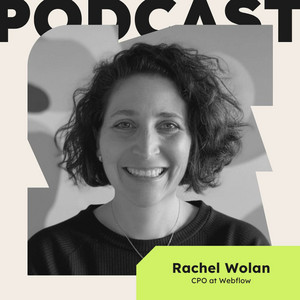
My guest today is Rachel Lohlin, Chief Product Officer at Webflow, a company that's navigated all of these challenges while building AI native tools in an increasingly crowded market.
Rachel brings over 20 years of product experience, including leading the main business at Dropbox and now steering Webflow's evolution into an AI native digital experience platform.
You're about to hear the critical questions to ask before entering a market why the real opportunity often exists at the top of the market rather than the bottom, and how to identify what competitors truly can't replicate.
Let's jump in.
Welcome back to the Product Manager Podcast.
I'm here today with Rachel Wallen.
She is a CPO of Webflow.
Rachel, how are you doing today?
I'm doing great.
Great to be here.
Start us off by telling us a little bit about your background and how you got to where you are today at Webflow.
Yeah, so I started as a software engineer many years ago, debugging on I don't know if you can see this Dreamweaver when I was 16 years old.
And it turns out Webflow is almost like a modern day Dreamweaver.
So I kind of grew up through product management, through a lot of different startups.
And then prior to Webflow, I spent three and a half years at Dropbox as the GM of the main business.
My through line is really working in a few different ways.
One is really working on applied AI types of problems.
I started working on that back in the day at TalkDesk when AI was really just ML products.
And it's been really fun to enter into this next generation with Gen AI products.
And so now as a chief product officer at Webflow, I get to think about this all day long.
It's really exciting time and excited to be here.
Yeah, we're going to get into some of the ins and outs of differentiation.
Now that we've got all these amazing generative AI tools that are powering like so much, making things possible that were never possible before.
A lot has changed about like how we fundamentally think about building software.
So, for product leaders like yourself evaluating this space, what do you see are some of the critical questions that we should be asking before deciding to enter the market?
I think that a lot of the questions are the same and a lot of the questions are different.
The questions that are the same is, does this product need to exist?
Is there a real gap that exists with what users can confidently do today and where you have a competitive advantage?
I think that is always the main question you should be asking yourself.
Like, is this a real pain that you are solving?
Is this a real problem?
Is this a vitamin that you're bringing into the world or is it a painkiller?
And then I think one of the questions I always ask is how will people discover this product?
This is really a distribution question at the end of the day.
And so I think those are what is your distribution advantage?
I think those are always questions you should ask.
But then I think the other questions that are maybe different in this age are are there new distribution mechanisms that are more AI, native distribution mechanisms?
Will this product still matter when the next model comes out?
Will it get better when the next model comes out?
Are you building on shifting sand?
And then I think the biggest question that is always the question that you should be asking, which is even harder to answer today sometimes is what do you have that competitors can't easily replicate?
And again, I think that gets to that differentiation.
And so it's something that we think about a lot, especially as we've been building and shipping a lot of different AI-native products.
Yeah, absolutely.
Yeah, I think that last one is an especially interesting question, now that we're kind of seeing this more of a democratization of tools and capacity to develop different products.
Let's talk a little bit about entering a space where there are already some established players, which is something you've dealt with in the past.
So how do you approach differentiation when you're kind of coming into sort of like a red ocean?
What kind of frameworks would you use to identify, you know, how can you win versus not?
I like how you put it, the vitamin versus a painkiller.
Yeah, I mean, I think that in most markets, there's oftentimes both a red ocean and a blue ocean.
And I think that is what is often not well understood.
The red ocean oftentimes happens at the bottom of the market, where it is a little bit easier to enter.
And then the blue ocean oftentimes is at the top of the market where it's harder to enter, but it ends up being a lot stickier.
And so that's maybe one way that I think about it is, the end users are often exactly kind of like trying to solve the same problem.
And where are those end users?
Are they working at an SMB or working independently as a freelancer in our case?
Or are they working for a larger company, working on a team, trying to accomplish something?
I think that that's fundamentally a question to think about is like segmentation.
I think the second thing that I often think about when I'm trying to enter into a new market that is fundamentally crowded is Where is my product strong today and what do people buy it for?
And will this lean into that differentiation?
So in our case, we have a new AI CodeGen product that's coming out very soon.
And CodeGen is a product area that has become very, very popular to generate a prototype.
And when we worked backwards, we said, hey, the real problem isn't just generating a prototype.
That's almost what a model can do on its own without any kind of agent or framework around it.
But the biggest challenge is going from 80, 90% that a model accomplishes today to 100%.
How do you get to production?
How do you ensure that you have security and the guardrails in place?
How do you ensure that you are discoverable?
So in our case, we're generating apps.
So discoverable via SEO, search engine optimization, or answer engine optimization, AEO.
And so a lot of this is really thinking about like, how does an app look on brand, right?
Are you using your brand design system?
And when that changes, does that automatically get updated, right?
So really kind of thinking about what are, kind of like, the core pieces of differentiation that make your platform unique.
And then does that AI native product leverage those core competencies?
I want to talk a little bit about some of the tools that we're seeing right now AI coding tools or low-code, no-code tools that are coming out.
They kind of take you from that zero to 80 piece.
But we're seeing this significant gap in the market between what you can achieve with the tools as they are today versus actually achieving production-ready results.
So what market signal told you that this was an opportunity worth solving for right now, and how did that shape the strategy for this product?
I think, first and foremost, we saw a bunch of different types of people who had never actually coded before starting to code.
And if we kind of look at Webflow's mission, maybe I'll back up a second and talk a little bit about what Webflow is.
Webflow is a AI-native digital experience platform.
So we help you bring all kinds of digital experiences to life using our brand operating system.
So that's really your CMS, your content management system, your design system, as well as basically, you're building a website, you are managing the content around that website and then you're optimizing the content around that website.
So when we started thinking about this, we were like hey, we noticed that a lot of people like product managers are starting to build prototypes.
What if we also made it possible for growth marketers to build out apps.
We made it possible for a content marketer also somebody who is maybe even less technically sophisticated to build out apps that are totally on brand.
And so that was kind of where the seed came from, that you know a lot of people who were really successful with a lot of the coding agents even the least sophisticated ones you know, like a lovable or a bolt were oftentimes maybe a little bit more technical.
Maybe they had a user experience background or product background, or they'd been a software engineer at some point.
A lot of people who use coding agents are software engineers.
And so we're like, hey, what can we do to make this even simpler?
So a lot of the parts that were hard were really deploying the app making sure it was deployed in a way that was safe and secure.
Making sure it fit your brand right out of the box.
Like those are the things that I think people found really hard.
And that was really where we started from was trying to understand where is that gap today?
We started to see.
The other thing was that, like we have a lot of different types of personas in our market,
So we have agencies and freelancers that are building on behalf of their clients.
A lot of times they want to kind of show a concept.
And so this was a way for them to start to like test out proofs of concept.
And then one of the other things is that a website or a brand really they may have like a side project where they want to go and build a secret Santa app or some kind of Halloween, a seasonal app, right.
Something that they would typically want to run a contest around and almost run as like an experiment in marketing.
And they don't necessarily want to hire an agency for that.
They want to use their agency dollars on something that is going to be really durable, and you know landing pages that they have their customers hit every single day.
A lot of it was kind of understanding where there is latent demand.
I don't think that everything is zero sum in demand.
I think a lot of times there is latent demand that expands a market doesn't necessarily mean that you're taking away from another part of the market.
Okay.
So I'm curious how you balance tension between speed to market and being able to kind of deliver on all of these promises and kind of lofty goals of you know.
Making all of these things possible, making it on brand out of the box, giving people all these capabilities.
What have you had to do in terms of trade offs?
And what has been the biggest challenge from a strategy perspective?
Yeah, I mean, I think that the biggest challenge has been can we get a product that is available for all of our customers all at once?
I think that's oftentimes where you'll release it for a smaller section of customers and then expand it.
In this case, we actually took a little bit more time and decided we wanted this product to be available for everyone.
It's going to be in beta that there's a little bit more of trial and error, especially with an AI product.
You want to actually see what is the eval, right?
What is the prompt that somebody is writing?
And then are they happy with the response or what gets generated based on that prompt?
And so I think that we are trying to ship this a little bit looser than other products, because we wanna see what people are trying to build and then continue adapting our product to what they're trying to build, rather than trying to anticipate every single prompt.
So that's maybe one place.
We also know that there are.
We really prioritize integration and interoperability into our platform rather than our entire ecosystem.
So we will be integrating a lot of different ecosystem partners.
But right out of the gate we decided hey, that's probably something that can come a little bit later.
And, you know, there are other things where we decided not to compromise.
So we decided that it had to be very easy to deploy.
It had to be something that was secure.
Right.
So I think a lot of it is what must be true in order to meet what that bar is.
So in our case, the bar was it needs to be prompt to production.
We wanted that value prop to be true right out of the gate.
Now, what production means, I think we'll continue to expand and expand over time.
But we will hit that bar for a certain number of our customers right out of the gate.
You briefly touched on something I want to go into right away, which is making it easy to use out of the box.
And something I find really, really interesting in this space is this kind of idea that users sort of need to adopt new behaviors and mental models as new products come out, as new products evolve.
Timing is kind of the essence, where you kind of need to assume that your users are going to have some kind of foundational knowledge in order to be able to adopt your product effectively out of the gate.
So how do you think about building products for users who don't have that technical foundation, since they are obviously a part of the segment that you're going after?
Yeah, I think that there's a couple of different ways we think about it.
One, we actually want to have this product to be usable and useful for both segments, right?
For less sophisticated customers as well as more technical customers.
The way that I think about building for a less technical customer is by making it very easy to integrate, for example, components.
So components are something that oftentimes get created by a designer or a developer and not used by a marketer.
But we have made them natively accessible.
You basically, and I can even show a quick demo.
You press a button and it is instantly shared as context inside of your prompt.
And so that was, again, one of the design decisions that we made.
We were like hey, this is going to be really important that you can include your navigation and footer, for example, in an app that you're building.
But we didn't want it to have to be something where somebody had to really think about it.
And we made a lot of kind of like small decisions like that where we wanted to produce something that felt like your brand right out of the gate.
Okay, let's talk a little bit about strategic positioning.
So, when you're developing an AI product and a more crowded category, let's say, how do you decide on what to build versus where to just lean on integration partners?
And how do you identify your platform's unique strengths and lean into them?
Yeah, so in our case, our platform's unique strengths were quite clear around the CMS.
That is what our customers buy us for.
I think the biggest challenge that we had was traditionally, people have not seen us as what I would describe as like a headless or composable CMS.
But we actually introduced an API this year that our customers have started to use so that they can use.
The CMS is basically a database for content.
And so now they can use that content in other apps.
So we knew that we had released that, but it wasn't something that we had really thought about how we would use it.
Integrating
So we actually ended up going and really thinking about where do we need to change our API to be integrated more easily with an LLM?
Part of that, I think we also benefited from releasing an MCP server earlier in the year.
So we saw a lot of different ways that people wanted to use our CMS API through an LLM.
That gave us ideas for what people might want to do inside of an AppGen.
Or we also have a AI assistant that we're building.
So I think a lot of this is like looking at ways that people can prototype with AI and seeing what people are trying to do and then figuring out well, where should we productize?
And then the second part of your question is, where should you partner?
So we already had some amazing partners that we had integrated for our Webflow Cloud.
So we released Webflow Cloud earlier this year, and we had already integrated storage.
We had already integrated database natively.
And so that was like kind of an obvious place for us to go and lean into partners.
I think there are going to be a bunch of different places around logging and observability and places where it's not necessarily part of our AI DXP vision, but it is part of us serving developers and serving them well.
And so we want to make sure that again, this is an enterprise-grade product that integrates interoperably and natively with all of the other products that we deliver to our customers.
Very well said.
So let's talk a little bit about distribution strategies, kind of to your point earlier about, that's kind of a big challenge.
You need to be able to get your product in front of people and make sure that they can find it.
And this has really changed as we've kind of seen AEO kind of enter the public vernacular.
We've kind of seen this change in the ways that people discover products in general.
So how should product leaders be thinking about discoverability and distribution right now, when building AI products, versus even a year ago?
Yeah, I think this is an awesome question.
Part of it is maybe even like going back in history and thinking about the history of distribution of products.
So if we think about, let's start with the internet.
The first way that the internet got distributed was through search engines.
So that was like the main distribution mechanism.
And then people started to learn.
You know, initially started with like keyword stuffing and then better content started to get ranked.
And there's really like an art and science to search engine optimization.
And obviously, it's very heavily linked to search engine marketing.
But there are many, many agencies and many, many billions of dollars spent on this industry, trying to get ranked in search engines.
Then you graduate onto mobile, let's say 10 years later.
And mobile has its own mobile engine optimization, right?
Both iOS store and Android store have their own.
Basically, search engine optimization to discover your app.
So this has kind of been like an ongoing, like you have to learn your distribution mechanism for the area that you're in.
The next generation, obviously, was social.
So people talked a lot about going viral.
Well, how did you go viral?
You went viral on social apps.
And so you actually built in distribution mechanisms into your app.
So we thought about this a lot, at Dropbox, of course, where you're sharing a link to get more storage.
And then basically, I share something with you, I get more storage when you sign up.
And that was our viral link and our viral loop.
And then we measured the viral coefficient.
I think that we're entering into this next generation where there are brand new distribution channels.
You mentioned answer engine optimization.
What is answer engine optimization?
Well first, an answer engine is you know, you go into ChatGPT, you ask a question about what is the best enterprise grade CMS or content management system, and you know Webflow.
Of course, we want Webflow to show up in that result.
And so you have to think about, well, what is feeding that result?
The things that feed that result are, of course, your own content.
So you, of course, want your own content to have authority.
You also like different answer engines are going to use different sources of truth.
So I think it's been widely reported that Reddit is a source of truth for a lot of answer engines.
YouTube is a source of truth for a lot of answer engines.
And so kind of working backwards.
As a product leader you should be thinking about.
This is the overarching message that we want to get my brand ranked for right.
And we want to be answering questions.
And then you also need to think about what are the 50 questions that somebody might ask as they're evaluating your product.
And I think that's very much you know.
Traditionally, you would think about product marketing, kind of translating your PRD into a much more rolled up version of a blog post.
And that might end up being, you know, kind of how you thought about announcing a new product.
But now you have this very, very long tail of content that is getting discovered about your product.
And oftentimes I think that's really going to be the product manager's responsibility to be able to say well, I think these are the 20 questions we need to answer.
And it's very, very different.
It's just kind of a different game now, trying to get your product to stand.
You know, kind of stick out through the noise.
But a lot of it is like, how well do you understand your customer?
How well do you understand the questions they're going to ask as they're evaluating that category?
And then how well do you answer them?
That answer was so packed full of value.
I feel like there's so many people right now, so many companies, who are really trying to understand and like kind of drill down, like at the crux of it, like how do we kind of wrap our head around, especially retrofitting for an AEO, because it's such a?
It's a similar but still very different way of thinking about optimizing for search and for discoverability.
So I appreciate that.
So, looking at the broader landscape, right now we're seeing AI tools democratize software creation in ways that can really fundamentally change how organizations, especially in a B2B context, can approach this sort of to build versus buy decision.
So how do you see this impacting product strategy over the next few years?
Yeah, I love this question.
I think that the first question, as a builder, you should be asking is this going to make my beer taste better?
Right.
Like.
I think that's always the question of like.
Should I deploy internal resources to solve this problem?
And is that really worth it?
Sometimes it might be.
It may be that it 10x is a process improvement and there just isn't anything else on the market that can solve that need.
I do think that there's going to be a lot of people who try to build internal software.
I still think there is like an art form to building great software.
Even if it is 100x easier to generate it, that doesn't necessarily mean that people have thought through permissions.
They haven't necessarily thought through how different systems integrate with each other.
And I think there's going to be a velocity of changes that happen with enterprise software like we've never seen before as a result of gendered software.
So that means that APIs are going to change faster.
That means that integrations will break more and you will have to maintain that.
That does not make your beer taste better, typically.
And so I think that's one of the things I think about a lot.
Like.
I'll give an example of something where yes, we absolutely could have built this ourselves, but we chose to buy a vendor for this.
And so I think one of the things that we chose to buy a vendor for is feedback consolidation, in particular, from our user research team.
Yes, we could have cobbled together using recording software and having an app and running it through an LLM.
Yes, we absolutely could have built that.
But do I think that is something that is going to be core to our business?
No, I don't think that's a quarter of our business.
And am I willing to pay some amount of our budget in order to make my team more effective?
Yes, absolutely.
So I think that that's one of the core questions.
And then, of course, it comes down to you know, if you have maybe I think a big part of it is is this something you're going to go and try to resell?
There are companies that build for themselves first, and then they go and try to resell that product.
And I think that is a totally valid strategy.
And we do that ourselves.
We are the number one user of Webflow.
And so we try to feel that pain.
And as well as when something is working, we know it's working because we're using it ourselves.
And so I think that's really the big question is Is this really part of your core workflow that you're trying to invest in and help your customers with?
So to kind of put a bow on this, having kind of gotten to this point, you know, in this place, in the timeline with the evolution of AI technology, what would you say is your kind of main advice for folks who are kind of looking to enter the market and get like an AI strategy together?
How do you advise thinking about timing and positioning at this time?
I think first the question I would ask is what segment are you operating in?
And then what kind of vertical are you operating in?
And there's almost like a 4x4 and 8x8, which is there's like, let's say, 10 functions inside of a company.
And then there's any number of jobs to be done.
And I would kind of look at it and be like, okay, it's almost like a cube.
Is this way up market, but you see that use case happening down market for the exact same end user and the exact same job to be done.
That is a really good signal that right now is probably a good time to invest.
If you're going after an existing segment, an existing user, existing job to be done, what are you going to do differently?
And how are you going to If it's a market that's taken off?
How are you going to do something that is going to get people to buy that from you rather than this competitor, even if it's closer to your platform?
So I think a big part of that is understanding what your strategy is in general and then accepting the timing.
You can't change the timing.
And I think that what I would say is...
Time is of the essence.
So if you see an opportunity, somebody else sees that opportunity.
And you need to be the first to that opportunity or it'll probably go away.
And so I think that, whereas maybe it was just a bit slower to execute in the past, execution actually has become a lot faster now.
But the harder part is getting people to understand that you've maybe shifted into this new market, or the harder part is trying to get people to try something new.
What's interesting is that we're at a moment in time where more companies are trying more tools than I think in the entire time I've been working in the last 20 plus years.
And so it's an amazing time to be building AI products.
For that reason, for people who you know, who are knowledge workers,
So I think maybe that's what I would say is it's an amazing time to be doing that.
And you just have to pick your points that you're going to go after.
I love that.
Thank you for sharing all the wisdom.
It's like so great and very humbling to be hearing from someone who's like really really right up to the space and kind of able to look at it and comment on all of these different points, the distribution angle as well as the actual tools themselves.
Rachel, where can listeners follow your work or learn more about what you guys are building at Webflow?
The best place to see what we're building is at webflow.com slash AI, where you can try the tools for yourself.
And you can follow me on both LinkedIn and Twitter.
So it's been great to get to spend some time with you today.
Yeah, likewise.
Thanks so much for joining us.
Thank you so much.
Next on the Product Manager Podcast, we have good news and bad news.
The good news is your organization is growing.
The bad news is that your organization is growing.
And while scaling an organization can be both a blessing and a curse from a leadership standpoint, our next episode is all about taking an operations lens to the space between product market fit and scaled product delivery.
This episode will be especially resonant for leaders of AI-supported platforms.
So if that sounds like you, make sure to hit that subscribe button so you don't miss it.