Bazinga, punk.
Now we're even.
Who is it?
Stripper Grimm.
Tag.
You're it.
Shouldn't you put him in a brown paper bag and set him on fire?
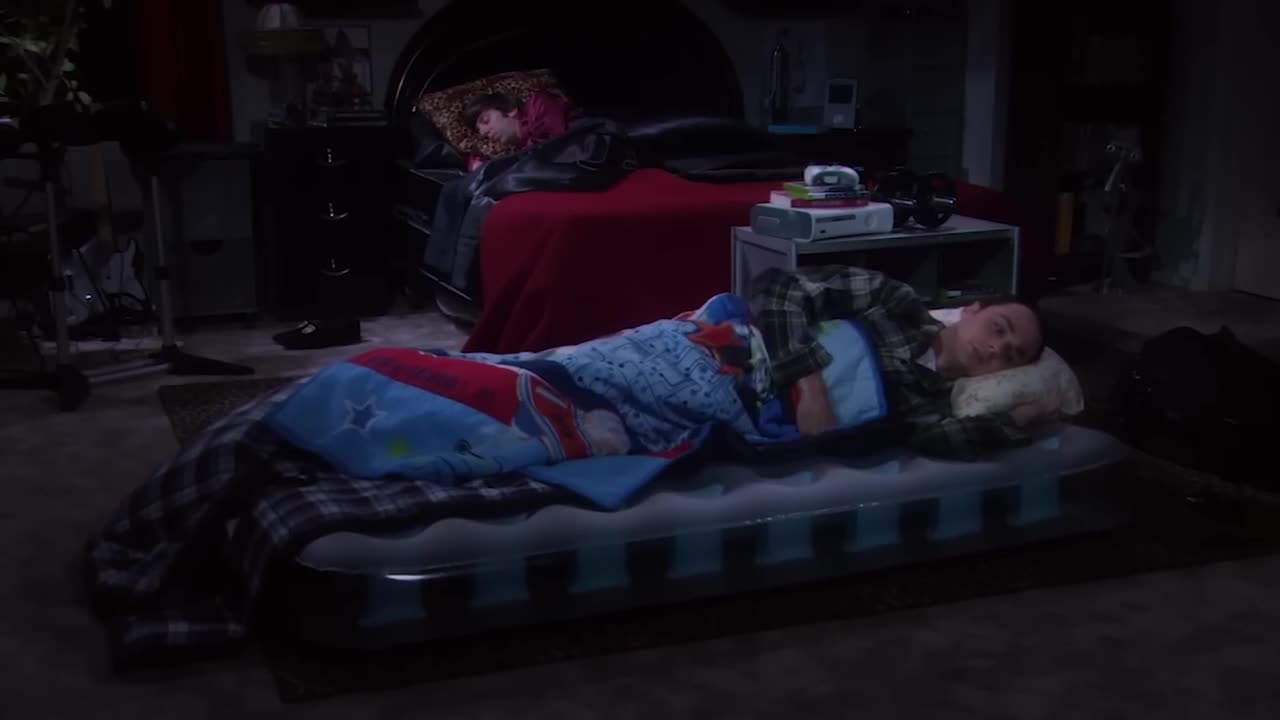
I've never slept on an air mattress before.
No lumbar support whatsoever.
Maybe you'd be happier on a park bench.
I don't see any way to get a park bench in here.
Do you want to switch?
No, that's fine.
I'm perfectly comfortable sleeping on a bouncy castle.
Get out of bed.
We're switching.
But now, only if you want to.
Just get in the bed.
What's going on?
Just talking, Ma.
If you don't settle down right now, I'm not gonna let you have any more sleepovers!
God's sake, Ma, I'm 27 years old!
It's not even a school night!
Comfy now?
Eh.
The poster of Halle Berry's a little unnerving.
So don't look at it.
She's like my fourth favorite Catwoman.
No kidding.
Yeah, Julie Newmar, Michelle Pfeiffer, Eartha Kitt, and then her.
What about Leigh Merriweather?
Oh, I forgot about Leigh Merriweather.
Well, I'm glad that's settled.
That makes Halle Berry my fifth favorite Catwoman.
There's Julie Newmar, Michelle Pfeiffer, Eartha Kitt, Lee Merriweather.
Please, I'm begging you, go to sleep.
I'm trying.
I'm counting cat women.
She did make a fine mutant in the X-Men movies, though.
Oh, for God's sake.
She's not my favorite of the X-Men.
In order, that would be Wolverine, Cyclops.
Oh wait, I forgot Professor X.
Professor X Wolverine Cyclops Iceman, then Storm Angel The Beat.
Oh, wait, Nightcrawler.
Professor X Nightcrawler, Wolverine, Cyclops, Iceman, then Storm... I'm coming.
Hey!
There he is.
There my old buddy-butt-butt.
Sheldon, we're working here.
That's all right.
I can barely hear you over my theremin.
Well, that was a little uncalled for.
No, that was completely called for.
We need quiet.
So your project is more important than mine?
Well, seeing as your project is to sabotage my project, yes.
Don't beat around the bush, Leonard.
If you don't want me here, just say the word and I'll leave.
Could have beaten around the bush a little.
When did we get a wall safe?
When there was no more room in the floor safe.
When did we get a floor safe?
When we got the security camera.
There's a security camera?
Aquaman, protecting your home since 2012.
Oh my God, we've done things on that couch.
Yeah, you don't have to tell me.
Explain the couch.
Well, there were some people on the first floor moving out, and they sold it to me for $100.
Howard and Raj helped me bring it up.
But what's wrong with the furniture we have?
They're lawn chairs.
And there was no place for company.
Did it occur to you that was by design?
According to the roommate agreement, I'm entitled to allocate 50 of the cubic footage of the common areas.
But you didn't notify me by email, so this is still a breach.
I did notify you.
Oh, you did, did you?
Drat.
Hoisted by my own spam filter.
What am I doing in your spam folder?
I put you there after you forwarded me a picture of a cat playing the piano entitled, This is Funny.
Don't let this be Sheldon playing bongos.
Please don't let this be Sheldon playing bongos.
Leonard, do you like my bongos?
Bet you didn't know that I had bongos.
Sheldon, it's three o'clock in the morning.
Three in the morning is a good time for bongos.
I was sleeping.
Leonard sleeps while I play bongos.
No, he doesn't.
Leonard, no sleep while I play bongos.
Bongo solo.
Stop, stop it!
Stop, stop it!
Stop it!
Okay, Sheldon, I am out of options.
Video store owner Nurses Manukian has no next of kin.
Well, you seem hot under the collar.
Or is that the sweater?
Oh, no, no, no.
It's because I spent all afternoon at the Armenian church where his funeral mass was held.
According to Father Solakian, no one attended.
Luckily, my trip wasn't a complete waste.
I lit a candle and prayed for your death, but I'm not Armenian, so it probably won't work.
This is over, right?
Not necessarily.
I suggest you look for long-lost relatives, either in Armenia or Lebanon.
Listen to me, Sheldon.
I am not going to Lebanon to return Super Mario Bros. the movie!
It might be fun.
You love hummus.
Why isn't this bothering you?
Isn't your brain getting itchy?
This is on your card.
This could be ruining your credit score.
Why isn't this making you crazy?
Leonard, I have something to tell you, but I want you to promise not to flip out.
To what?
Seven years ago, I found out the DVD was late and I paid for it.
What?
I was going to mention it at the time, but then I thought someday this might be a teachable moment about getting a dining room table.
Yeah, you actually do a room for one up there.
Oh sure, i sit on the floor for years.
No one cares.
The pretty white girl's there 10 seconds and suddenly we're all running to ikea.
No one is running anywhere.
We're not getting a dining room table.
I know you don't like change, but it's not a terrible idea.
Yeah, you guys never use that space up there.
Why not get a table?
Do you want the long answer or the short answer?
Hey, how can we never get that option?
Chaos theory suggests that even in a deterministic system, if the equations describing its behavior are nonlinear, a tiny change in the initial conditions can lead to a cataclysmic and unpredictable result.
Translation?
Well, I don't want a table.
Hey, Penny and I are going to go shop for a dining room table.
You want to come with us?
Yeah, I'd love to, but, um...
Too busy falling back in love with Windows 98.
Seriously, you haven't used this desk in years.
The second I want to get rid of it, you're up here working.
Yeah, I can't talk right now.
I have several thousand updates to install.
Are you really going to sit here all day?
Think of me as Arthur Dent in Hitchhiker's Guide to the Galaxy, lying in front of the bulldozers to protect his home.
If you'll recall, the Vogon fleet blew up the Earth anyway.
It's a made-up story, Leonard.
I don't even know why you're talking about it.
I'm putting all this stuff in storage.
We don't need any of it.
How can you say that?
You show me one thing in here.
We can live without your inbox.
Oh, this one looks nice.
No, sheldon doesn't like reclaimed wood.
Why not?
He's afraid the original owners will come back.
Yeah well, sheldon's not here.
Well, he is here.
So unless you want to dig him out with a bone saw and a melon baller, there's nothing i can do about it.
Sweetie, you're paying for this table and it's your apartment too.
I know, but... No buts.
You've got to stop letting him boss you around.
You're right.
He decides what TV shows we watch, what food we eat, who my favorite hobbit is.
I wanted Frodo, but we can't both have Frodo, so guess who's stuck with Samwise Gamgee?
See, right there.
You're a grown man.
You should be able to pick whichever hobbit you want.
Wish you wouldn't, but one problem at a time.
You make a lot of sense.
I like this table, and I'm getting it.
Really?
This one?
That one.
Damn right I like that one.
Hey, all set.
What do you think?
There's plenty of room for everybody, a view out the window.
My spot on the couch has a great view of a window.
Sometimes I can see space battles through it.
It's called a TV.
Give it a chance, Sheldon.
You might actually like it.
You're absolutely right.
Nope!
Oh, you can't say he didn't give it a fair shot.
Sheldon, Amy, will you please come join us?
Yeah, it's fun up here.
So why are you trying to ruin it?
No, thanks.
We're fine.
If you people want to eat at the table, then that's what you should do.
I like eating down here because this is how we've always done things.
And if those days are gone, they're gone.
It just makes me sad.
I feel bad.
Don't anthropomorphize him.
He's got big eyes, but his feelings are not like ours.
No, it just seems silly for us to sit in two groups.
It's not silly if you think of that group as being led by a big, evil baby. down there.
Should we go?
Yeah, let's go.
Penny, this was your idea.
You said that I should stand up to him.
Forget it, Leonard.
It's over.
Fine.
Rajesh?
Screw that.
I sat on the floor for seven years.
I'm staying right here.
Come on, Raj.
It's not the same without you.
Fine.
But no more making fun of how I say tings.
You mean tings like moustache?
Wasn't this nice?
Sometimes the baby wins.
Once we agree on the delivery system for the message, maybe we should talk about what the message could be.
Well, I think we should show what Earthlings look like.
The plaque they sent up on the Pioneer probe had a drawing of a naked man and woman on it.
Yeah, I never cared for that.
It's advertising to predator races just how soft and squishy we are.
Squeeze yourself.
Oh, don't be offended.
You know of the four of us, you have the most veal-like consistency.
Greetings from planet Earth.
Just turn left at Alpha Centauri.
You can't miss it.
Buona sera.
It means good evening in Italian.
May I say having to explain that to you calls into question the authenticity of your ristorante?
Okay, I'm out of here.
Un momento.
Oh, for heaven's sake, now you're being deliberately stupid.
Where are you going?
I'm having dinner with Priya at Raj's.
I think Howard's going to be there.
You want to join us?
Tonight's Thursday.
On Thursdays, everybody comes over here and has pizza.
Or a reasonable facsimile prepared by someone claiming to be Luigi but who sounds suspiciously like Jackie Chan.
Can we make a one-time exception for tonight?
We could.
We could also stop using the letter M. But I think that idea is isguided and oronic.
Just come with me to Rajah's.
I don't want to go to a party.
It's not a party.
It's the same group of people who hang out here hanging out over there.
I'm sorry, but five people eating and chatting is a party.
How come it's not a party when we do it here?
Because we don't throw parties.
I don't know what to tell you, Sheldon.
I'm going to see Priya.
Everyone's over there.
You coming or not?
No, sir.
And do you know why?
In a word, tradition.
Every Thursday night for the last eight years, you and I and our friends have gathered here in this very spot to break bread covered with cheese and sauce, discuss the issues of the day and yes, share a laugh or two.
But I guess our rich heritage means nothing to you.
I guess you're right.
See you later.
Wait, Leonard!
Wait!
What am I going to do for dinner?
Come with me to Raj's and eat there.
I can't do that.
What if he serves haggis and blood pudding?
I really doubt that's what he'll serve.
But what if he does?
I'll be obliged to dine on liver and lungs stuffed in a sheep's stomach.
And frankly, blood pudding is essentially the same thing.
I don't know why he's serving both.
What do you want to do?
Do you want to come with me or do you want to sit here alone?
No, I'll go to your haggis party.
I'm telling you, this is adness.
This is utter and complete adness.
What's with all the yelling?
Leonard disproved my element.
Now all the attention is going to go away.
Oh, that's great.
You must be thrilled.
That's it.
I'm down to seven friends.
He's counting hobbits and superheroes, right?
When I thought the element was real, I didn't want it.
But now that Leonard made it not exist, I want it more than anything in the world.
The element never existed.
I didn't take it away.
Science took it away.
Be mad at science.
Don't you dare use science against me.
Science is my best friend.
Oh, good.
I'm back up to eight.
Will you tell him he's out of his mind?
Actually, I get what he's saying.
Yes!
Nine!
Welcome back buddy, if you're dating someone you're not that into and then they break up with you and then you want them more than ever.
I have no idea what she's talking about, but we're ganging up on you, so i agree.
Okay sheldon, what do you want me to do?
Uh, hide the information if i don't publish it.
It's just a matter of time before someone else does.
But no no, of course you have to publish.
That's your responsibility as a scientist.
Doing otherwise would be unethical.
You have no choice.
Fine, i'll publish.
Can you believe this guy?
I think the end result will be a measurable enhancement to Penny's quality of life.
You know what?
You convinced me.
Maybe tonight we should sneak in and shampoo her carpet.
You don't think that crosses the line?
Yes.
For God's sake, Sheldon, do I have to hold up a sarcasm sign every time I open my mouth?
You have a sarcasm sign?
No, I do not have a sarcasm sign.
Who came into my apartment last night while I was sleeping?
Yes, but only to clean.
While I was sleeping?
And snoring.
And that's probably just a sinus infection.
But it could be sleep apnea.
You might want to see an otolaryngologist.
The throat doctor.
And what kind of doctor removes shoes from asses?
Depending on the depth, that's either a proctologist or a general surgeon.
Did you remember to ask for the chicken with broccoli to be diced, not shredded?
Yes.
Even though the menu description specified shredded?
Yes.
Brown rice, not white?
Yes.
Did you stop at the Korean grocery and get the good hot mustard?
Yes.
Did you pick up the low sodium soy sauce from the market?
Yes.
Thank you.
You're welcome.
What took you so long?
Just sit down and eat.
Fine.
All right, it's shredded.
What do you want me to do?
Leonard has no idea what I did to his coffee.
It wasn't replaced with Folgers crystals, I'll tell you that much.
Hey, can we please get back to work?
This is Leonard.
He's your best friend in the world.
Just stop.
This is ridiculous.
Sometimes he gets cranky.
But you can trust him with your life.
And he does more things for you than I can even begin to list.
Thank you.
Oh, no, he's drinking it.
The problem appears to be unsolvable.
Maybe we could run some computer simulations.
There are too many variables.
It would take forever.
We've got to be missing something.
Let's start again.
The movie is playing here at 7.20, here at 7.00.
Here at 810 and here at 845.
All right, these theaters have to be eliminated.
Why?
They're state-of-the-art.
Digital projection, 20-channel surround sound.
Yes, but they have no IC machines.
Despite my aggressive letter-writing campaign, I might add.
What about the multiplex here?
The seats are terrific.
They have Twizzlers instead of Red Vines.
No amount of lumbar support can compensate for that.
Well, it's going to take at least an hour to eat, and I don't see a Sheldon-approved restaurant proximate to a Sheldon-approved theater.
We could eat after the movie.
Done.
Acceptable.
The delay would result in tomorrow morning's bowel movement occurring at work.
Hang on, hang on.
There's a 7-Eleven here.
We smuggle Slurpees which are essentially ICs in under our coats after having a pleasant meal either here, here or here.
Wow.
I don't see how we missed that.
Excuse me, in what universe are Slurpees Icys?
That's how we missed it.
Sheldon, would you be prepared, on a non-precedential basis, to create an emergency ad hoc Slurpee Icy equivalency.
Oh, Leonard, you know I can't do that.
Okay, I guess we only have one option.
Yep, I don't see any way around it.
Bye, Sheldon.
See ya.
Later, dude.
They're right, it was the only option.
Impress her by tracking her down on the internet and then showing up unannounced at her door.
Making the extra effort.
Good for you.
Great timing, food just got here.
Oh, Siam Palace?
Yes.
A meat, crab, and chicken satay?
Yes.
Extra peanut sauce?
No, but you can have mine.
Oh, well, very well.
Oh, and on the topic of sharing things that are yours, there is a gentleman caller bringing flowers to your fiance as we speak.
What?
Why didn't you say that first?
Why didn't you get extra peanut sauce working on yep?
Remember when i said if you went through with your surgery there was a one in seven hundred thousand chance of dying?
Yeah well, i've been crunching the numbers and so far i've gotten your probability of death all the way to a sphincter tightening one in three hundred.
Great timing, my check sphincter like just went on Leonard.
What if you have an allergic reaction to the surgeon's latex gloves?
I'm not allergic to latex.
Then why don't you wear the rubber gloves I bought for you to do the dishes?
For the same reason I don't wear the apron or the hairnet.
Fine.
What about epilepsy?
I don't have epilepsy either.
You don't, but the surgeon might.
And your carotid artery is just one shaky scalpel away from becoming the dancing fountain at Disneyland.
Sheldon, do you realize that driving is riskier than surgery?
I do.
I have the drive to the hospital right here.
And that is if you make it to the car without falling down the stairs.
And don't expect me to carry you.
I do that enough in life.
Buddy, I get that you're worried about me, and I appreciate that, but I'm not going to die.
You don't know that.
Well, I do know that it won't be from an asteroid strike.
You know who else said that?
Every cocky T-Rex currently swimming around in the gas tank of your car.
If there was an asteroid strike, wouldn't you die too?
I don't know.
I'm smart and scrappy.
I think I'd find a way.
Tell you what, the surgery's not for a week.
I'll think about it.
Thank you.
And while you're thinking about it, if you have the surgery in Nicaragua during monsoon season, I can practically guarantee your death.
Zzzz.
You hit me!
I'm bleeding!
What was that?
Sheldon tried to take the ring and I punched him.
That's my girl.
So, Sheldon, how's it feel to get beaten up by a girl?
To play with the transporter toy.
But it's mint in box.
Yes, and to open it would destroy its value.
Consider this.
What is the purpose of a toy?
To be played with.
Therefore, to not play with it would be... Illogical.
Damn it, Spock, you're right.
I'll do it.
Sheldon, wait.
Wait.
You have to wake up first.
Of course.
Set phasers to dumb, right?
Goody, goody, goody.
This is wrong.
This is wrong.
I'm so excited, but this is wrong.
That's what I always thought 1975 smelled like.
One to beam down, Mr. Scott.
Aye aye, Mr. Spock.
Energize.
Energize.
Don't be broken.
Please don't be broken.
What did you make me do?
Okay, okay.
Think.
It's only logical.