
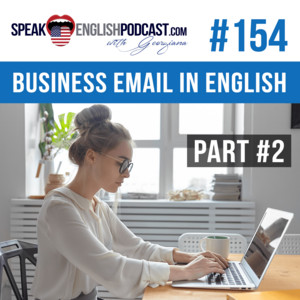
[Mastering Formal Business Email Closings and Grammar Through Storytelling]-[#154 How to write a business email in English part #2]
📋 Summary
Mastering Formal Business Email Closings and Grammar Through Storytelling
In this episode of the Speak English podcast, host Georgiana provides a comprehensive guide on how to professionally conclude business correspondence, followed by an interactive grammar exercise designed to improve language intuition.
The Art of Closing a Professional Email
Writing formal emails can be "challenging," and Georgiana emphasizes that after the core message is delivered, the closing remark is essential for maintaining professional etiquette. She suggests several key phrases to encourage further communication or express gratitude:
- For inquiries: "If you require any further information, please do not hesitate to contact me."
- For expectant replies: "I am looking forward to hearing from you soon" or "I appreciate your prompt reply."
- For general follow-up: "Please let me know if you have other questions or concerns" or "Thank you in advance for your reply or your help."
These phrases serve to bridge the gap between the sender and the recipient, ensuring that the tone remains polite and helpful.
Complimentary Closes and Sign-offs
Once the closing remark is set, the email must conclude with a "complimentary close" followed by the sender's name. Georgiana notes that expressions such as "Best regards," "Kind regards," "Sincerely," and "Best wishes" can be used interchangeably. She personally favors "best regards" as a standard professional sign-off. Additionally, situational closings like "Have a good weekend" or "Have a safe flight" are acceptable depending on the context of the relationship with the recipient.
A Practical Template for Business Communication
To illustrate these concepts, Georgiana provides a concrete example of a formal request. In this model, the sender addresses a customer regarding a SIM card request, informs them of the delivery status, and asks for billing confirmation. Crucially, she uses phrases like "I would like to inform you" and "I would really appreciate it if you could respond" to maintain a professional demeanor while acknowledging the urgency of the situation. The email concludes with the standard, "If you require any further information, please do not hesitate to contact me," followed by the sign-off, "Best regards."
Improving Grammar Through Point of View Stories
Beyond technical writing skills, the podcast focuses on grammar acquisition through "point of view stories." Georgiana tells a cautionary tale about a character named Kelly who, in her haste to apply for a job, mistakenly attached a "picture of herself lying on the beach instead of her CV." This embarrassing mistake serves as a reminder to "pay great attention" when sending emails.
By retelling the story from the singular (Kelly) to the plural (Kelly and Tom), Georgiana allows listeners to "intuitively notice the changes" in verb tenses and pronouns. This technique demonstrates how shifting the subject—from "Kelly was looking for a job" to "Kelly and Tom were looking for a job"—helps learners internalize grammatical structures without rote memorization. The lesson concludes with the practical advice of reading an email "100 times" before sending it to ensure accuracy, highlighting that even the most professional structure is useless without verifying the attachments.
Deep Learning with ListenLeap


