
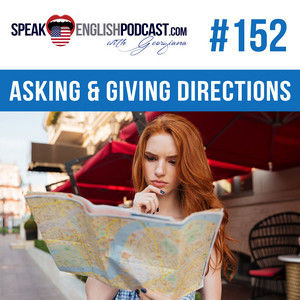
[Mastering Directions: Essential English Phrases and Conversational Practice]-[#152 Asking and giving Directions in English]
📋 Summary
Navigating Conversations: How to Ask and Give Directions in English
Learning to navigate a new city is a fundamental life skill, but as Georgiana highlights in this episode of the Speak English Now podcast, it is also an "excellent opportunity to practice English." While modern GPS technology makes getting lost less common, the ability to interact with locals remains a vital component of language fluency.
The Art of Asking for Directions
When you find yourself lost or in need of guidance, politeness is key. Georgiana emphasizes that you should always "say excuse me before you ask a person." To initiate a conversation, she suggests several versatile expressions:
- The Standard Approach: "Excuse me, how do I get to [location]?"
- Seeking Efficiency: "What is the quickest way to get to the movies?"
- Direct Inquiry: "Excuse me, where's the nearest post office, please?"
- Specific Search: "Excuse me, I'm looking for..."
- Emergency Check: If you are truly disoriented, the simplest question is, "Where exactly am I?"
These phrases serve as building blocks for natural, spontaneous communication, moving beyond the reliance on digital screens.
Giving Clear and Effective Directions
Once you are on the other side of the conversation—providing directions—the key is to be concise and use directional imperatives. Common phrases for guiding someone include:
- Basic Movement: "Turn left," "turn right," and "go straight ahead."
- Sequential Instructions: "Take the first, second or third street."
- Advanced Navigation: "Cross the street," "go up," "go down," "go out of," and "go through."
For instance, to direct someone to the city center, you might say: "Go straight ahead and take the second street on the right." Adding context, such as "cross the square," helps the listener visualize the route.
Mini-Story: Practical Application Through Interaction
To solidify these concepts, Georgiana introduces a "mini-story" designed to simulate a real-life conversation through a series of questions and answers. In the story, a woman named Martha asks a man for directions to her hotel. The man provides clear instructions: "Go straight ahead and take the third street on the right. Cross the square and turn right at the corner."
However, the story ends with a humorous twist: Martha followed the instructions so literally that she "arrived at the same place where she started" because she had "followed the man's instructions backward." This serves as a reminder that language learning is a process of trial and error. By answering questions like "Did Martha ask a fireman for directions?" or "Did she have to cross a park?", students practice their listening and comprehension skills in a low-pressure environment.
Conclusion
Ultimately, Georgiana’s lesson underscores that language is not just about vocabulary; it is about interaction. Whether you are asking for the quickest way to the mall or explaining how to reach a hotel, engaging in these small, real-world exchanges is the most effective way to improve your English fluency. By practicing these phrases—and learning from Martha's navigation mishap—learners can build the confidence needed to navigate both foreign streets and the English language with greater ease.
Deep Learning with ListenLeap


