Hey, History This Week listeners, your producer Ben here.
We talk a lot about time on this show.
History moves pretty fast. Maybe sometimes you feel like you don't have time to treat yourself.
Like go out and get a gourmet meal.
Well, that's where Factor comes in.
Factor arrives fresh and fully prepared, perfect for any active, busy lifestyle, and you can Calorie Smart, Protein Plus, or Keto.
I really liked their garlic butter chicken, which tasted like it came straight from my favorite restaurant.
Reach your goals this year with ingredients you can trust and convenience that can't be beat.
Eat smart with Factor.
Get started at factormeals .com slash Factor Podcast, and use code Factor Podcast to get 50 % off your first box plus free shipping.
That's code FACTORPODCAST at factormeals .com slash factor podcast to get 50 % off plus free shipping on your first box.
This podcast is brought to you in part by Stash.
Are you still putting off saving and investing because you'll get to it some day?
Stash turns some day into today.
Stash isn't just an investing app.
It's a Registered Investment Advisor that combines automated investing with dependable financial strategies to help you reach your goals faster.
They'll provide you with personalized advice on what to invest in based on your goals, or if you just want to sit back and watch your money go to work, you can opt into their award -winning Expert Managed Portfolio that picks stocks for you.
Stash has helped millions of Americans reach their financial goals and starts at just $3 per month.
Don't let your savings sit around, make it work harder for you.
Go to get .stache .com slash htw to see how you can receive $25 towards your first stock purchase and to view important disclosures.
That's get .stache .com slash htw, paid non -client endorsement.
Not representative of all clients and not a guarantee.
Investment advisory services offered by Sache Investments LLC and SEC registered investment advisor.
investing involves risk, and investments may lose value.
Offer a subject to T &Cs.
The History Channel Original Podcast History This Week, April 3, 1974 I'm Sallie Helm.
It's evening in Gwyn, Alabama, and the Alexander family has been holed up in their basement for hours.
Betty and Branford Alexander are sitting with their pregnant daughter and son -in -law in grandchildren.
Branford's elderly mom is in a rocking chair.
There's a storm raging outside, and they know there might be a tornado coming.
After a while, Branford goes upstairs to check on things, and then Betty hears him yell, everyone needs to take cover in the basement.
Just as he reaches the top of the basement steps, coming back to join them, the electricity goes out.
The family makes their way to a back closet with a flashlight, then they hear breaking glass and the roar of a storm.
Betty later recounts the story to a writer named Charles Jordan.
She says they could feel a terrible pressure in their ears and the kids were crying and there was the sound from outside of trees falling on the house.
It felt to Betty like they were in there three or four minutes, but she later learned it was just 16 or 17 seconds.
When it's over, she says, it seemed as if we had lost our hearing and everyone was confused.
But they're okay. No one in the family has been hurt.
One of her daughters goes out to sweep up the broken glass.
Many of the Alexanders are barefoot.
And then they walk upstairs.
It's a scene of devastation.
One family member puts it simply, the house is gone.
This is a scene playing out all across Alabama and across 12 other U .S. states.
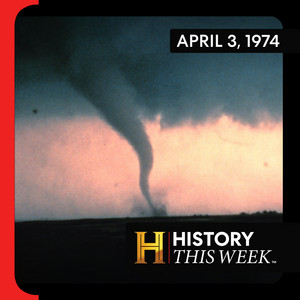
A group of some 33 thunderstorms hit today and have caused an unprecedented outbreak of nearly 150 tornadoes.
It is, at that point, the largest tornado outbreak in the nation's history.
It was the first outbreak that was so bad that we gave it a special name, super outbreak.
It set the benchmark for just how bad things could get.
Today, the tornado super outbreak of 1974.
Why did so many deadly tornadoes hit on this one day?
And how did it spur life -saving changes that are still with us decades later?
Hey, History This Week listeners, your producer Ben here.
We talk a lot about time on this show.
History moves pretty fast. Maybe sometimes you feel like you don't have time to treat yourself.
Like, go out and get a gourmet meal.
Well, that's where Factor comes in.
Factor arrives fresh and fully prepared.
Perfect for any active, busy lifestyle.
And you can pick meals that match up with your dietary preferences, like Calorie Smart, Protein Plus, or Keto.
I really like their garlic butter chicken, which tasted like it came straight from my favorite restaurant.
Reach your goals this year with ingredients you can trust, and convenience that can't be beat.
Eat smart with Factor.
Get started at Factormeals .com slash Factor podcast and use code Factor podcast to get 50 % off your first box plus free shipping.
That's code Factor podcast at Factormeals .com slash Factor podcast to get 50 % off plus free shipping on your first box.
Sometimes, historic events suck.
But what shouldn't suck is learning about history.
I do that through storytelling.
History that doesn't suck is a chart -topping history -telling podcast, created by me, Professor Greg Jackson.
I've been chronicling the epic story of America, episode by episode, decade by decade.
Original music and immersive sound design accompany us on our storytelling journey, and every episode is painstakingly researched and rooted in fact.
The promise is in the title.
History that doesn't suck.
Scientists who study the weather are kind of in the business of predicting the future.
When Greg Forbes was a kid, he thought this seemed magical.
What the weatherman said changed the way he and his family lived their lives.
If it was a sunny day, my mother would hang clothes outside on a clothesline to dry instead of using the dryer.
I figured that, well, I can go and make forecasts and people can use those to plan their daily lives." So when he grows up, he studies meteorology at Penn State and at the University of Chicago.
And eventually, he gets especially interested in severe weather.
It's nice to know about sunny days so that you can hang your laundry out, but knowing when a tornado is coming can save your life.
Forbes would go on to serve as severe weather expert for The Weather Channel for 20 years.
We also talked to another meteorologist for this story, Professor Jeff Trapp.
He teaches atmospheric science at the University of Illinois.
And he remembers his mom used to take severe weather predictions really seriously.
My late mother, I used to tell her that I blamed or thanked her for this because when I was a kid, whenever there were any kind of hints of severe storm events, we'd immediately be ushered down into the basement and told to stay into the basement until everything was over.
So I told her that I wanted to know what I was missing.
So he grew up to study storms, including tornadoes.
Now, he knows exactly what they are.
By definition, a tornado is a violently rotating column of air in contact with the ground.
A tornado comes along with a thunderstorm.
You've seen these. Thunder, lightning, and often wind.
If that wind gets going in just the wrong way, a thunderstorm can start spinning.
And if that happens, it can sometimes cause a tornado — that column of rotating air that extends down out of the clouds.
Professor Trapp told us, they don't always look like that spinning gray funnel you might imagine.
Sometimes the funnels are fairly transparent because they haven't picked up much debris.
Sometimes they're relatively narrow, especially during the latter stages of the tornado and sometimes they have a shape of wedges and stovepipes, meteorologists give all kinds of names to them.
Now, not all tornadoes are created equal.
Some of them don't cause much damage at all.
But, if the winds become really strong, then tornados can tear buildings apart.
They can also pick up objects right off the ground and carry them along in the air.
Greg Forbes told us, Worcester tornado in massachusetts in 1953 is reported to have dropped the mattress into the boston harbor.
Down along the florida panhandle there's been one report that i have scene.
I can't vouch for all of these, but they're in the reports of an alligator falling out of the sky.
Oh my gosh. Cars, farm animals, mobile homes can be swept up in a tornado and dropped a ways away.
Sometimes this causes strange fantastical occurrences, like alligators falling out of the sky.
But of course it can also be really dangerous.
Even deadly. Back in 1974, we could detect and predict these dangerous storms, but the technology for doing that wasn't great.
Meteorologists used relatively crude radar technology to basically get a picture of the growing storm.
Those days, all you could get were blobs of white color basically showing where the storm was and the shape of the precipitation pattern.
It often looked like a little fish hook or a little swirl.
Then there were a lot of those on April 3, 1974.
It isn't uncommon for tornadoes to occur in groups as an outbreak because a spinning thunderstorm can easily cause multiple tornadoes, and that's what's popping up on the radars in April of 1974.
Greg Forbes, at this time, was a graduate student studying tornadoes.
He was working under a meteorologist named Dr. Ted Fujita.
Fujita was known in the field as Mr. Tornado.
Because he had done so many studies.
He was intense. He was meticulous.
He was a workaholic.
He seemingly worked 24 hours a day.
But even if you had to work hard, being on Fujita's team was like being in the popular crowd of tornado scientists.
It was where you wanted to be.
They were working on things like how you measure the strength of a tornado.
They came up with something called the F -scale, which we still use today.
And Forbes loved the work.
But in April 1974, his future on Dr. Fujita's team was unclear.
There hadn't been a major tornado in years and Fujita's funding was dwindling.
So on April 3rd, Forbes was actually in an interview for another job—to study hurricanes.
And in the middle of that interview, in came Ed Pearl, one of our meteorologists.
and he said, sorry to interrupt, but you might want to see this come to the roof.
There's a rotating thunderstorm that's right over the building.
And so going opposite to what we tell all the public to do, we all ran to the roof instead of to the basement.
And indeed there was rotating thunderstorm there that were hailed in fell to the size of golf balls.
And Dr. Fajita had his wife collect some of that to have a cocktail on the rocks later in the evening.
At this point, it wasn't clear just how bad the storm was going to be.
But scientists are definitely expecting some kind of tornado activity on this day.
There's a dangerous storm system moving eastward across the central part of the United States.
So, after they run up to the roof, these meteorologists go back down to their office to follow the weather.
Watching the weather maps, watching the teletype, listening to the radio, watching television to see accounts of the tornadoes coming in, it was kind of like a sports player getting, you know, getting nervous tension before the big game.
This was a big game for the meteorologists.
Weather scientists all across the country are tracking these storms. Forbes had seen that potentially dangerous storm in Chicago.
And there were also really intense thunderstorms building in places like Georgia and Tennessee.
As the day goes on, storms develop in Indiana, Alabama and elsewhere.
The weather conditions are perfect for tornadoes because of the way temperature is working and the way the wind is blowing.
And indeed, scientists in these states begin to see those telltale hook shapes popping up on their radar.
They immediately try to get the word out to the public so that they can take cover.
The people working at the weather station will run to a teletype, which is basically a typewriter.
They were clickety -clacking out at about 80 characters per second, I guess.
One line at a time, clickety -clack.
Next line. Next line.
And so it took probably a minute to type out one of these warnings.
The problem was that with so many storms in the same area, the warnings got backlogged.
At the other end of the teletype were television and radio stations waiting keep the public informed.
It was kind of a manual procedure.
Somebody had to rip that sheet off the teletype and hand it to the disk jockey and he'd read the tornado warning.
The severe thunderstorm warning has been changed to a tornado warning.
— Yeah, but tornado reports are on the ground.
He's just been picking up numerous reports.
The tunnel is dipping up and down.
— But it's a slow process.
And so not everyone gets the word. Plus, many of the communication systems soon become overwhelmed because, over the course of about 18 hours, 147 tornadoes will hit in the United States and one just over the border in Canada.
Around dinner time that day, Dr. Fujita's team in Chicago gets a call from the head of the National Severe Storms Prediction Center, who tells him, you guys are going to need to do some damage surveillance tomorrow.
Because what appears to be a historic tornado outbreak is in progress.
People all across the country are bracing against the storm.
And many of them are about to get hit.
On April 3rd, meteorologists are watching this storm with their radar and getting the word out with their teletypes.
But for a lot of regular people on the ground, this starts out as a pretty ordinary afternoon.
In towns across northern Alabama, for example, a lot of people would have just felt hot.
It was humid with mid -summer temperatures even though just a few days earlier it had been freezing.
People are probably complaining about this as they hole up in conditioned rooms. And meanwhile, above them, cold air sat on top of the hot, moist air near the ground, which meant that conditions were ripe for a big thunderstorm.
As people head home from work, they can see those storms building in the sky.
And all day long, they've been hearing tornado warnings and alerts.
Some people take them seriously, but others probably think, we've heard all this before.
Betty Alexander and her family in Gwynn are definitely keeping tabs on the weather.
They've been on the edge of a big tornado in Gwynn back in 1956, so they know these things can be serious.
They cook dinner, and then hunker down in the basement...
until the tornado hits.
As the Alexanders shelter in that back closet, they're having an experience that families all across the country are having tonight.
You could hear the debris hitting the buildings, and then you could hear the tearing apart of the buildings.
It doesn't just immediately tear apart the whole building, it's sort of a cascade of failure.
Takes the roof off, and then the walls begin to collapse or get broken down.
The tornadoes on April 3 tore through homes, farms, businesses with winds stronger than an atomic blast. They snapped centuries -old trees like toothpicks.
They crushed one of the world's largest power plants, which was located in Alabama on the Tennessee River.
One news reporter saw the tornado from his car.
He jumped out and hid in a roadside ditch. He later described the storm, quote, "...it was like something out of the Old Testament, a pillar of clouds—black, majestic and ominous." Professor Trapp told us it would have been, for many people, like nothing that they'd ever seen before.
These tornadoes are rare, and so there are very few people who would have seen these at that point.
And I think that would have been quite frightening to anyone seeing this.
There are reports in Indiana of two by fours dropping from the sky.
Some towns get hit by more than one tornado.
These were the kind of tornadoes that just were going to turn ordinary buildings into rubble.
The foundations were swept clean, the house was just individual chunk -sized pieces of wood that were tossed sometimes a half mile or more downstream from where the building had been.
So it was a nightmare for the people that's for sure.
The Alexander family in Gwynn emerges from the basement to see that their house has been destroyed.
Thankfully, they're all okay.
But soon, a neighbor comes running over to them saying that a little boy has been blown into the Alexander's yard, and he needs help.
They carry him to the couch in the basement.
His face is covered in dirt and blood.
They clean him up as best they can, and he's okay.
but his mother and his aunt, they soon learn, have been killed.
All night, rescue squads are coming through Gwen, trying to help the wounded.
Sirens are sounding all across the U .S. By the time the sun rose on the morning of April 4th, 148 tornadoes have landed, spreading from Michigan and western Ontario down through states in the Midwest and Southeast — even as far as New York.
Estimates of the damage vary, but some place the number as high as four billion dollars.
Over three hundred people were killed, and some six thousand were injured.
It was a historic outbreak, the first to be called a super outbreak.
The next morning, people begin the hard work of putting their lives back together.
And meanwhile, meteorologists like Greg Forbes still have a job to do.
Dr. Fujita told the students and staff that everyone should come in early the next morning and we would have to charter some high -winged, small aircraft to fly around in to document it.
There's a lot they can learn from documenting the damage.
After a day of prep, Dr. Fujita splits everyone into teams. Forbes and the two other graduate students go up in a small plane with a pilot.
None of the students had done this kind of work before.
So it was baptism by fire if you will.
Here we've got what turns out to be the worst tornado outbreak in United States history at the time, and we have to sort of try to document it before they get out there with the bulldozers and start cleaning everything up.
The students tried to map a tornado's path by following its tracks.
Some of it was pretty easy to see.
It was over the fields of corn stubble and you could see the path marks and of course you could see the debris where it hit buildings.
They're flying at practically a 45 degree angle so that the photographer can get good photos.
It's a little harrowing.
In fact one of the students starts to feel sick so they have to make a quick emergency landing on a grass landing strip to settle his stomach. And once they're there, the pilot it says.
It's kind of soggy down here.
And boy, there's a barn and a power lines down at the end.
So he says, Well, boys, I'm not sure we're gonna be able to take off, we're pretty heavy with four people in this plane.
Are we gonna go for it?
Or are we going to call a tow truck?
Who? We all looked at each other.
And there wasn't a one of us we'd have sooner died at that point, then have to call Dr. Fujita and tell him that on this first stay out of our historic tornado damage survey that we weren't going to be able to do our mission.
They take off again, clear those power lines by about three feet.
It probably, in retrospect, was an even more harrowing flight than it seemed like at the time.
But it was an adventure.
And the damage surveys do yield some interesting data.
Dr. Fajita spotted some damage patterns on the ground that didn't look like they were tornado patterns.
It looked like the air was coming down and then fanning outward in kind of a starburst outward pattern." That wasn't a classic tornado damage pattern.
People thought of tornado wind as going up and in, not down and out.
And so it led him to begin to hypothesize that there were some of these narrow little what he called microbursts.
these are small downbursts of air that we now know often come along with thunderstorms. And Dr. Fajita thinks it might be that these microbursts helped trigger the start of more tornadoes during this super outbreak.
Not everyone agreed with that reading of the evidence.
Some people didn't think microbursts existed, but then not very long after the super outbreak, along came a crash at JFK Airport in New York in June 75 and the airline asked him to investigate that and he looked at the data and sure enough he was able to detect these little puffs of microburst downdrafts that were coming down the ground.
He believed these microbursts caused the crash, and later data helped prove it.
So that original data from the 1974 tornado outbreak helped lead to discoveries that had a big impact on pilot training—how to detect and avoid microbursts.
Since that crash in 1975, there's only been one recorded crash in the U .S. where microbursts played a role.
The superoutbreak also had a big impact on weather science.
It was a monumental event in terms of allowing us to get from where we were then to where we are now.
The super outbreak helped spur funding and research that ended up really advancing things like radar technology.
Today we can see tornadoes much more clearly.
They're not just those white blobs on the screen anymore.
Now we can see the whole rotating storm, with much more clarity, and in color, which helps us understand the severity of the storm.
And we can see tornadoes coming sooner, give people more notice.
The 1974 tornadoes also helped lead to improved communications, so that the word could get out faster.
People started using specific weather radios to get their severe weather information, which made a big difference in how much warning they had.
Today smartphones can obviously do that for us.
And all in all, we're in a much better position now when it comes to tornado warnings.
Of course, we still have had deadly tornadoes since, even with the latest technology.
But the advances we've made came about partly as a result of this huge 1974 storm.
And in general, Forbes reminds us, weather prediction technology today is pretty incredible.
Then you were lucky if you could predict the weather for today and tomorrow.
Now, we come to expect the almost perfect forecasts five or six or seven days in advance.
Which is part of what brought him to meteorology in the first place.
That amazing ability to predict the future, and save lives.
Thanks for listening to History This Week.
For more moments throughout history that are also worth watching, check your local TV listings to find out what's on the History Channel today.
This episode was produced by Julie McGruder.
History This Week is also produced by McCamey Lynn, Ben Dixteen and me, Sally Helm.
Our editor and sound designer is Dan Rosato, and our researcher is Emma Fredricks.
Our executive producers are Jesse Katz and Ted Butler.
Don't forget to subscribe, rate and review History This Week wherever you get your podcasts.
And we will see you next week.