This is Planet Money from NPR.
The first ships with the 145 % tariffed goods from China had just started pooling into US ports last week when just a few days later, the US announced that that mind bendingly high tariff was now gone, paused.
The US and China agreed to temporarily bring the tariff way, way, way back down from 145 % percent on most Chinese imports to 30 percent, though the tariff on things like cars and steel and aluminum is higher, about 50 percent.
And you know the deal came pretty quickly after talks in Geneva and it was maybe unexpected or maybe not at all unexpected because the 145 percent tariff on China and China's retaliatory tariff on the U .S. was already threatening a global recession.
And in all the tit -for -tat back -and -forth, some companies caught really unlucky, like those whose goods arrived at U .S. ports before the pause.
If a medium -sized company had a million dollars worth of goods imported, they had to pay an extra million and a half dollars on top of that just in the tariff.
And had their shifts arrived like a day later their bill would be punch -to -the -gut so much less.
And even though this unprecedented tariff only lasted a month, it already inflicted its scars on the economy.
Today on the show, what a month of 145 % tariffs looked like and felt like for three people in the global economy whose lives were all affected and still will be.
We'll start at the biggest port in the Western a 93 degree day.
This is uniform. Well when you run the port, yeah that's the uniform.
Gene Soroka runs the port of Los Angeles and 45 % of everything that comes into this port is from China.
So half, half of the business?
Half of the business.
When we met up, the big, scary, 145 % tariff was still in place.
Are you like stressed?
Are you doing okay?
How are you feeling?
I'm doing okay, but I am concerned.
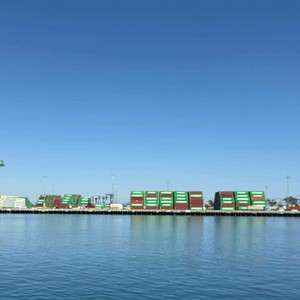
Gene and I are at one of these seven terminals at this port where the cargo ships pull in to get unloaded.
Like where those giant cranes lift the big steel shipping containers off the ship and like stack them on the dock.
That's where we're at at the Evergreen Marine Terminal.
Today there are nine cranes and their booms are all up.
There's not a ship at the Evergreen facility today.
Are you expecting one today at this terminal?
Not today. And no ships earlier today.
Oh, there hasn't been any today.
This is a huge void, so if there's anything that's emblematic of where we stand right now with international trade, it's the fact that there are no container ships at one of our most famous terminals, Evergreen Marine.
When there is a ship here, how long is it here?
On average, it takes about four days to get one of these large workhorse vessels unloaded and reloaded with exports before it heads back to Asia.
Four days? I thought it was going to be like hours.
So, not seeing a boat here actually is like a very stark image.
It's a huge deal. That's what I've mentioned.
Last year, this port had its second busiest year in its 117 -year history, but then last week was one of its slowest. The port was getting 20 % fewer ships, 32 % fewer shipping containers.
That is the biggest drop off save March of 2020 as the country went to lockdown during COVID.
Even more so than the Great Recession back in 2008 and 2009.
During the Great Recession, there were like 15 % fewer containers.
And the drop off now at LA has been double that.
The Port of LA normally gets 10 to 12 ships a day, but in the month of May, it's been getting eight ships a day.
And, fewer ships mean fewer containers, mean fewer jobs.
Every four containers that come into the port of Los Angeles create one job.
Four of those big 40 -foot long steel shipping containers, four of them equal one job at the port of L .A.
and one ship has about 8 ,000 of those containers.
So one fewer ship not carrying goods from China represents 2 ,000 fewer jobs.
Fewer dock workers, truck drivers, warehouse workers.
So Gene has been trying to get more cargo coming in, or out of this port, from anywhere to anywhere.
Like, the port workers just need cargo.
We've been out there hustling, finding where the cargo is.
So whether it's cargo that is now being sourced out of Vietnam, Indonesia, Malaysia, Thailand, my job is to get that cargo here because every four containers create one job, and that - Or at least keep, keep one job.
Conversely, let's maintain so we keep those jobs.
Now, the new temporary tariff on China is substantially lower.
And I did check back in with the poor, but Jean says he still has not seen a big rush on cargo.
A 30 % tariff is still a high, high tariff.
And he's not sure companies will want to bring in goods that cost 30 % more than they used to.
30 % tells me that the importers are going to go look for alternative ways to source their products.
Well, let's say demand does come back, like in full force, and there are signs that it is coming back.
Jean says it can still take a month and a half before this port starts to see some of its ship and container volume return, because it's just gonna take a while to line everything back up.
It'll take the shipping lines a couple of weeks to line the vessels back up at major ports from Qingdao to Shanghai.
It'll take another two weeks to steam across LA and then a couple weeks after that to get all that cargo into the US distribution network.
The 145 % tariff amounted to basically a trade embargo with China.
And even though that's now paused, global trade is just not something you can shut off and then turn back on, just like that.
Hello, and welcome to Planet Money.
I'm Sarah Gonzalez, and today we are bringing you a portrait of this historic moment for the US of an unfathomably high tariff.
the ones who got lucky, and the ones who got really unlucky.
And also, if the tariffs are meant to bring manufacturing back to the US, what is the right tariff?
Is there one? We consider this from the perspective of one small US company.
This message comes from ServiceNow.
People should do the creative work they actually want to do, not boring busy work.
Now with AI agents built into the ServiceNow platform, you can automate millions of repetitive tasks in every corner of your business, IT, HR and more, so your people can focus on the work that they want to do.
That's putting AI agents to work for people.
It's your turn. Get started at serviceNow .com slash AI dash agents.
This message comes from NPR sponsor Acura.
The all -new Acura A -D -X is a compact SUV built for versatility.
Available all -wheel drive for weekend escapes.
Google built in for seamless connectivity, as well as a Bang & Olufsen premium sound system for high quality audio.
The all new Acura ADX is crafted to match your energy.
Visit Acura .com slash ADX to learn more.
Google is a trademark of Google LLC.
Trying to run a small business during a trade war is about the roller coaster that you might expect.
You try to get ahead of it, to shield your company, but so much of it is out of your control.
Take Kara Dyer. She always knew she wanted to create a product, a new thing.
She wanted to design something and sell it to people.
Kara is a mechanical engineer by training.
Yeah, I started my career designing missile guidance systems and...
Missile guidance systems?
Missile guidance systems, yes, yes.
For the US military.
Kara also used to design cockpit displays for the military, but then she went to business school with the goal of creating and selling her very own product with her own patented technology and the product she designed.
Yeah. It actually is the exact opposite of missiles.
Her product comes in this little box with a handle.
And then, you know, it's like this little flap that you open.
And it's like a little book immediately.
Yeah. You see the little book.
And then there's all of these pieces.
It's like sturdy, foam puzzle pieces that kids can build into the fairy tale world that is depicted in the story.
Oh, they build the three little bears house, and it's got three bowls of porridge and three chairs and three little beds.
It's like a gingerbread house kind of vibe.
Yes. And this is like our patented technology.
So like, for the three little pigs, the straw house blows down easily.
Like it's not very stable, and you can knock it over.
and the stick house is sort of the same way but the brick house we've designed it so that like it really stands firm.
The goldilux playset and the three little pigs playset are hands down the two most popular items at storytime toys Cara's company.
Oh so you're sold out no no we're totally sold out of these right now.
Which is why back in December Cara wanted to put in an order for more of these sold out playsets with the factory that she uses in China that manufactures her products.
and regardless of whether you think we should or should not import goods from China or whether we should all do with less from China less pencils less dolls Every time Cara imports one toy from China it creates and supports more jobs in the u .s then in China even Normally Cara puts it in order for a hundred thousand dollars worth of playsets and these 3d puzzles she also makes but she didn't want to do that in December because she was Anticipating that there would be a tariff because President Trump had been saying things like tariff is the most beautiful word, and she was worried what the tariff
would be. Because, you know, you have to pay the tariff as a lump sum when the product arrives.
So she put in a smaller order than usual, just $30 ,000 worth of the Goldilocks playsets and the three little pigs.
Just one small container on a ship.
But it takes about a month and a half for the factory in China to make the products for her, and a lot of companies were doing the same thing that Cara was doing, putting in these early orders anticipating tariffs.
So our order took a little bit longer than I was hoping.
Like months longer.
And then on April 2, the tariffs were announced and quickly escalated to 145%.
And at that point, it was out of our control.
A 145 % tariff on $30 ,000 worth of goods.
The tariff that I'd have to pay would be $45 ,000.
Extra on top of the 30 ,000.
I like that you just do the math like that quickly in your head.
I know. I've been thinking about that $45 ,000 an awful lot.
Oh, right. Of course.
US Customs and Border Protection had issued some guidance on when goods needed to leave China to avoid that tariff.
Yeah. It was on one of their web pages that says, it was like an on the water exemption.
On the water exemption.
The cutoff was April 9th.
which happened to be the day that Cara's inventory left the factory in China, and likely arrived at the Ninghua Port in China too.
So, maybe getting in under that on the water exemption deadline.
Does on the water mean on a ship in the water or can it mean like on the dock at the port?
Yeah, so that's super unclear.
You don't know. Yeah, I don't know.
And even our customs shipping coordinator didn't know.
Oh, she's uh, she's got I got bad news for her if you're listening the ship had to depart by April 9th Ryan Peterson runs a global shipping logistics company So he knows so ship had to depart.
Um She's gonna have to pay it Oh Oh Oh, man That is so frustrating because because at that point we had no control over our shipment.
Like it had already, the wheels were in motion.
This exact thing was happening to businesses across the U .S. These are the unlucky people in the trade war.
And Cara says the cost here is not just the tariff on the imported toy itself.
When there's any tariff, it has a ripple effect.
The shipping boxes are gonna be more expensive and the labels and everything.
so there's so much more that that's adding to the cost too that I don't know what we're gonna do you seem really sad yeah it is sad it is sad I don't want to lose my business you know mm -hmm well let me ask you this could you make all of your toys in the US at a factory in the US no no we couldn't so I mean I've looked into it every year.
That would be amazing.
Dream. Dream scenario.
It would be totally a dream scenario.
The whole trade war started when Trump proposed a 54 percent tariff on China and 54 percent, not 145 percent was meant to be so big, so bad, so prohibitive that companies would stop importing from China and start manufacturing in the US.
But there aren't that many manufacturing facilities in the U .S. that Cara can turn to, she says there'd be like a six -month wait, maybe more, and she'd have to order these like huge quantities for them to even put her in their production line.
But more importantly, the U .S. doesn't really have enough of the material that Cara needs.
Our products are made from the same materials that yoga mats are made from, which is EVA foam, and China is really the only place where they make it.
There are a couple of factories in the U .S. that make the foam, but Cara says their capacity is completely taken up by the shoe industry.
The foam is apparently also used for the insoles of shoes.
So I couldn't buy foam from them, even if I wanted to.
She's tried. So we would have to import all the materials.
And if she imports the foam material from China, she'd still have to pay a tariff on the material, which is almost as much as paying a tariff on the whole finished product.
and the foam is kind of like what sets Cara's toys apart.
Using this foam is one of our competitive advantages.
Like, we have these pieces that interlock, and you can pull them apart without any tools or screws or glue.
So I even hesitate to think about changing our material.
And if I was going to change to another material, I still think we would have a similar problem.
like we would if we were to change to cardboard, well we would probably have to source the cardboard from China.
China is the biggest producer of cardboard. Or if we were to change to bamboo, same thing.
Technically Cara could open her own manufacturing facility and buy and import the fancy printer from probably Germany and the fancy die cutting machine and laminating machine from probably China, which would also be tariffs.
But like Cara has a toy business, not a business building manufacturing facility.
It's not like she can just do all this no big deal.
And for Cara, it is very important to point out that even though she is importing goods, every time she imports one toy from China, she spends way more money on the U .S. side of things.
When we import a toy, say we spend, for example, $4 to have that manufactured in a factory in China.
Well, then, once it gets back over here to the United States, for that $4, I also spend another $15 to $30 getting the product into the hands of our customers.
15 to $30 on US jobs, every toy.
Because when you ask a factory in China to make you something, that would have been our design that we sent over there and we work carefully with them, and I would have already probably worked with artists and designers and possibly some other engineers and packaging designers here in the US, and we would have coordinated quite a lot with the factory in China.
And that's just to get the product made.
Then when her product leaves China, it goes on a container and a ship that is often a U .S. based company.
There's the logistics coordinators that help her clear customs on the U .S. side, the dock workers, the truck drivers that drive the container to Cara's warehouse in Buffalo, the people at the warehouse who unload every single Goldilocks box.
And then every time an order comes in, they package it up and ship it to a store or a house.
There's the photographer who takes pictures of the playsets for the website, the people who maintain the website, the customer service reps, the sales reps, the store clerks who sell the toys at mom and pop stores and big box stores, like, these are all US jobs.
There's a whole chain of people for that one product that will be affected if I don't bring that product in.
After the break, once you effectively shut off trade, how long does it take to turn the faucet back on?
Also, why high tariffs on China is not all bad news for some people.
As U .S. trade with China exploded, American manufacturing shriveled and workers struggled.
They saw their communities decline and then the world change very rapidly around them, while they kind of aged in place.
Data doesn't speak in words but that's a very dramatic story.
In a recent Planet Money bonus episode, we hear from the economists who help tell that story and change the way economics thinks about the costs of free trade.
To hear it, sign up for NPR+.
Just go to plus .npr .org.
It takes a while for a cargo ship to cross an entire ocean.
Oh, you'd be surprised.
They're like as fast as a speedboat.
Oh, the world's just a big place.
I mean, you're going 18 knots or something.
I don't know what knots are, Ryan.
This is Ryan Peterson, again, who measures speed in knots because he's in the cargo shipment business.
His company Flexport helps other companies ship cargo all over the world.
And there are so many logistics involved in the import -export business.
So many rules, so many agencies actually, just to import like a couch. In fact, in the United States alone, there are 43 government agencies that take an interest in imported products of some kind.
Name an agency that we wouldn't think of.
Fish and wildlife. Well, for the couch it's going to be, who does the fumigation certificates?
If it's made of wood, you have to show that it's not infected with bugs.
In the last three weeks or so, Ryan said ocean carriers have canceled between 25 and 40 % of their ship sailings from China to the U .S. So there've been all these ships with nowhere to go, nothing to carry.
So if you look at a map of the world's ships, a lot of them are sitting idle off the coast of China, sitting there empty waiting.
Just sitting there empty.
Waiting for their next orders.
Because they were supposed to sail to the United States and that sailing got canceled.
You could actually see all of these ships on this live tracker online.
Tankers, passenger vehicles, tugs.
Oh, like tugboats. Tugboats, yeah, you don't need to see those.
So just the green ones are the cargo vessels.
All of the cargo vessels that are moving on the ocean and rivers show up as these green arrows indicating the direction that they're petted.
If they're idle, they become a green circle on this map.
They'll always turn to a circle when they're at the port because they're not moving.
But if they're in the ocean and they're a circle, that's odd behavior.
They're idling for no reason.
And off the coast of China?
You see all those circles that aren't moving?
Yeah. Those are all just ships waiting, they've been canceled for their sailing.
So, some empty ships idling in the middle of the ocean, but a lot of ships actually already went looking for goods somewhere else.
A lot of them actually were repositioned to sail to Europe or sail Vietnam to the U .S. Vietnam may be a big winner in all of this because so many people were avoiding China that Vietnam actually surpassed China in exports for Ryan's company.
And it could be good for Vietnam for a while because many large companies at least have already been using factories in multiple countries.
And when there are high tariffs, there's an incentive to shift even more production to those lower tariff countries.
Shipping components from China to another country, assembling those through a process that's called substantial transformation, which means you transform it to now it's a made in Vietnam product, perfectly legal.
You may have heard a Planet Money episode about this recently.
And then it ships from Vietnam to the US.
So from a logistics standpoint, you just ship the same thing twice, once from China to Vietnam and then once from Vietnam.
Oh, so that's good for you.
Trade might actually go up at all of this.
Not like trade for the US necessarily would just like global trade.
Global trade movements.
Moving around. And now, now that the Trump administration has backed off of the 145 % tariff and agreed to a 30 % tariff for 90 days, well now Ryan is expecting a ton of demand during those 90 days as businesses rush to ship out goods at the lower tariff rate.
After the pause was announced bookings from China to the U .S. at Ryan's company was 70 % higher than their biggest week of the year so far.
Now Ryan's company says it is too early to tell how many ships can shift back to China, and how quickly because, right, they were already rerouted.
And when a ship is sailing to, say, Europe to pick up goods, you can't just turn the ship around and send it back to China.
Now that demand is back, the ship has to continue to Europe, pick up the goods, sail to let's say the U .S., drop off the goods, then sail to China, get loaded up, sail back to the U .S. And that can take a month, two months depending on where in the process the might be and where in the ocean.
So they are bracing four bottlenecks.
And Kara, Kara who ordered all those Goldilocks playsets, her ship is luckily still making its way to the port of New York.
So she had not yet paid Adara.
And just like that, she no longer has to pay $45 ,000 extra dollars on her shipment she'll just have to pay nine thousand extra dollars and how are you feeling well I I have a mixed emotions honestly she's not quite celebrating I do feel a little bit like a weight has been lifted just a little bit but I'm also feeling super cautious she doesn't feel confident that the 90 -day pause will even stay in place.
You don't. No, no, I don't.
It's scary, it's super scary.
I feel like something could go wrong at any second.
Right around now, Cara would normally be putting in her big $100 ,000 order and a 30 % tariff on that will still add an extra $30 ,000, whole dollars, but like, who knows?
In the months it takes for the factory to make her order and ship it, maybe the tariff will be higher again.
Like this has literally already happened to me and so like, it is very risky, it's very uncertain and it's not going to feel okay until there is a real solid trade agreement in place.
Kara says her business would not be able to handle a surprise higher tariff on her big order.
Just extra, like out of pocket.
Like, just... No, I can't.
Like, we... we are a small business.
A hundred thousand dollar order is not that much, actually.
She's already preparing for a bunch of extra surprise costs that will come from the technically good news of a lower tariff.
Like, a bunch of new demand for ships from people rushing to place those orders in the next 90 days.
That could mean that ships get a lot more expensive.
This happened to Cara during COVID.
If shipping is crazy because of the supply chain disruption, that could be a surprise cost that comes up.
And yeah, ocean freight rates from China to the U .S. are likely to triple in the next month, according to Ryan at the Shipping Logistics Company.
So Kara normally pays $10 ,000 just in the ocean freight, now she'll pay about $30 ,000.
And with all the extra costs Kara is expecting, she'll have to increase the price of her products 10 to 15 percent, which is better than before, but U .S. shoppers are really price sensitive.
Think about what 4 % inflation felt like just a few months back.
This will be like 10 to 15 percent inflation basically.
It is not insignificant.
Cara is actually gonna see if she can get her factory in China to share some of the costs of the current 30 % tariff and share some of the risk.
What I'm going to propose to our factory is that we share the tariff, the expense of the tariff.
And I think that they can come down a little bit on their price, so that we can do that.
And then also both share the risk of the tariff reemerging.
So if it ends up that we have to pay a tariff of 50 % or 80 % that they agree to pay half of that, and I will agree to pay half.
I don't know. I'm gonna propose it to them.
Yeah. It's I'm, uh, I think it's at least worth asking and, um, I, I don't think that they have a lot of room.
Um, but my other choice is to go out of business.
You know, sell all the inventory that I have and, and then go out of business.
So, um, the 145 percent tariff already did its damage.
It was like throwing a bunch of little missiles all over the global supply chain.
And to try to understand what all the disruptions might be and the costs and the bottlenecks, I think we're going to try to import a Chinese good ourselves.
I have a idea. I'm wondering if we could just put a little Planet Money something onto your next shipment just so we can kind of follow along and track the process.
We can definitely do this.
We could work with our factory to make a little Planet Money something.
But they don't just make, like, one one -off products.
Well, it's a sample.
Oh, we could get a Planet Money doll sample.
You obviously pay them.
Yeah, no, we would pay them.
Maybe you could make a plush planet.
Maybe, like, a squirrel.
OK. Yes. Like, it could be an astronaut.
Yeah. And then the ship will give you a tracking link, so you can just follow it as it stops in multiple places across the world.
So stay tuned for our very own imported tariff toy of some sort.
Today's show was produced by Emma Peasley and edited by Jess Zhang.
It was engineered by Jimmy Keeley and fact -checked by Willow Reuben.
Alex Goldmark is our executive producer.
Also, if you want to play around on the live cargo ship map, it is so cool.
It is in our show notes, just select cargo ships.
And you should check out our newsletter on why there are so many vacant manufacturing jobs.
I'm Sarah Gonzalez.
This is NPR. Thanks for listening.