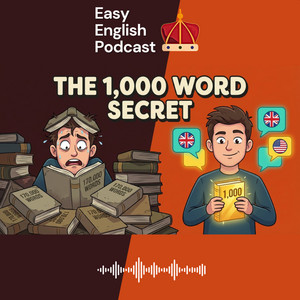
Hello my Easy English Learners and welcome back to the Easy English Podcast.
The best place to practice your English language learning listening.
I'm your host Oliver, and today we are going to help you become more free and fluent with your English.
And I want to reassure each and every one of you that you're doing great.
And you actually don't need as many words in English as you might think.
I'm going to destroy a major source of stress for English learners.
And I see people struggling with it every single day.
And this is the idea that you need to be a walking dictionary to be fluent.
That you need to know lots and lots and lots of words.
Think about it.
There are over 170,000 words in the English language.
That's a lot.
If you tried to learn them all, you would be like a hundred years old before you're even finished.
And perhaps even older than that.
But there is a secret that schools don't really teach you and they don't really teach it in textbooks that not all words are equal.
Not all words are as important as each other.
And in fact, native English speakers only use about half, one to two thousand words for the vast majority of their lives and conversations, whether they're writing, speaking or engaging at school or work.
We tend to only use about one to two thousand words.
And to be honest, it's the same in your native language, too.
We're talking about the 80-20 rule. where a tiny bit of vocabulary makes up most of the language.
So today we're going to start talk about how to be a little bit more focused with your vocabulary and how you can maximize the learning based on the vocabulary that you do know.
But first, As always, let's have a look at our key vocabulary for today's episode.
These are going to be words which I think are very useful for you to know for the episode today.
If you want these words and extra words as flip cards that you can practice every day, make sure to become an Easy English Patreon supporter.
On the Easy English Patreon, you get access to a bonus episode every week, as well as bonus content and series and all of the catalog.
At the moment, there are over 50 bonus episodes on the Patreon.
So if you sign up today, you get access to all of those and you get flip cards and PDFs for each episode as well.
So, I hope to see you there on the Easy English Patreon.
The link to support is in the description below.
Let's get back to our key vocabulary.
Our first word for today is heavy lifter.
Heavy lifter is a compound word, more of a phrase, and a heavy lifter is something that does most of the work in a situation.
For example, in English, verbs like get are real heavy lifters in the language.
So there are certain words that we use in different forms a lot more than others.
These are the heavy lifters.
Our second word is versatile.
Versatile.
This is a great adjective.
And versatile means something that can be used in many different ways.
So a certain word can be versatile.
It can be used in lots of situations, contexts, and ways.
A tool, a type of tool might be versatile as well.
You might be able to use it for lots of different things, like a hammer or a screwdriver, for example.
Okay, our third word today is again another compound word, and that is word gaps.
Word gaps.
And these are the moments when you forget a specific word during a conversation.
So don't let word gaps stop you.
Just describe in the words that you know instead.
Our fourth word for today is functional.
Functional, an excellent adjective, and it means designed to be practical and useful.
So if something is functional, it is practical and useful, rather than something that is just attractive or looks good.
So you want to have functional English.
You don't necessarily have to have English that is attractive, that looks good.
The most important part about English language is that it is functional first and foremost.
Our final word for today's key vocabulary is fillers.
Fillers.
And a filler word, I'm sure you know this, are words such as um, uh, well.
These are words that take up space while you think.
So using fillers is actually a natural way to sound fluent.
And it's not a bad thing having ums and uhs.
I do as well in this podcast.
And I put them into the transcripts on the Patreon because they are part of my speech.
So I want people to be able to read and see them.
Now on to our next part is the 80-20 rule.
So, now that we have our key vocabulary for today, I want you to listen for these words as we talk about the 80-20 rule today.
If you like this topic and you want more topics and you want more episodes every week to help your English, make sure you're following and subscribed and turn on the notifications as well, so you don't miss our new uploads.
So let's get into the math, the mathematics.
But don't worry, it's very simple.
There was a guy who was named in the past Pareto, and he noticed that 80 of results usually come from about 20 of the effort.
And this can apply to a lot of different things, whether it's the performance of a company, whether it is the performance of a specific task or research.
And in English, this is a total game changer.
It is no different.
The top 1000 words in English cover about 80% of everything that we say.
And that means if you master these core 1000 words, you can handle the airport, you can handle a business meeting or even a deep conversation about how you're feeling.
Now yes, it sounds nice saying one thousand, but really in reality it's probably somewhere between one and two thousand words.
So somewhere in that range is what you're going to want to know, that total amount.
And it's not too much.
You can really, really learn these words over time.
But even a thousand words, not even 2000, but one will get you to a position of being very fluent and sounding very natural if you can master the correct words.
The fluency trap in general is when learners spend hours and hours memorizing difficult words such as perpetual or juxtaposition.
So learning more advanced vocabulary, because people believe that that is what you need to become fluent in English.
A lot of you listening are intermediate level, B1, B2, maybe even into C1.
And you're thinking about getting to that next step, that next level of fluency.
And that's not necessarily how you do it.
Again, you can take someone that is not academic, maybe someone that isn't technical, and they aren't going to use these complicated words in their speech, but they're still fluent.
So those are nice, they might sound nice, they might look good on paper, but you'll not really hear many native speakers using them casually or day to day, which is the important use case of your English in most situations.
The funny thing is, even when native speakers know the big words, we usually choose smaller ones, which are easier, because they're faster and clearer.
We want people to understand us, which is why most people focus on those core one to 2000 words when they're actually speaking.
It makes sense when we think about it.
So it's, um, you aren't searching for like a massive library of difficult words.
You know you're.
You're using words that everyone knows and that are much more simple and clear and quick at getting your point across.
Now, how can you actually survive with only 1000 words?
That seems like not very much.
But in general, we have words which I call Swiss army knife verbs.
So a Swiss army knife is very versatile.
You can use it in lots of different ways.
And just like this, these English words, you can use them in lots and lots of different ways.
One word can sometimes do 50 different jobs and contacts, which can be quite crazy.
So let's look at one of these today.
And this is one that I'm sure that you know, because it is definitely the king of English verbs and English phrasal verbs.
And that is the word get, get.
Seriously, if you master the word get, you can stop worrying about a dozen other verbs.
So you don't need arrive, for example.
You could say I got home late instead of I arrived home late.
You don't even need to say understand.
If you know the word get, you can say I get it instead of I understand it.
You don't need become.
You can just say get.
It's getting cold rather than it's becoming cold.
You don't need to say bye.
You can just say I'm going to get some coffee and people understand from the context.
Do you see what I mean?
By using these versatile verbs that you can use in lots of different ways, your speech becomes faster and it becomes less complicated to, and you don't have that awkward silence while you're searching for a high level vocabulary word.
Of course, words like buy or understand are not very difficult, but this applies at much higher levels with other words.
It's efficient to use simple English, and to be honest, in most cases, it sounds more fluent.
Using more complicated words doesn't make people sound more fluent.
It makes them sound like they maybe have more advanced vocabulary.
But if they're searching for these words, if they're slow, it's not something which is natural.
And to be honest, most people don't use them.
So it's also not really like a native speaker if that's what you're going for.
But I chose get because it is such a good word.
In fact I think in my book.
So in my phrasal verbs are easy book I teach, like phrasal verbs, 50 of them through short stories to help you learn them.
And quite a few of those I think it was at least three or four of those were using get in those phrasal verbs.
So if you haven't actually got a copy of that yet, you can see the link in the description below and you can pick up that ebook to learn some of these get phrasal verbs and some other useful ones too.
So this brings me to the next point, and that is some learners have a real fear of having a word gap.
So that is when you hit that natural pause.
You're talking first everything is going really well, you feel like you're fluent, and then you forget a word, maybe a slightly more complicated word.
And you freeze, maybe you become a little bit embarrassed or you start stressing, trying to think about the word, and it can slow down the whole conversation.
But here's the thing in general, even native speakers forget words all the time, and I'm sure you do it in your language too.
It's not something to be stressed about.
The difference is when you forget a word, like if I forget a really complicated word, I just describe around it.
So if you forget the word...
Stapler, for example.
So stapler, you could say, hey, do you have that metal thing that joins pieces of paper together?
That is a stapler.
It puts pieces of paper together with staples.
And there you go.
Your friend will understand and say, oh yeah, stapler.
There you go.
And the conversation never stopped.
And it sounds natural.
You're working out what the word is.
This can apply to absolutely anything.
If you forget a word, try to describe it.
Try to describe around it using the words that you know.
It takes a bit of time, but the more you do it, the less you will stress and the more natural your speech will also become.
And this is a skill you can actually practice quite easily.
Instead of saying or instead of memorizing more nouns, you can practice describing things using the basic words that you already know.
So, for example, if you can't remember the word refrigerator or fridge, you can call it the cold box that you store food in.
If you can't remember pedestrian, you can call it a person walking in the street.
If you can't explain what you mean using the 1000 words that you already know, you are sorry.
If you can explain what you mean by using those 1000 words that you already know, or 2000 if you know 2000, you are by definition already fluent in English.
You might not have all the vocabulary, but you are fluent already because you're talking, you're not pausing and you're not feeling stressed.
Okay, that brings us to our listener spotlight for today.
Last week, I asked for some of you, or as many of you as possible, to share your English language learning routine.
But more about, you know, if you stopped learning English.
So if you ever had a pause, if you stopped and if you started to forget English, just to tell me a little bit about your experience with English, learning English.
Like, have you ever stopped for a while or have you learned every day?
And I had some great answers, some excellent comments on both YouTube and Spotify.
And I want to read a few of those to you today.
And the first one is, let's see.
So it's from someone, Jack.
And they said, hi, Oliver, I'm from Vietnam and you can call me Jack.
Thank you for your amazing podcast.
Now I would like to answer your question.
Last year, I didn't practice my speaking skills for about three months.
After that period, I realized my speaking had become rusty and worse.
I felt quite sad because I forgot many things and find it difficult to express myself.
From this experience, I decided to practice speaking every day for at least 15 minutes.
I believe consistency is very important so we should never give up.
Thank you again for your wonderful podcast.
You're very welcome, Jack.
And thank you for your lovely, lovely comment.
You can also tell me if you're not.
If your name isn't Jack, you can tell me your full usual name and I will try my best to pronounce it.
But thank you so much.
That's a lovely comment and it really highlights how crucial consistency is for English speaking.
So thank you for that.
We had some more comments, so I had Eduardo, and Eduardo said hi Oliver, I hope you're doing well, or I think it's sorry it's Caroline, but on Eduardo's account,
Hi Oliver, I hope you're doing very well.
My name is Caroline, and I am from Brazil.
I started learning English more than 20 years ago, but for several years I stopped using and studying it.
However, I decided to start again after I turned 40.
For the past two or three years, I've been making a real effort to improve my English.
I really appreciate your podcast and I'm very grateful for every episode.
Best regards, Caroline.
What a lovely message, Caroline.
I'm so glad that you got back into studying English and I can see that you're doing excellent and very well.
Thank you for your comment.
I hope to see you again on the Easy English comments.
Okay, we had another comment and it was from let's see, we had Benna Marek and they said Hi Oliver, I started learning English for work, but after four years I got a job at a German company.
So I had to focus on German for the next four years.
Because of that, my English got a bit rusty.
I think we can all relate to that.
Now I'm working at a company where English is necessary again.
So I'm trying to switch my brain back into English mode again.
It is so hard.
I feel like I've forgotten everything.
Don't worry, it will come back and it's all in there somewhere.
So I hope that episode was a bit of an encouragement for you because you will learn so much faster than you did the first time, because you've learned it once before.
Thank you so much for your lovely, lovely comments.
And that brings me to this week's question.
So, this week we are talking about vocabulary, right?
And I want you to tell me the hardest English word that you learned.
That can be a very complicated word, or it can be one that you just kept forgetting that you struggled and struggled and find it so hard to remember.
So tell me a bit about your experience, maybe a word that you struggled with, that you find difficult, but you've finally mastered.
And I look forward to reading these out in the next episode.
And I will chat to you in that episode on the listener spotlight.
So that brings me to our conclusion for today's episode.
My challenge for you this week is to be simple. to simplify.
Stop trying to sound overcomplicated or to make things too complicated with your speech.
You don't focus.
You can focus on increasing your vocabulary with more difficult words.
There's nothing wrong with that.
But when it comes to actual everyday speaking, don't stress.
Focus on being fast, clear, and simple using words that you already know.
In the background, in your own time, with your studies, you can improve and increase your vocabulary.
But for everyday speaking, for speaking practice, don't stress.
Use the heavy lifters.
Use the versatile words and verbs and really, really focus on just becoming fluent, but more with the style, with the fluency and freedom to speak, rather than stressing about too much vocabulary.
Thank you very much for listening.
If you are new, make sure to follow and subscribe.
If you want extra content or you just want to support the show, you can subscribe to the Patreon link in the description below.
Thank you and I will see you in next week's episode.
Goodbye.