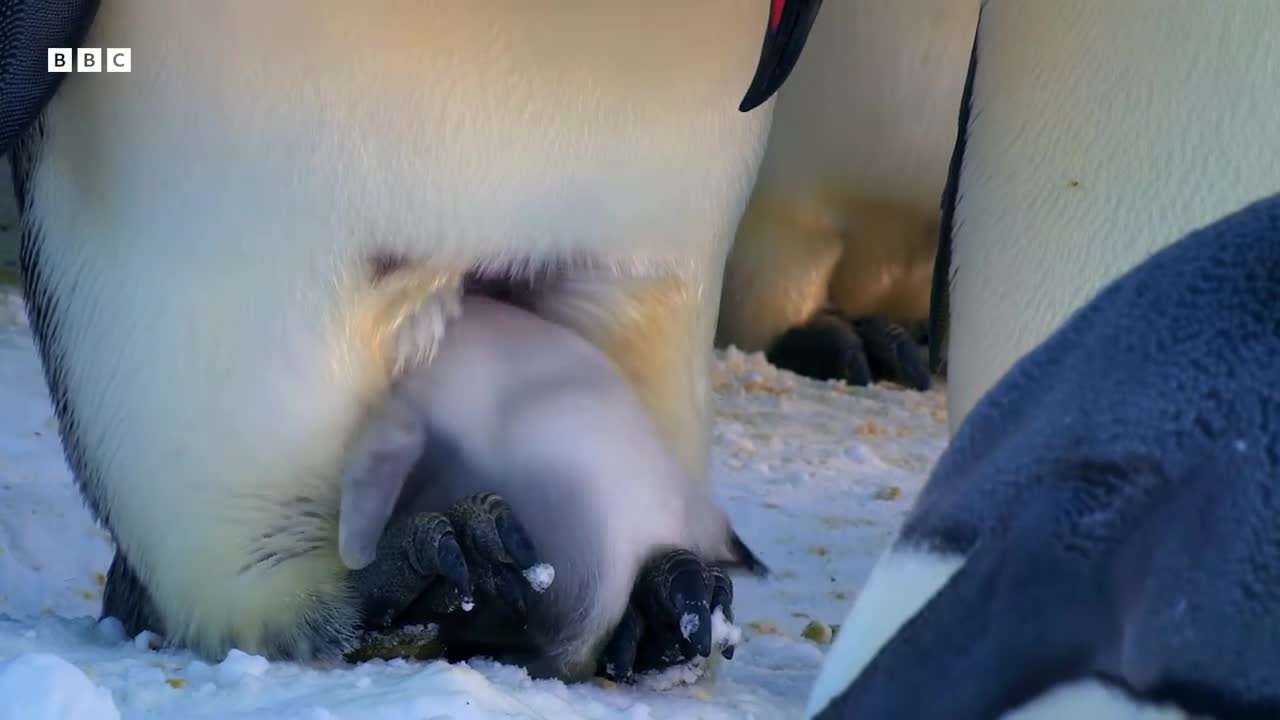
Two weeks have passed.
The chicks are testing their independence and spending time away from their mothers.
All, that is, except one.
As the last to hatch, he's way behind in development.
While the older chicks are boisterous and confident, he still feels most comfortable in his mother's pouch.
But penguins are sociable birds, and to survive, he must learn to play his part in the colony.
It's a daunting prospect.
But the little chick finds some courage.
It's a shaky start but he mustn't lose his nerve.
Time for a bit of tough love.
With every step he gains more confidence.
It's just as well.
He has so many friends to make.
But when you're the smallest, it's tough to join the gang.
For now, there's always mum.
Out in the open ocean, the fathers are reveling in being back in the water.
They haven't eaten for four whole months and have lost half their body weight.
To stock up on fish and squid.
They hold their breath for up to 20 minutes and dive to nearly 600 meters.
Deeper than any other bird.
At the colony.
Three weeks have passed and the chick is confidently following his mother wherever she goes.
He's still learning how things should be done.
And how they shouldn't.
He soon thinks there's nothing left to learn.
So nervous toddler turns cocky explorer.
But at this age she mustn't let him out of her sight.
The next morning, and the cubs are doing well.
There are healthy 1.2 kilograms each.
And as the days roll by, the cubs continue to thrive under Giles's watchful eye.
So we try and spend a little bit of time with them every day.
It's really important because ultimately from day one we've been building our bond with them.
And the fact that they just get used to, you know, hearing my voice and the sensation of being touched and picked up and stuff is really good.
His eyes are still completely closed, so this is day eight.
Yeah, it's usually between six and twelve.
Yeah.
You gotta stay still for just a second.
Wow.
See they're growing quickly.
That's 200 grams again in a day.
It's fantastic.
So they're only 12 days old and they're all already double their birth weight.
The stronger and bigger you get, the quicker you get, the better your chance of survival in the wild.
I just noticed that one little eye was open.
She's awesome.
You can see me now sort of.
You can see a shadow anyway.
For the first couple of weeks, they're not gonna be able to focus properly.
It's still gonna take, like a human baby, it takes a few weeks for the eyes to adjust.
Two weeks later, the cubs are growing stronger and it's time for Giles to give them names.
So if you look at the two of them together, This little chap has more of a continuous stripe going along this way, whereas this one's a bit more broken looks like a spot.
So this is, we're calling this one spot for the time being, and this one stripe.
And he tends to have a little bit more of a feisty character than his brother.
He is going to be a challenge, I can see it already.
See what I mean about being stroppy?
Aren't you?
Yeah.
That's good, you've got spirit.
So this is one we're calling Spot.
This little chap was the first one born, and he was the one that, for the first couple of hours, we were a little worried about.
He had a bit of a tougher time, didn't you?
You're doing well.
He's nearly the same weight as his brother now.
Despite their good health, life for young tigers is precarious.
Globally, over a third of captive-born Sumatran cubs won't make it to adulthood.
See, you need to relax like your brother.
Relax, hey.
So Giles has made a difficult decision to safeguard the cubs' future.
You're going to pass with flying colours, buddy.
Yeah.
He's going to hand-raise them himself at home so he can give them 24-hour care.
And Mel the vet has come to check if they're healthy enough to leave.
The heart sounds really good.
Steady beat, no murmurs.
So relaxed he is.
He's so relaxed.
We're starting off with such... robust, healthy little cubs.
They're not too young, so we've already got so much strength in them.
The cubs will be vulnerable to illness until they're around six weeks old, so Giles has got to keep a close eye on them round the clock.
There is an awful lot of pressure.
First and foremost, there's pressure because these guys are so important to not only us here at the zoo, but also to the breeding program potentially a lot of eyes around the world that are watching what we're doing and making sure we do a good job.
You're giving it a good go, hey?
We're giving it a good go.
You're so fluffy.
Her eyes and ears that were closed for the first two weeks of her life are now opening.
And with this comes a whole new world of sensory stimulation.
She uses her vision to move around.
But does she see the world the same way we do?
Well, dogs are colorblind.
But that doesn't mean that everything is black and white.
She does see color, but mostly just blues and yellows.
It's because she only has two types of color receptors compared to humans who have three.
And it's also why your dog will often ignore an orange toy in the green grass, as those colors look the same to them.
Better to give them something blue.
But it's when things are moving that her vision comes into its own.
Dogs' eyes process what they see more quickly than we do.
It's almost like they see in slow motion.
That's why they're always in the right place to catch the frisbee.
A dog's hearing is also superhuman.
They can hear things four times further away and twice as high pitched as we can.
It's why we can't hear dog whistles.
But it also means they can hear the hum of lights and even the pulsing sound of a quartz crystal in a digital clock.
But there's one sense she'll use more than any other. her sense of smell.
A dog's brain is 1 tenth the size of ours.
But the part that controls smell is 40 times larger.
They have up to 300 million scent glands in their nose compared to our 5 million.
Our story begins with a tantalizing glimpse of something very special. just 10 days old.
Wild cubs as young as this have never been filmed before.
For their first six weeks, most cubs usually hide away in their dens, hardly glimpsing daylight.
These are unusually adventurous.
They seem totally unaware of the dangers.
Although their eyes are just opening, they won't see clearly for another six weeks.
They're the mother's first litter, and they're going to be quite a test for her.
The tigers must pick them up by the scruff of the neck.
It's a delicate operation.
A little too much pressure and she'll hurt her cub.
She can bite with a force of nearly 500 kilos, but this requires the gentlest touch.
Tigers usually have two or three cubs.
Four are quite a handful, and these already seem more challenging than most.
The ratio between the sexes among newborns is usually equal.
True to form, two of these cubs are male and two are female.
It will be rare indeed for all four of them to reach maturity.
Many dangers lie ahead.
At this size, they make a snack for even the smallest predator.
Their mother must make sure that everyone is accounted for.
With two back in the den and one on its way, there's only one straggler left to worry about.
The cubs' contact cry makes sure he's not forgotten.
As long as the cubs call, their mother is compelled to keep retrieving them.
But this would try any mother's patience.
The young cubs' life is very precarious.
Had the mother been away hunting at a moment like this, the outcome could have been very different.
She's clearly going to be a devoted mother, but she still has a lot to learn.
This is not the way to do it.
Such behavior is unprecedented.
It gives us an extraordinary opportunity to follow these cubs as they grow.
The aerated water of the falls creates prized feeding grounds.
But the currents are fierce.
Baby's 35 gram fluff balls must learn fast or face being swept away.
Mum leads them down the side of the falls.
Their goal is a rocky island.
Mom and dad gather their chicks and they're off.
The duckling's downy feathers trap air like a life jacket as they bob across the surface.
It's a good start.
But one chick is swept away.
Mom and dad look frantically for their missing duckling.
In the chaos, they have to make a difficult choice risk everything for a rescue or keep their other chicks safe.
They push across the final current to the rock.
Mum makes a break for it.
One lone chick struggles through, swiftly followed by dad.
The rock is a refuge, but the insects they eat live underwater, so this duckling has to go in again.
Luckily, the island gives shelter from the full force of the torrents.
Now its downy feathers make it too buoyant to dive.
So in the shallows, it grips the riverbed with its tiny feet and drives its head underwater.
Today, these parents have led their duckling through its toughest rite of passage.
With no other bears around, she makes the move.
This is a big moment in the cubs' lives.
She's got to be careful though.
Another bear could turn up at any moment.
The cubs are a bit nervous being out on the creek and they know they have to stick close to her wherever she goes.
While there are still lots of salmon around, the mother bear can be selective with what she eats.
She takes a bite of this salmon and then drops it.
As she can probably tell from the taste, it's a male.
Bears need to target the richest, most nutritious food source.
What she really wants to find are female salmon.
And she'll go out of her way to catch one.
Female salmon are loaded with thousands of brightly colored, nutrient-rich eggs.
This is the best part of the salmon, high in calories and fat.
And she doesn't want to leave any behind.
The cubs though, still need to learn which are the best parts to eat.
Though the cubs are still nursing, they need these protein rich salmon as much as their mom does.
The whole family has to put on as much weight as possible before winter hibernation.
The mother bear is always alert to potential dangers to her cubs.
Surprisingly, it's another ghost bear.
This one looks like a large male.
The cubs know that when another bear is around, they have to get out of there.
They retreat to the safety of the trees.
The mother bear is much smaller than him, but she's still going right after him.
I'm not sure that's such a good idea.
He could certainly do some damage to her.
And he doesn't seem much deterred by her approach.
That's a risky move on her part.
Anytime two bears physically interact like that, there's a good chance one of them could be hurt.
They're very powerful animals.
I don't know her character well enough yet to decide if she's foolhardy or brave.
Only time will tell.
But her cubs knew what to do in this situation.
They knew that their best defense was to get up as high into a tree as quickly as possible.
She is very determined in going back to somewhere in a very, very straight line.
This is super encouraging.
This is exactly what lionesses do when they've got tiddlers.
I will put money on the fact that in those bushes she's got a little surprise for us.
We're just going to keep back, keep back, keep back, see what's going on.
That's it, she's going in.
See ya. deep, deep, deep, deep in there.
They are tiny.
Tiny cubs, they are no more than a week old.
Ears are still folded, almost flat, they're blind.
Very wobbly, they can hardly walk or move.
Their mouths are open, they're just gorgeous.
The cubs have tiny spots like a leopard.
They'll fade as the cubs get older, but they're great camouflage for the moment.
Oh, they are exquisite.
Well, here we are in the season of renewal and she Tippi, as I now refer to her has got her own young family.
They are completely helpless 100 dependent on her for everything, because that's all they're getting.
They haven't even got teeth yet.
She's just totally chilled, totally relaxed, which is lovely.
What an amazing thing to find.
Isn't it a beautiful illustration of just how tender and attentive a massive brute of a predator like that can be?
It has been 18 days since Lili gave birth.
For her to produce twins is not unusual.
Half of all panda births result in them.
But for both twins to survive, certainly is.
Pandas almost always abandon one cub.
It's thought that they don't have sufficient milk or energy to care for two.
But the team at Chengdu have hit upon a cunning plan.
By removing one cub at birth and then switching them throughout the day and night, keepers are able to encourage panda mothers to feed both siblings while being under the impression that they have only one.
Lili is distracted with a bowl of honey water, but is reluctant to give up her cub.
Doing this successfully requires enormous patience from the keeper and great trust from the panda.
One twin is taken to the incubator, where it will have a top up of formula milk and switched with the other, which will now get his share of his mother's milk.
The keeper will swap the twins up to 10 times a day.
And Li Li will almost always have one cub with her.
Chengdu's technique of twin swapping at last opens the way to a possible 100 survival rate in newborn captive cubs.
It's March, and light returns to the high Arctic, sweeping away four months of darkness.
A polar bear stirs.
She has been in her den the whole winter.
Her emergence marks the beginning of spring.
After months of confinement underground, she toboggans down the slope, perhaps to clean her fur, perhaps for sheer joy.
Her cubs gaze out of their bright new world for the very first time.
The female calls them, but this steep slope is not the easiest place to take your first steps.
But they are hungry and eager to reach their mother, who's delayed feeding them on this special day.
Now she lures them with the promise of milk, the only food the cubs have known since they were born deaf and blind, beneath the snow some two months ago.
Their mother has not eaten for five months and has lost half her body weight.
Now she converts the last of her fat reserves into milk for her cubs.
The spring sun brings warmth, but also a problem for the mother.
It starts to melt the sea ice.
That is where she hunts for the seals she needs to feed her cubs.
And she must get there before the ice breaks up.
For now, though, it's still minus 30 degrees and the cubs must have the shelter of the den.
This puppy was rejected by his mother at birth, but he's had the good fortune to be adopted by a cat.
Her mothering hormones are so strong, she accepts him as her own.
The puppy was born on the same day and he happily adapts to his new family.
But kittens live by different social rules, even when they suckle.
They name tag teats with their own individual scent and return to it each time.
This simple rule maintains peace and harmony during feeding time.
But for dogs pack life requires fighting for your share in the rough and tumble of competing mouths.
This puppy breaks all of the cat's social conventions.
His wild instincts express themselves, despite his unusual family.
Ultimately, the puppy's needs and his foster mother's nurturing feelings overcome any differences.
For now,
But as adults, these top predators will differ in almost every detail.
When a cat drinks, he uses a refined technique.
The rough upper side of his tongue curls downwards to pick up the liquid using surface tension.
It pulls the column of milk up into his mouth without making any mess at all.
A solitary hunter can afford to take his time.
It's a different matter when you hunt as a pack.
A dog also pulls a column into his mouth, but unlike cats, he shapes his tongue into a ladle to slosh more liquid in.
For pack animals, beating your rivals to a drink is more important than cleanliness.
X-ray shows how the milk is thrown backwards at five times the force of gravity and his mouth shuts like a trap as it is swallowed.
It might be effective, but it's far messier than the cat.
Orphaned weasel Twiz is now five weeks old.
Her eyes have opened, her hearing is becoming more acute, and she's much more active.
In the wild, Twiz would be playing with the rest of her litter, so Rob has to take over this role.
Play is how a weasel would learn how to fight and to hunt.
They use all four limbs to grip the prey items, deliver a real powerful bite then to the back of the neck, but very gentle at this stage.
She's only small still, so it's fabulous to see that she's got this instinct in her already.
The little chittering, this is like a contact call.
I've heard this in the wild with wild weasels lots of times and to me it's one of the most beautiful sounds there actually is.
Twiz must start strengthening her muscles to improve her agility.
And this needs to be done indoors.
We're going to test her strength, agility and a safe environment.
Rob wants to see if Twiz is brave enough to explore but also cautious enough to hide from any danger.
Got to be always close to cover because they're vulnerable from attack from other predators.
She's heading for cover when she's really unsure, which is a great sign, because she needs to be absolutely on the ball when she's out in the wild.
At this age, wild weasel kids would go on day trips with their mum, who would show them how to hunt prey.
And Rob's got just the thing to help Twizz.
It'll be an easy target.
In a matter of weeks, they'll actually be independent and hunting for themselves.
Weasels eat anything from birds to voles, so they need to climb and tunnel.
She's just coming back for a little bit of reassurance.
That's what we'll be doing in the wild, going back to the mother.
Then she'll go off again, adventuring.
She's showing great signs.
Yeah, it's great to see.
Back in the nursery, Min Min's baby is fighting fit.
She's now ready to go back to mum.
Not as straightforward as it sounds.
Min Min may not have had time to bond with her baby, and it will be covered in different smells.
So there's a risk she might have nothing to do with her daughter.
The team hold the baby in front of Min Min, expecting her to come forward.
But she shows little interest.
This is not a good sign.
After all that she has gone through, there is a real possibility that Min Min will now reject her baby.
The keepers move the baby closer.
The youngster cries out desperately for mum to pick her up.
But she still ignores the helpless baby.
The keepers step in, making Min Min more comfortable.
They try again.
Then something clicks.
To everyone's relief, Min Min's maternal instincts finally kick in and she gently accepts the baby.
Things are at last looking up for the reunited family.
If they become separated, they could easily drown.
Oh my God, one is gone.
The mothers try in vain, but they can't contain all three.
As they save one, another washes away.
Oh, God.
It's still going, and the baby's gone.
Soon all three are being swept downstream fast through the crocodile-infested waters.
The current's even too much for the mothers.
They have to let their babies go.
David can't see how they can possibly survive.
Oh, man, this is no good.
Let's go, let's go.
Let's go.
You can hear the poor females.
OK, up there.
No, no, no, right, right.
All the big females are running.
Oh, God.
OK, one baby is out.
Man, the other one is here.
The other one is here.
Wow.
There are two babies actually here.
Wow, they're really tough.
Come on, big females, come in.
Oh, please don't move.
Oh, they're coming down.
The females are coming down.
I hope they will save them because they will get tired.
And if a crop grabs them, that's it.
Mothers have reason to be worried.
A male from another pride will readily kill their young.
Their instinct is to stage a preemptive strike.
Working together they're a match for any male, but unfortunately their hair-trigger aggression has caused a serious mistake.
This male is from their own pride.
They vent their remaining aggression on each other.
For highly strung predators, violence comes with the territory.
It's best not to take it personally.
Cubs are usually a few weeks old before their mother risks introducing them to their father.
He tends to be a bit rough with the kids.
The cubs are mesmerized by this 200 kilo goliath.
He may be 100 times bigger than they are, but lying down, he seems relatively harmless.
Even so, touching him is playing with fire.
His fuse can be even shorter than their mother's.
There's nothing quite like putting your head in the lion's mouth.
In parenting, lions are from the old school.
They aren't afraid of discipline.
Like human children, cubs are more restless than their parents, but they soon learn to relax for 20 hours each day.
And wave power creates towering fortresses like these cliffs in the Arctic, home to tens of thousands.
The faces of the cliffs are accessible only from the air and have plenty of nooks and crannies for those that can get there.
But to feed, seabirds must still master the ocean world beyond.
A puffin.
He's a fisherman and a father.
He has a mate for life.
Both share the burden of raising their weak old chick, their puffling, who needs five square meals a day.
The parents alternate fishing trips.
It's dad's turn.
When fish stocks are low, puffins must fly as much as 50 kilometers out to sea to reach the good fishing grounds.
Once there, they plunge into another world.
Good fishing spots are hard to come by, and they have company.
Guillemots.
Like the puffin, their wings are short and good for diving.
Puffins can hold their breath for over a minute and dive as deep as 40 meters.
But it's a long way home.
After an exhausting round trip of almost 100 kilometers, this puffin's nearly made it.
But there are pirates on this coast.
Arctic skewers.
All around, returning parents are being robbed.
The skewer's long, range-backed wings make them faster and more maneuverable.
Puffins must choose their moment wisely.
A near miss.
The last desperate burst of speed.
And it's made it. safely home after a three-hour round trip.
Where his patient partner is waiting.
Today, their puffling will eat.
But where fish numbers are in decline.
Many puffins now find it hard to get enough food for their chicks.
In the changing seas of today, it can be even harder to be a successful puffin parent.
These animal parents take self-sacrifice to a new level to care for their young.
But alongside nurturing, the other key parental responsibility is protection.
And this job often starts before the baby is born.
Sometimes it's not the mums who take on this role, but the dads.
The male members of the seahorse family, otherwise known as the synathidae family, are dedicated child carers.
These fantastical creatures glide almost invisibly around the ocean bed.
Both the male leafy sea dragon and the male weedy sea dragon use their flamboyant decoration to help keep their brood safe.
There's little risk of predation when you're as well camouflaged as these eggs.
The dads carry their eggs around for one month until they hatch.
Then the hard work is finally rewarded.
The little baby sea dragons are born, complete with yolk sacs still attached.
These tiny hatchlings will grow fast.
Their father has played his part, bringing them safely into the world.
And now it's over to them to play theirs.
Also in the same extended family, the pipefish, a master of disguise and another super dad.
After enjoying a graceful mating dance with the female, she swiftly transfers the eggs into his brood pouch.
He keeps them safe for 10 days until they hatch as perfectly formed miniature versions of himself.
Once she has had her fill, her sons dominate the carcass.
It's only when they have finished that their smaller sister Beepa, gets her chance to feed undisturbed.
Alarm calls warn of an intruder.
This time, it's an adult male tiger.
He's a third bigger than Raj Bhaira and much more powerful.
This is the cubs' favorite waterhole.
Mother and sons sleep off their meal.
But Beepa heads off alone.
Adult male tigers sometimes kill cubs, so to approach one is a huge risk.
Unless, of course, he's your father.
The only male in the forest who would never harm her.
Tiger fathers rarely meet their offspring.
And he doesn't seem keen to get acquainted.
But while he is patrolling the forest, other males will keep away and the cubs will be safe.
It's taken us about three weeks to get this ostrich used to the car and then gradually over the three weeks.
Um, we've just closed the distance every day.
If it ever looks like they're going to leave the eggs, we just back off.
The other thing i've been doing is talking to it, so it knows my voice.
So every time i drive up i'll speak in a strange squeaky voice.
It's for some reason at home with my chickens.
I talk to them like that and they seem to like it.
The last thing we want to do is put them off the eggs.
So we've been really careful.
And yeah, he just gets used to your voice.
He's an awesome dad, like dad of the year.
I think yesterday he must have sat on the egg for probably about 15 to 16 hours without a break, without water, without going off to have a snack.
Fingers crossed in the next two, three days, the eggs should start to hatch.