Hello, my friends. Welcome back to English Unleashed.
I'm Tom. Today I want to share something very important with you.
It's called the chunking method. Chunking is a simple but powerful way to learn English. if you want to speak English fluently and naturally and If you want to think in English, then chunking can really help you.
In this episode, I will teach you what chunking method is, and how you can use it in your everyday practice to be able to speak more fluently and naturally.
As always, I will speak slowly and clearly to help you learn English step by step.
So get ready and let's begin. Okay, what is chunking?
Let's start very simply. When you speak English, you don't need to build every sentence word by word.
That is slow. That is difficult. That takes too much energy.
And when you think like that, you may get stuck.
You may feel nervous. You may forget the words.
But there's a better way. You can use chunks.
That's right, chunks. Now, what are chunks?
Chunks are groups of words. They are small phrases that often go together.
We don't change them. We don't build them from zero.
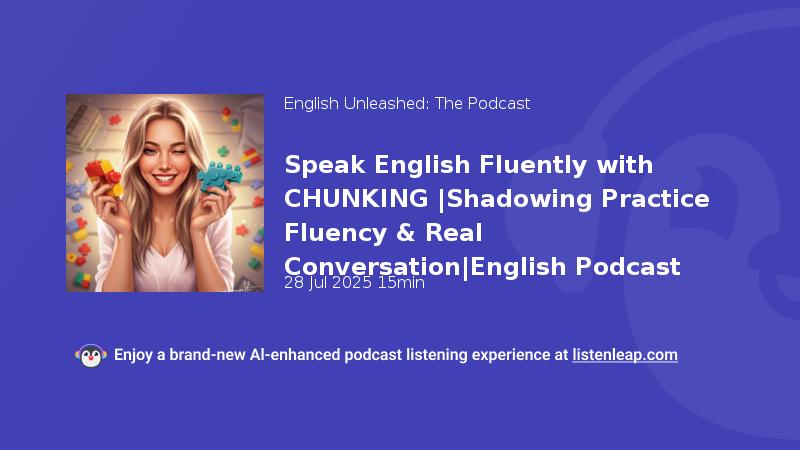
We just use them as they are. Think of chunks like Lego blocks.
E chunk is a block. And when you speak, you just put the blocks together.
Okay? You put the blocks together. Let me give you some examples.
You already know many of them. Like, how's it going?
I don't think so. Let me think. Long time no see.
Have a nice day. No worries. It depends.
These are all chunks. We don't stop to think about the grammar.
We don't say, how is it going? Slowly. No, we say, how's it going? in one smooth unit.
And that's why chunks are powerful. When you learn a chunk, You learn a full idea, not just individual words.
You know when to use it. You know how it feels.
And it helps you sound natural and confident.
Now, let's do some practice together. You can repeat after me, slowly, okay?
How's it going? How's it going? Now you repeat.
Okay. I don't think so. Good. Let me think.
Great. Do you feel it? Yeah, we're not learning random words.
We are learning chunks of meaning. little blocks of real English.
This is the Chongqing method. And believe me, When you know 20, 30 or 50 chunks, you can already have great conversations without translating without overthinking.
Alright, now that you understand what chunking is, Let's talk about why it helps you, OK?
Especially if you want to speak English more fluently.
When you try to speak English word by word, your brain has to work very hard.
You have to think about every single word.
You have to remember vocabulary. You have to decide on the correct grammar. you have to find the right sentence structure.
That takes a lot of time. And sometimes you get stuck.
You just stop. You pause. You feel nervous You lose confidence Now, imagine this Imagine you could use a whole phrase, a whole sentence, without thinking about it.
You just say it naturally, quickly, and correctly.
That's what Chungking gives you. When you learn chunks, you're thinking in phrases.
You are thinking in complete ideas. And this is how native speakers talk.
They don't build every sentence from zero.
They don't stop and think, Hmm, I need a subject, a verb.
And an object. No, no. They speak in ready-made expressions. in chunks, in blocks, in patterns that are already in their minds.
And when you speak like that, you sound more natural.
You speak faster. you feel more confident because your brain is not working so hard.
And that means your brain is doing less thinking and more communicating.
Let me say that again. When you use chunks, your brain is doing less thinking and more communicating.
That's the goal, to speak from feeling, not from fear. to speak in patterns not in pieces.
Another reason chunking helps is this. When you hear English spoken around you, you will start to notice the same phrases again and again, right?
Phrases like I'm not sure. Let me check.
It's up to you. you will begin to recognize these chunks.
You will begin to know these chunks. They will become part of your own English.
You won't need to memorize them. You will just hear them so many times that they become natural for you too.
And the more you use them, the more fluent you become.
That's why chunking is not just a method.
It's a mindset. It's a way of thinking in English.
It helps you move from translating to speaking freely and you don't need to know a thousand grammar rules.
You just need to know what to say and say it in chunks.
Alright, now let's go deeper. Let me give you more real-life examples of chunks.
Remember, chunks are not rules. They are not just random words.
They are natural pieces of English that people use every day.
So, here are some useful chunks. Let's look at them slowly, one by one.
The first one is, I'm on my way. I'm on my way.
This means I'm coming, I'm going to the place now.
You don't say, Now I go to the place where you are.
That is too slow. Too difficult. You just say, I'm on my way.
You memorize it and you say it in the right context.
That's a chunk. It's fast and natural. I'm on my way.
Here's the next one. Let's keep in touch.
Let's keep in touch. This is another chunk.
We use this when we want to stay connected.
Maybe you meet someone new or you finish a course or a job.
You want to talk again in the future. You say, let's keep in touch.
Let's keep in touch. It's a perfect goodbye chunk.
You don't need to think about the grammar.
You don't need to think about every single word.
You just say the phrase. Let's keep in touch.
As easy as that. Here is the next one. That's not the point.
That's not the point. This means that's not the important part.
Maybe someone is arguing. Maybe they don't understand what you mean.
You can say, that's not the point. Here's another chunk.
That makes sense. That makes sense. This means that's logical.
We say this when something is clear, when something is easy to understand, easy to follow.
That makes sense. It's a very common phrase in everyday conversations.
Now, did you notice something? Each of these phrases is complete.
Each one gives a clear message. You don't need to think about grammar.
You don't need to build them word by word.
You just say them naturally. And that's the beauty of chunks.
They save you time. They make your English sound real.
They help you speak the way people actually speak.
Now you may be thinking, That is great, Tom.
But how do I actually learn chunks? That's a good question.
A very good question. Let me walk you through it step by step.
Learning chunks is not difficult, but it needs a new way of thinking, a new mindset.
You don't study individual words, you study whole expressions.
So let's talk about how to do that. Step 1.
Listen carefully, really carefully, really carefully Listen to people speaking English in movies, in podcasts.
Listen to how they talk. Listen to what they say again and again. you will start to hear certain phrases, phrases that come back, And that's not a coincidence.
You don't need to create them. You just need to notice them.
Step 2. Write them down. Now, don't trust your memory.
Take out your phone or a notebook and write the chunk down.
Not just the words. Write where you heard it, how it was used, and maybe the emotion.
Was it happy? Surprised? Angry? This helps you remember when to use it and not just what it means.
Step number three. Say it out loud. Now, this is really important.
Don't just read chunks silently. Speak them out loud.
Yeah, even if no one is listening. Even if you're alone.
Even if it feels a bit strange. Because when you speak chunks out loud, your mouth starts to remember them.
Your tongue gets used to the rhythm. your brain starts to connect the sound, the meaning, and the feeling And soon, the chunk will come out automatically, without effort and without translation.
Step 4. Review your chunks often. Chunks are like little plants.
You need to water them. You need to see them again and again.
So every few days, open your notebook. Look at your chunks.
Say them again. Remember how they felt.
Try using them in new sentences or just read them out loud. even five minutes a day is powerful.
So, every day, Find just two or three new phrases, not 10, not 20, just two or three.
That's enough. Maybe you find them while watching a TV show.
Maybe in this episode, right? or from a conversation.
Just listen carefully. When you hear something that sounds natural something short and useful write it down.
For example Let me know. I'm on it. I'm not in the mood.
Keep it small and real. Okay, my friends, today you learned about chunking, about how it works. about why it helps.
Remember, English becomes easier when you speak in chunks, not word by word. but phrase by phrase.
Just a few chunks a day can make a big difference.
So keep going, keep listening, keep speaking, and as always, keep believing in yourself.
I'm Tom, and this is English Unleashed. Thanks for listening and thanks for learning with me.
Bye for now.