Hey everyone, welcome to this episode of Chinese Folk Tales.
I'm Huang Rui.
This episode presents some short witty and horse-related stories to celebrate the Chinese Year of the Horse.
And here comes the zodiac calendar.
If you were born in the year of 2014 2002 1990, 1978 or other years adding or minus 12 years you, my friend, might have the horse as your Chinese zodiac.
Horses are widely regarded as symbols of speed, strength, freedom, and oh yeah, success.
And the stories we're going to share today each holds the Chinese wisdom of success.
First up, we've got the legend of the wise horse judge.
Bo Le Xiang Ma.
Bo Le discerns a noblestie.
Imagine yourself as a winged steed that can roam faster than the wind.
But your daily job is nothing other than pulling a millstone in endless circles.
You're tied up on a farm?
Who would know your true talent?
What a frustrating life that would be.
More than 2,000 years ago, there was just such an underappreciated horse.
It might have looked skinny, didn't eat much, but it could run a thousand li a day without tiring.
That, by the way, is about 500 kilometers.
Okay, maybe not literally, but the point is...
The horse was born a genius as far as horse talent went.
But no one knew.
Except this man named Sun Yang, who possessed an extraordinary talent for judging the quality of horses.
In Chinese mythology, the immortal believed to govern the heavenly steeds was named Bo Le.
Out of deep respect for Sun Yang's skills, people began calling him by that celestial name, Bo Le.
Legend has it, the king tasked Bo Le with the mission, find a legendary a thousand li steed.
Bo Le searched all over the kingdom for a long time, but the perfect horse was nowhere to be found.
One day, Bo Le saw a sweating horse struggling up a steep hill pulling a heavy load.
As bony as it was, The moment he took a closer look, he knew.
This was no ordinary horse, but a Qianli Ma, a thousand-mile horse.
Bo Le jumped off his cart and, overwhelmed with emotions, rapped at the saddle and cried.
The horse, sensing a kindred spirit, lowered its head and snorted, and then lifted it and neighed loudly, not in pain but in recognition.
In that instant, Bo Le and the horse understood each other.
And this moment wasn't just captured in a legend.
More than a thousand years later, A Tang Dynasty writer named Han Yu wrote about it in an essay called Ma Shuo on Horses, in which he said Only when there is Bo Le can there be a thousand-mile horse.
Because here's the truth.
Great horses are everywhere, but experts with the eyes to see them are few.
Hanyu went on to say even a legendary horse can end up pulling cards stuck in a stable or working itself to exhaustion, not because it isn't fast enough, but because no one understands what it's truly capable of.
A thousand mile horse needs proper food, proper guidance and trust.
Treat it like an ordinary horse and it will never run a thousand miles.
Then people sigh and say, There are no great horses left.
But Han Yu asks, Is it really the case that there are no great horses?
Or is it that we don't know how to recognize them?
The story of Bo Le gives us our first piece of ancient Chinese wisdom.
True talent needs an appreciative eye to be discovered.
So whether you are a horse or a Bo Le, this story asks one simple question.
Are you running at your true speed?
And just as important, are you helping others unleash their true potential?
As Bo Le grew older, he realized that his ability to recognize extraordinary horses was a gift too valuable to keep to himself.
So he wrote a book, The Classic of Horse Appraisal, basically the ancient version of a star manual, detailing everything he had learned after a lifetime of studying horses.
It is said that a thousand-mile horse has a high, broad forehead, bright and alert eyes, strong and well-shaped hooves.
Each detail matters.
His son got this treasure book and was super excited, eager to find a winged steed himself.
He searched strictly according to the illustrations, checking off every feature.
And guess what he found?
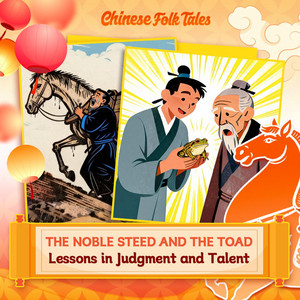
Out of all the creatures he came across, he found a toad.
He rushed home joyfully and told his father.
I found the super horse.
Its forehead is prominent.
Its eyes are bright.
Only that its hooves aren't quite right.
Bola took one look and didn't know whether to laugh or cry.
Finally, he said, Well, this horse loves to jump too much. you'll never be able to ride it.
This story gives us our second key of wisdom.
Be flexible.
Think beyond the obvious.
Buoluo's book was a summary of his experiences, but the real world is complex and constantly changing.
Rigidly following stereotypes without adapting to reality can lead to laughing stock moments like mistaking a toad for steed.
So, as we gallop into the year of the horse, let's carry these two key pieces of wisdom from ancient tales and of course, we have more great stories up our sleeves.
And next time we'll share a few clever tricks for winning even when the odds are against you.