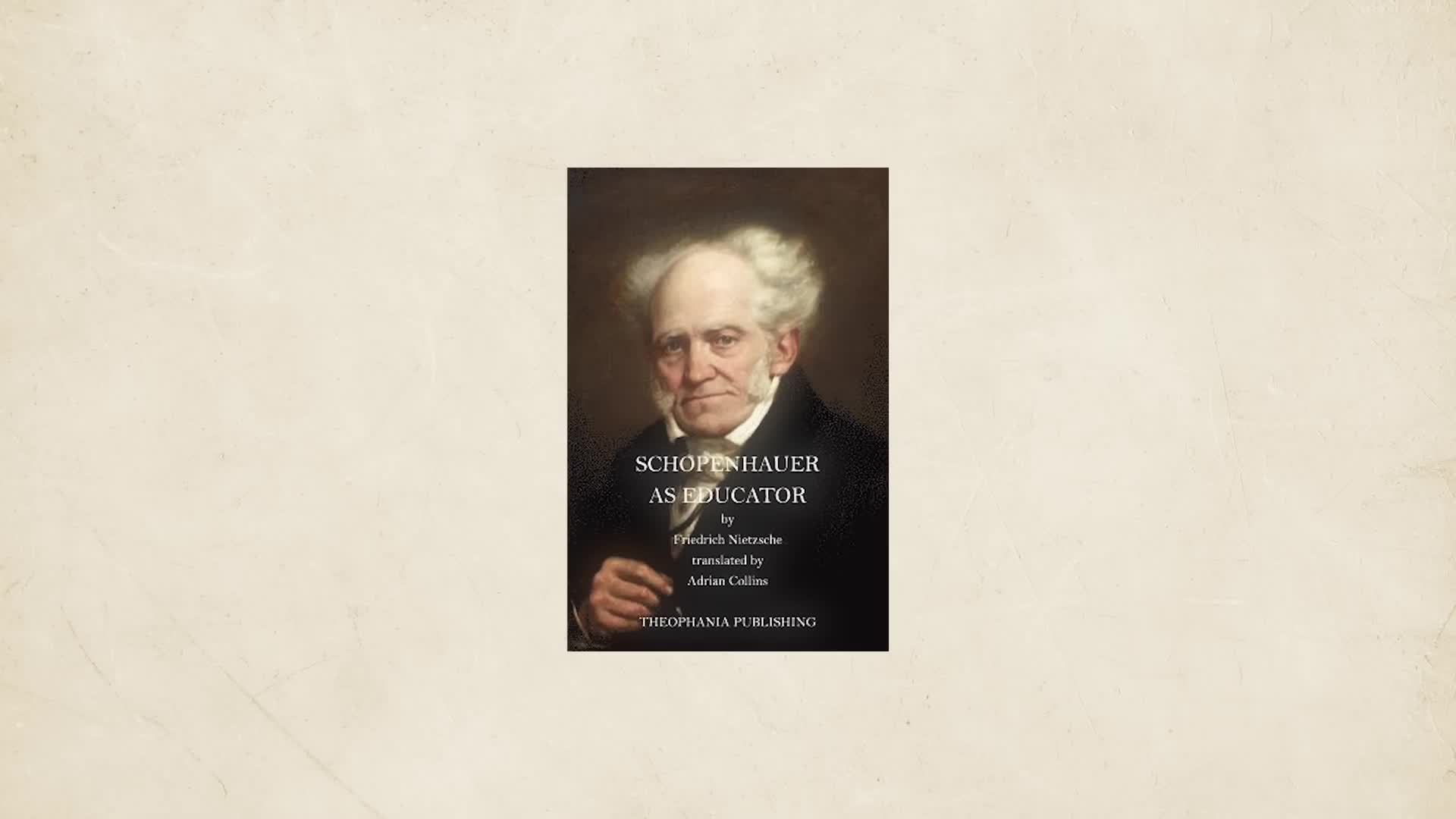
I recently read Schopenhauer as Educator, an essay written by Nietzsche, first published in 1874.
That is forever ago, but it continues to resonate in our modern world.
As I read it, I wrote down some of my own reflections and interpretations, and today I would like to share that with you.
We are responsible for our own existence.
We have only ourselves to answer for our existence.
Consequently, we want to be the real helmsman of this existence and not permit our existence to be a thoughtless accident.
One must take it somewhat boldly and dangerously, especially in any case, since one will always lose it.
It's both so terrifying and so liberating to understand that we ourselves are fully responsible for our existence because, On one hand, we sometimes want someone else to just tell us what to do, what the right choice is, and even for them to make it for us.
I know I've had moments where I've been at a crossroads and I will just beg someone close to me to decide for me.
Just tell me what to do and I will do it.
But what if they do decide for you and things go south?
Is it possible not to feel at least a little bit of resentment?
Or perhaps we will even grow cynical and start questioning if they actually even wanted what was best for us.
Or if things go well, we might think to ourselves...
We should have trusted ourselves, and why did we need someone else to fully decide for us?
Now us being fully responsible for our own lives does not take away from the fact that life is in many ways unfair and that the state of the world directly impacts our lives, and that there are people to blame for some things that might have unfolded for us.
However, you are still the helmsman, as Nietzsche writes, the person who steers the ship, and there might be waves, There might be broken glass, there might be someone on board who was acting like a fool.
You cannot control the uncontrollable, but you can execute a plan, right?
And you can train that execution muscle, if you will, by starting small, by planning something that is doable for you.
In fact, I think you should do that today.
So, for example, decide today that you will walk a thousand steps or anything, because you know life, especially confidence.
It's all about keeping a track record of i can'ts, and it's your track record that becomes your identity.
It becomes how you see yourself, in my opinion, and you want to see yourself as the person that you would trust to steer a ship and also the person others would trust to ride with.
So how does one do that?
Well, you sure don't just mindlessly and passively let the ship of your life float around.
You don't let the journey just be a series of meaningless and directionless event, no.
You have to take control, you have to have a plan and, as Nietzsche writes, to embrace it boldly and dangerously, because to live fully and authentically takes courage.
To live.
You know, as spring is approaching, I have been fully immersed in this topic in particular because, with the sun reappearing after 6 dark and cold months, and with all the beautiful colors finally coming back I, on one hand, feel filled with joy and excitement about the seasonal transition, but I also experience increased anxiety and stress levels because I feel this pressure to spend these next few months in the best way possible.
But how do I make sure that, however I choose to spend my days, I spend it in a way that authentically aligns with what I enjoy and with what I want?
Not because of social pressure or because I'm comparing myself to what I see online, or because I want to seem interesting or aspirational.
No.
I want to spend my days in a way that feels fulfilling for myself.
And I know that a lot of us can feel our anxiety peaking in late spring time.
So I'm very grateful that my paid partner BetterHelp, can connect you with a therapist who can provide support.
And actually most people who seek support via BetterHelp do so because they experience anxiety, and 69 of members report improved anxiety symptoms after 6 weeks of therapy on BetterHelp.
I really appreciate how easy, convenient and accessible BetterHelp is.
To get started, you just fill out a questionnaire and then you will be connected with a credentialed therapist as soon as possible.
And if you, for some reason, don't feel like it is the right fit which, by the way, as someone who's gone to therapy for years, it's completely normal.
You can switch therapists at any time at no additional costs.
If you ever have any questions, their support team is there to help you.
BetterHelp has over 7000 reviews and a 43 rating on Trustpilot, so you can trust them and take the first step towards helping you with your anxiety or any other block that you might currently be experiencing in your life.
Click the link in my description box or go to betterhelpcom slash Lana and get 10 off your first month of therapy.
Thank you so much again to BetterHelp for continuing to support this channel and making it possible for me to create these videos.
The opinions of others.
Why cling to this clod of earth, this way of life?
Why pay attention to what your neighbor says?
It's so provincial to oblige oneself to opinions which, just a couple hundred miles away, are no longer binding.
You know, i've thought about this and the fear of what others will think and this might be controversial.
But Isn't it quite self-centered to think that everyone will have such strong, strong opinions about us?
What I'm referring to here is when we shrink ourselves because we are so concerned with approval or judgement from others that we hinder ourselves from creating a life that aligns with our own wishes and values.
And this can range anywhere from deciding where to go to school or the job we pick where we live.
A trip we want to take our hobbies.
A new business endeavour.
And also, why does others having opinions have to be such a scary?
You know, what someone else thinks doesn't necessarily directly reflect who you are as a person.
Our opinions are often based on things like our own personal experiences, our own values, our upbringing, our culture, our personality.
So naturally there are things that I, for example, will find embarrassing or a bad idea or a waste of time that someone else will think is not.
So whenever I feel this resistance to do something because I fear what others might think, like to say to myself it's safe to assume that at least one person is going to have an opinion about this thing and i am deciding now that i am fine with it.
Now, the goal, i think, is not to reach some state of mind where we don't care what anyone ever thinks of us.
You know, i think it's healthy to care to an extent, because i don't know how else would we have a functioning society if no one ever cared about what anyone else ever did, ever.
The goal instead, is more so about reaching a state of mind where we can be okay with being judged or disliked, or perhaps even looked down upon.
Because ultimately, what's most important is what you know about you, not what others think about you.
Embrace your individuality.
Nobody can build the bridge for you to walk across the river of life, no one but you yourself alone.
There are, to be sure, countless paths and bridges and demi-gods which could carry you across the river, but only at the cost of yourself.
You would prong yourself and lose.
There is in the world only one way on which nobody can go except you.
Where does it lead?
Do not ask, go along with it.
Who was it who said, a man never rises higher than when he does not know where his way can lead him.
The river of life.
The challenges, the struggles, the decisions that must be made.
No one can face it for us.
You'll always be in the front line of your own life.
And sure we can seek advice from others, we can accept a helping hand, but ultimately our entire lives are our own responsibility.
This bridge that Nietzsche writes about must be built by us.
And isn't that part of what makes life so exciting?
I mean, overwhelming too, for sure.
But one of the luckiest things in life is to have options and to get to choose. all on your own.
It's one of those things that I get increasingly grateful for the older I get.
But how do we make the best choices for ourselves?
How do we know that it's right?
Now, of course, we each have our daily obligations.
But obligations are also a choice, are they not?
Because, let's say, for example, you choose to care for an elderly relative because it aligns with what you deem to be right to do.
You choose to work those extra hours because it aligns with the life that you're looking to build for yourself, and so on.
And each day, if we are lucky, there are many different paths that we can take.
Now, do we take the tempting one, the one that gives some sort of a short-term gratification or relief?
Do we take the one that carries risk or discomfort?
Do we take the path that someone else has already forged and we just follow their steps?
And we face these daily dilemmas often, even if we don't always pay attention to them, because most of life ends up going on autopilot.
We face it when we set our alarm for the morning the night before.
Do we decide to sleep in every morning um, or do we set our alarm for 25 minutes earlier so that we can do something that is going to help us reach some sort of a potential long-term goal, or perhaps not even long term, you know.
Perhaps the thing that you want to do is to simply Enjoy your coffee at a slower pace in the morning to get a better start of your day.
And those 25 extra minutes are going to make that possible.
Or you know, do we not put our art out there and not leave that relationship and not take a leap of faith and apply for that PhD or something?
Because it's scary and we would rather stay comfortable and safe.
But is it really comfortable to trade off your authenticity and integrity?
That sounds scary too.
What has shaped you?
Let the youthful soul look back on life with the question, what have you truly loved up to now?
What has elevated your soul?
What has mastered it and at the same time delighted it?
Place these venerated objects before you in a row, and perhaps they will yield for you, through their nature and their sequence, a law, the fundamental law of your true self.
Compare these objects, see how one complements expands surpasses, transfigures another, how they form a stepladder upon which you have climbed up to yourself as you are now, for your true nature lies not hidden deep within you, but immeasurably high above you, or at least above that which you normally take to be yourself.
Nietzsche challenges this idea that we should look deep within ourselves to find our true selves.
Instead, our true selves lie above us, and it's what we discover by reflecting on the experiences we've had in life so far.
Your true self manifests itself as the things you love, the things you do, the things you feel, the things you think.
And by reflecting on your journey so far, we may notice patterns and sequences that can help us understand who we really are, but we can only achieve this by taking a very honest look at ourselves.