Discussion keeps the world turning.
This is Roundtable.
You're listening to Roundtable with myself, Her Young, I'm joined by Steve Hatherly and Fei -Fei in the studio.
Coming up, you are at work.
The place where you spend most of your waking hours, surrounded by colleagues, familiar faces passing by, voices filling the room.
You nod, you smile, you exchange the usual pleasantries and jet.
A quiet emptiness lingers.
Why do I feel so incredibly alone?
We discuss this phenomenon and need a boost to crush the weak.
Our special segment, Motivational Monday is your ultimate adrenaline shot to kick things off strong.
Our podcast listeners can find us at Round Table China on Apple Podcast. Got a question that's keeping you curious from social issues to tech and everything in between, let us take a stab at it.
Email us at RoundtablePodcast at QQ .com.
Now let's switch gears.
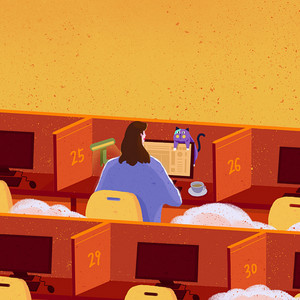
Workplace isolation, a growing concern in contemporary offices, can arise from established routines and communication barriers.
But might the solution lie within the problem itself?
Studies from the US show that generational differences could be seen as a source of division, may offer an intriguing solution by strategically encouraging interaction and knowledge -sharing across age groups, organizations could foster a more inclusive and connected work environment.
But can this truly bridge the gap or might forced interactions simply exacerbate existing divisions?
These reports mainly come from the American workplace.
How are folks feeling and from Where are they working?
Yeah, so this is from a McKinsey .com report from July of 2024, the American Opportunities Survey.
It illuminated how many people are offered the option to work from home, who works flexibly, and how they feel about it.
So 58 % of employees, they have the opportunity to work from home at least one day a week.
35 % reported having the option to work from home five days a week, that's quite a high number.
What makes these numbers, I think, particularly notable is that the respondents, they work in all types of jobs in every part of the country and every sector, and that includes blue collar and white collar professions as well.
Another interesting takeaway from the survey, when people have the chance to work flexibly, they take it, 87 percent take the opportunity if it's offered to them.
And that flexible working world was born from a crisis, wasn't it?
And it's a shift in how Americans want to work and it's a shift in how they are working.
What's perhaps surprising, or perhaps what was unexpected, is how people feel at the office for those who do work at the office on a regular basis.
And it's quite... I think it's a two -blade story really.
For example, if I am offered that I have the option to work flexible, I will definitely take it.
But then on the other side, that would also mean probably the line, the barrier between work and life will be blurred.
because you sort of, the home, or the home office that you're at are not the only, the office, like the workplace anymore, it's sort of - Yeah, you have two workplaces.
Yeah, so that means probably you will take some of the work, even though you are off, the time is off, you still need to take care of some of the work.
And then that would also mean pressure, I guess.
Hold on, I'm sorry I need to jump in here.
Because let's look at China.
Do you get the option to have one day to flexibly work elsewhere?
No, you don't. And now these folks are complaining.
Are they complaining that they feel lonely because they have a day they can work at home?
Are they? Well, we'll get to the reasons why they feel the loneliness that they feel.
But what we're seeing here in 2025 is a lot of major companies are making their employees come back into the office five days a week.
But when we hear that and then hear the statistic that we learned before, 87 % take the opportunity to work flexibly if offered.
To me, what that is, is a potential problem because it means that most employees don't actually want to be in the office, but companies want their employees to be back in the building.
And so this is an issue, isn't it?
And that's one of the reasons that loneliness may have extended inside the workplace.
There's evidence too that this is true.
31 % of US employees feel engaged on the job.
This is from January 2025 data from Gallup.
That's a 10 year low.
Only 39 % of employees feel strongly that someone at work cares about them as a person, And only 30 % strongly agree that someone cares about their development.
Workers under 35, especially members of Gen Z, they experienced a more significant decline in engagement than other age groups, dropping five points compared to the previous year.
Those are pretty alarming numbers, if you ask me.
31 % feel engaged at work.
and 39 % think there's only 39 % thinks there's someone that cares about them at the office.
Well, at the risk of selling callous, but again, let me play the devil's advocate again and also putting on the hat of a ruthless capitalist. Folks you're not here to make friends.
You're paid to be here to work and deliver.
I don't care if you're lonely or not.
Or, like, oh, what's the percentage, 34 or 39 % of Gen Z feel like nobody cares for them at work?
No, they feel disengaged at the office.
Now, but it's not just an American thing, by the way.
We should point that out.
There's a consulting firm named EY.
They did a survey in 2022 of more than 5 ,000 workers.
They covered Brazil, Germany, the UK.
They covered the US as well, but they found that 82 % of respondents indicated that they felt lonely at work.
And nearly half of those polled, almost 50%, experienced loneliness more now than before the pandemic.
Again, that's according to the UI report.
Globally speaking, one in five employees reported experiencing loneliness a lot the previous day, that's the term, a lot the previous day at work.
And loneliness now is more prevalent among employees younger than age 35, than it is for those older than age 35.
Perhaps expectations are different.
The same percentages of working men and working women report loneliness, so it's not one particular group more than the other, both 20%.
And this is becoming a big problem.
Why or what is contributing to people or workers feeling workplace loneliness?
Well, they say that engagement, or lack thereof, is one of the big problems. The Gallop survey looked at this as well.
So they looked at the engagement percentage.
17 % felt engaged at the office.
Sorry to stop you for one second.
What do you mean by engagement?
Is it like somebody talks to you, or is it you feel connected to your work?
Yeah, that's what I take it to mean, is that you feel excited about doing your work, you feel connected to your work, and I guess you feel a sense of reward. That's my definition by the way, that's not from the survey.
17 % felt engaged, 19 % felt not engaged, 31 % felt actively not engaged.
So if you add up those numbers, that's about 50 % of employees that are either not engaged or actively disengaged with their work.
And we might think, from the business point of view, well, we're paying you to do a job, right?
And if you don't feel emotionally satisfied, sorry.
but there have been studies that have shown that having positive feelings about your workplace really helps you improve your productivity as an employee.
Yeah that I can understand.
But what I don't necessarily understand here is your job satisfaction has anything to do with you feeling lonely at work?
I don't know like how excited I feel about my work has much to do with, oh, I'm feeling lonely at work.
Yeah, I think part of the disengagement definition as well is that we don't have people in the office that we feel connected to.
So part of the definitions is about the work itself, but part of the definition is about the environment.
This is really interesting.
Today, there are five generations in the workplace more than any other time in history, and that increase in diversity is primarily due to older workers remaining in the workforce longer than in the past, and that could be because of economic necessity, increased longevity or health.
In 2024, 18 % of the US workforce belonged to Gen Z.
They surpassed the baby boomers born 1946 to 64.
They make up 15%. Gen X that's 65 to 80, 1965 to 80 being born in that group.
They're 31 percent of the workforce.
The largest are millennials at 36 percent and then finally one percent of the workforce belong to the silent generation.
Have you heard of the silent generation?
Born 1928 to 1945. You're still working?
Those will be your older, your oldest co -workers.
And a lot of corporations see this diversity as a serious challenge because you have so many different age groups represented in the office.
And this could be part of the reason for the feelings of loneliness or isolation at work is because you have a hard time finding someone your own age to become close to.
That's one of the things.
They reference this.
It's a phenomenon. It's known as age -similarity preference, and it often causes us to gravitate towards people similar in age, including our coworkers, and that could be part of the issue as well.
It could be part of the reason that people are feeling loneliness.
So what do you do about it?
Well, the answer might be in the problem, they suggest. So what they talk about is that the diversity in the office among different age groups can be used as an advantage by pairing people together.
And what that means is pairing an older employee together with a younger employee for kind of a mutually beneficial exchange.
The exchange could be something along the lines of the younger employee will teach the older employee about new computer programs, AI, something along those lines.
The older employee could teach the younger employee about office culture, how to behave, how to get along well with people.
And they say that this could really work because that relationship doesn't have a pressure that other office relationships might in the sense that the older employee and the younger employee probably are at different stages in their career, the competition won't exist between the two of them.
And there's more of an opportunity for an organic friendship to grow.
So it's kind of like a mentoring program.
It's like a co -mentoring program.
But that reminds me of, in traditional, a lot of the Chinese factories, they do have this mentoring program.
It's not mutual mentoring.
It's sort of apprentice program.
But I think in some surveys here in China, that also can lead to problems like isolation that because you are of different apprentice you are sort of in different circles and if you are not under in any of these circles you are the one who's been sort of isolated then you will be feeling lonely as well so but then this one is about mutual mentoring i'm not sure because here in china i don't think we have that much of a generational diversity in offices right now.
But I do think that the offices are getting quieter.
It's definitely getting quieter.
You can feel that. Yeah, it's getting quieter, especially compared to when I first started working.
Well, I won't say the exact number, but it's definitely more than a decade ago.
I think one of the reasons is because a lot of the communications right now in workplace are carried out online.
Yeah, there's more texting, in -office texting.
Yeah, so you won't necessarily making calls, you won't necessarily need to talk to your coworkers face -to -face, because you can just messaging them.
And that can also lead to loneliness.
You feel like you've been sitting in the office all day, but not necessarily talking a lot.
And also with the younger people joining the workforce.
And this is a new generation who's more comfortable with texting than sometimes face -to -face communication.
How scary is that? But anyhow, coming from an older person, the workplace is changing and issues come up and they should be addressed.
And you're listening to Round Table coming up next Motivational Monday.
Motivational Mondays!
Motivational Mondays!
Yeah, this is our Motivational Monday segment, and considering what's going to be shared, and how timely it is, I will happily take up this one, if you guys don't mind.
Go on then. Oh yeah, folks.
I went for a night out in the town to a concert.
And if you live in Beijing, then you have probably seen the news about it and also traffic alerts about it.
What a night at Zhonghui Mei or Ah Mei's Bird Nest concert in Beijing last night and three hours of full on live vocals singing and dancing nonstop.
And she's never missed the beat.
And her voice is known to be raw and raspy yet soared with explosive power like gritty fire reaching the clouds.
And she's a walking combination, or you can say of contradictions.
Vulnerability fused with powerhouse high notes.
And it's not just Alan.
It's mastery built over decades.
Watching her, I couldn't help but think of Mariah Carey, who I've shared the experience of going to see her concert in Beijing last year.
Both are true vocal legends, but Ah Mei, 4 years younger, has carefully protected and refined her voice over, shall I say, almost 30 years by now.
In a world obsessed with youth, she s proof that time can be your ally, if you keep showing up for your gift. And let s not forget, her three decade long career hasn t been smooth sailing.
There were times she lost her voice, faced harsh online criticism, and went through public weight shaming.
But she's never let that define her.
And now no matter what she weighs, she sells out stadiums every single time.
And she's transcended the spotlight's obsession with looks.
People come for her music, her energy, her live performance.
That hits straight to the heart.
And on today's show, I want to share with you that rock anthem kai men jiang shen and it hits like a spark open the door and boom there's the mountain right no fluff no filters just the truth standing tall is her way of saying cut the noise go straight for it and it's like shouting don't waste time don't water it down just go so if you're stuck this monday don't be kick the door open face the mountain and that's your moment to rise, and make it count, please.
And enjoy the music I suppose.
And that brings us to the end of today s show!
Thank you so much Steve Hatherly and Fei Fei for joining the show and sharing your wonderful thoughts.
Thank you for tuning in, I m He Yong.
Enjoy Zhang Hui Mei, Kay Men Jiang Shen and I will see you tomorrow!