Welcome to Spotlight.
I'm Liz Waid.
And I'm Colin Lowther.
Spotlight uses a special English method of broadcasting.
It is easier for people to understand no matter where in the world they live.
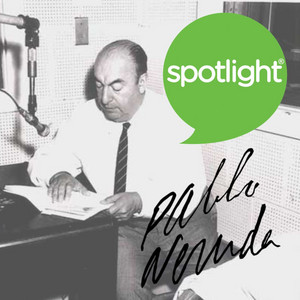
Today's Spotlight is on famous Latin American poet Pablo Neruda.
We begin with one of his poems called, It Is Born.
Here I came to the very edge where nothing at all needs saying.
Everything is absorbed through weather and the sea.
And the moon swam back, its rays all silvered.
And time and time again, the darkness would be broken by the crash of a wave.
And every day, on the balcony of the sea, wings open.
Fire is born, and everything is blue again like morning.
This poem talks about the power of the sea.
But Neruda wrote many poems.
Some poems told stories from history or demanded change in society.
Neruda also wrote poems about politics.
He wrote emotional and sexual love poems.
And he also wrote poems about common things in life, like nature and the sea.
Pablo Neruda was born in 1904 in Chile.
His name at birth was Ricardo Eliezer Neftali Reyes Pasualto.
Even as a young boy, he was always interested in literature and writing.
In fact, he started writing poetry when he was only 10 years old.
A local newspaper first published his writing.
He was only 13 years old.
But in 1920, he began to use a pseudonym or false name in his writing.
Neruda's father did not approve of his son's writing.
So, Neruda used a false name to hide his writing from his family.
He chose the name Pablo Neruda.
In 1923, Neruda published his first book of poems.
It was called Crepusculario, in English, Book of Twilights.
And a year later, in 1924, Neruda published his second book of poems.
It was called Vente Poemas de Amor y Una Canción Desesperada, or in English, 20 love poems and A Song of Despair.
Some people thought these poems were too erotic or sexual, especially because he was so young.
But they were very popular.
Each of Neruda's first books was translated into many languages.
And they remain popular even today.
Here is part of one of the poems from 20 Love Poems.
Tonight I can write the saddest lines.
I loved her, and sometimes she loved me too.
Through nights like this one, I held her in my arms.
I kissed her again and again under the endless sky.
She loved me sometimes, and I loved her too.
How could one not have loved her great still eyes?
Tonight I can write the saddest lines.
To think that I do not have her.
To feel that I have lost her."
During his life, Neruda travelled all around the world.
He lived in other countries as a representative for Chile.
But he also continued writing.
And he experimented with different kinds of poetry.
During the 1930s, Neruda was working in Spain.
Spain was experiencing a civil war.
The people had suffered.
Neruda saw the effects of war there and he became very interested in politics.
Here is a part of the poem.
I'm explaining a few things.
It is about his time there.
And one morning, all that was burning.
One morning, the bonfires leapt out of the earth, devouring human beings and from then on fire, gunpowder from then on, and from then on, blood.
Come and see the blood in the streets.
Come and see the blood in the streets.
Come and see the blood in the streets.
When Neruda began writing, his poems were about many different things.
But now his poetry turned toward more political subjects.
One of Neruda's most famous and political poems is called Canto General or General Song.
It was made up of almost 250 poems in 15 different parts.
It told about much of South American history.
It even told about the land and plants.
But most of all, Canto General demanded social justice for all people.
It was translated into many different languages.
And it is one of Neruda's finest works.
Another of his most famous poems is called Alturas de Machu Picchu, or The Heights of Machu Picchu.
In 1943, Neruda went to Peru.
There he saw the ancient Incan remains of Machu Picchu.
He wanted to write a poem about the place.
The poem was made up of 12 different parts.
In the poem, he wrote about the beauty of the remains.
But he also told of the slaves that helped to build the structure.
In the poem, Neruda invited the dead slaves to come back to life.
He said that he would be their voice.
Here are some parts of that poem.
I come to speak for your dead mouths.
Throughout the earth let dead lips congregate.
And tell me everything.
Tell chain by chain and link by link and step by step.
Speak through my speech and through my blood.
This poem also encouraged interest in the ancient people of South America, like the Inca.
In 1971, Neruda won the Nobel Prize for writing.
Some people debated if he should win.
They did not agree with his political beliefs.
And the government of Chile did not always like his work and ideas.
But other people worked hard to make sure Neruda received the award.
They believed his writing was special.
Neruda retired to Casa de Isla Negra, his house on the Black Island.
He loved this home because he loved the sea.
This is where he wrote the poem we read in the beginning of this programme, It Is Born.
He died in 1973.
Records say that he died of a heart attack.
But there have been many questions and even investigations around his death.
But his poetry still lives.
Over the years, Neruda's poetry has inspired many people.
We end today's program with a part of his poem called, Poetry.
And it was at that age poetry arrived in search of me.
I don't know.
I don't know where it came from, from winter or a river.
I don't know how or when.
No, they were not voices.
They were not words, not silence, but from a street.
It called me from the branches of night abruptly, from the others, among raging fires or returning alone.
There it was, without a face, and it touched me.
Do you enjoy reading or hearing poetry?
Have you ever heard the poems of Pablo Neruda?
Do you have a favourite poet from your country?
Tell us what you think.
You can email us at contact at spotlightenglish.com.
You can also find us on YouTube, Facebook, Instagram and Twitter.
The poems in this program were translated by a few different writers.
For more information, visit our website at www.spotlightenglish.com.
This program is called, The Life and Poetry of Pablo Neruda.
Visit our website to download our free official app for Android and Apple devices.
We hope you can join us again for the next Spotlight program.
Goodbye.