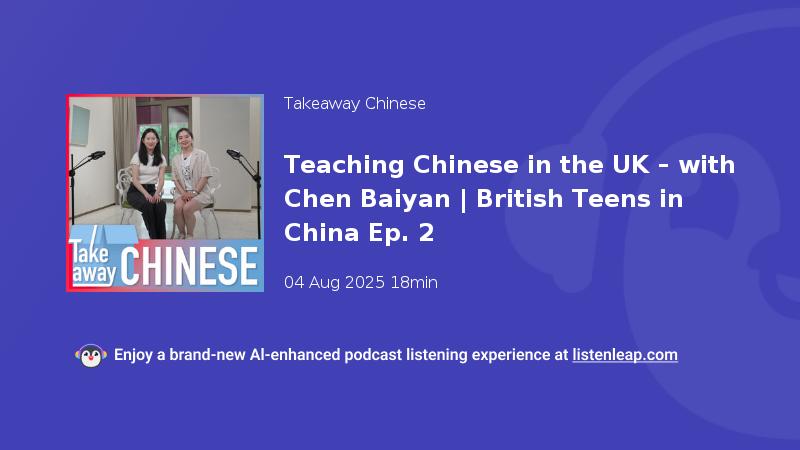
你好 ,欢迎收听随行汉语。 Welcome to Takeaway Chinese, I'm Niu Niu.
And this is a special edition of our show.
My colleague Ma Jing recently visited Beijing Language and Culture University, where she met a group of UK students studying Mandarin, along with the teachers who are accompanying them.
It turns out that the students are here for an exciting 11 -day summer camp packed with language learning and culture experiences.
In this episode, Ma Jing talks to one of the Chinese teachers, Chen Bayan.
She has been teaching Mandarin in the UK for over seven years.
Chen shares her experience teaching Chinese along with some handy experiences and useful tips for learners.
Is pinyin the most important starting point for Mandarin?
How can we create an immersive learning environment if you're not in China?
Let's hear her take on that.
Hello, I'm Ma Zhu, and today we are in Beijing Language and Culture University.
I have a special guest here.
I'm joined by Chen Baiyan.
Hello. So many of our listeners are actually Chinese language learners from across the world.
So you are a Chinese teacher.
I'm sure you have lots of insights to share with our listeners.
Could you tell us a bit about yourself first?
Oh, yeah. I'm Baiyuan Chen.
The students also call me Miss Chen.
And I teach Mandarin in the U .K. for more than seven years.
And also, I finished my Master's degree there, and I become for qualified teacher in U .K., to start my Mandarin teacher career in the UCL Academy.
More than seven years, so there must be a lot of stories.
Yeah. So, do you remember any funny moments or interesting moments?
Definitely. The first lines for my first lesson I want to mention, the UK students are quite different as for Chinese students.
They're quite challenged.
Their behavior is very hard to manage.
And they're not following teacher's instruction.
So the first lesson is quite cannot deal with for their behavior.
It's very tough for me.
During that time, I'm doubt that these are the real things that I want to be a teacher in the UK.
But my mentor encouraged me.
And after the first lesson, I reflected for myself.
I found myself to learn how to deal with their behavior, how to give the clear instruction, and let them calm down.
So after the first lesson, I gradually, gradually, step by step, become more and more qualified teacher.
That sounds like a hard work.
Yeah, really hard. So, do you find your job rewarding?
Yeah, the job rewarding one is, for myself, I've become more and more patient.
And also the other things, even the student behaviors are a challenge but I can feel very worthy to be the teacher and it is quite rewardable and that made especially when they mentioned for Miss Chen like this one anytime even I feel I will struggle to manage their behavior but as long as they mentioned to me with Chinese and that was super super great so has teaching students from different cultures ever changed your views about Chinese yes I think for me me I want to be more patient to let the student understand that the culture different.
And also I use the third version to see what's difference between what's the view and the Chinese view, I would like them to understand both which side we can get a neutral way to be great for both part.
I think that's quite great.
That's great. So when I am learning English, I always think which one teacher is better?
Should I learn from a native speaker directly, or should I learn from someone who's from the same background as I am?
Maybe a Chinese teacher teaching me English.
So what do you think?
Who could have more advantage, maybe a teacher like you, a totally native speaker?
I'm more recommended for both sides, because, if you have got the whole of the Chinese -English teacher one, you would get more very strict and also very fixed systems of the grammar one and for the keywords meaning of that that will be like you can build for the system where you fastened or solid and for the if you get for native speaker one that you can to let your language skills improve quite a lot especially for the authentic and spontaneous way that very great great okay so let's talk about the language itself some language tips for our listeners so when we start learning a new language especially
chinese so where should we start what do you think should we start with pinyin because i remember this how like we as chinese kids were taught first in school pinyin what do you think uh ma i will more highlight for the characters to them and we are start from numbers as numbers just stroke and circle the one two three first line second line third line it's really easy to the student learning to writing down and also based on the characters we have a culture lens lesson inside of this one also culture version inside of this we can introduce the writing the characters from left to right from top
to down that's really interesting things for the student get to know and also we are combined the chinese characters with the with jaguar together with a picture because the the student will be easy to identify the picture based on picture and they have meaning inside and we can let for students guessing what's the meaning of that one for example for the Shan is a mountain one.
We were just drawing for three triangle things together in the whiteboard and then that student mentioned what's this guessing and the immediate answer it's definitely mountain.
So that's where we're great ones because for the nowadays based on the reading and research mentioned, the Chinese characters, it's only one language have the characters with the meaning will be combined together so also the first lesson we are introduced the newspaper will bring for the authentic materials newspaper handout to students that them to read you can see the whole of Chinese life just no pinyin you only read for Chinese characters so if you want to study far away from Chinese learn more deeper of Chinese Mandarin you definitely need to get know of the Chinese characters to identify
that is your journey but do you think that's a little bit hard for students the newspaper the newspaper definitely very hard to learn and it's not we don't ask them to them to to read of that one we'll ask the student to get the environment to get the feeling of the one you can see the real chinese life will be all the things will happen in chinese characters without any pain so don't rely on the pinyin just try to write on the chinese characters to identify that that'd be great great so why do you think students are taking Chinese class?
Because when we had the parents evening and we ask to our parents why you want to choose for Mandarin why do you want your children to choose Mandarin the first one we have because the students really were enjoying of the Mandarin because you have taste lesson at least for three months at the beginning of the every academic year the whole of the students are just to taste the Spanish, German and Mandarin and they are for Mandarin, so this time our Mandarin teacher will be show of our skills to get more attractive of this lesson and the student quite enjoy to learn of this time and also the parents
mentioned to me that they think the Chinese economics grow very fast and they think maybe in the future Chinese language is in the means future so please let my children to learn of this language.
So what mistakes do you think students often make?
The student mistake will be the stroke order cannot follow the left to right up to down and also you cannot imagine what the characters are writing.
It's really hard to identify.
Yes. They're handwriting very bad.
So how do you help them overcome the difficulty?
Because in China we may use这剃 Yeah yeah.
Do you also use? Yeah we are used for the Chinese characters worksheets for that one we are print out the shadow of the characters.
For example, for the Mi Fan, the first two characters are the shadow one, you just make the shadow follow us and then continue to write it.
That's very helpful.
And also we are doing that to read more Chinese authentic materials for the reading one.
Same as our our way to learn English.
I think the more input will let the students to get to know more output in the future to learn Mandarin that's great.
And also do you think there's a shortcut to learning Chinese?
Maybe you can provide us with some useful tips.
Oh, the useful tips for the culture part I think.
And I have one student, he learned Mandarin as one of his A -level subjects.
That means he will choose Mandarin for his university exam.
and during that exam they should use the characters to write down for the neuro films and analyzations texts all of this will be written down in characters just like our Ruo Du Li Jie that's very very hard but he finds it really really great for his journey to learn Chinese and he's quite enjoying of this one especially he mentioned for the Xiao Shu of fiction fiction for the each of folder the special page and he's quite enjoying to read out that version it's very lovely one so you mentioned a lot about the connection between language and the culture you also organize a lot of cultural activities
what part of the culture thing that students like and what part they don't like what do you think um the really enjoyable one for students to own maybe the chopsticks one they use of chopsticks not often we can have this competition that you get different balls of that one with chopsticks that have a taste of chopsticks or workshop and the other one because i think very interesting is for the calligraphy because in the uk they didn't use any calligraphy lesson they have the art lesson but they don't use that style of brush to drawing on a tool writing down the characters that's a whole different
system for the west side and the chinese side pressing very interesting and different they're quite enjoying Enjoy and enjoy this.
Great. So, is there anything they don't like, maybe they think it's a little bit boring or dull?
The boring one is for writing down homework.
Homework, yeah, because they keep complaining about the Mandarin, how a lot of homework lie.
But, I just want to show it.
You learn the language.
The language, that means you have to be in the atmosphere, in the environment.
So, it means more input and you can get out now.
So I encourage my students every day 10 minutes for Mandarin practice.
That'd be great for you to learn Mandarin.
Please have this habit, please.
Okay, that's funny.
So here's a funny one because I understand sometimes people get confused by translation because we have some things that doesn't translate properly because sometimes you heard 小心地花 but sometimes people translate as sleep carefully.
Wait, actually! So, which actually means that the floor is slippery.
So do you often see these kind of situations?
The sentence order is very hard for students to learn Mandarin, but I would encourage them to have the, for example, have the PTMA sentence structure in their memory, in their mind.
For example, every person, time, action, with someone, go to some place, buy some transport, and then do the action.
That way, it's easier for the student to learn Chinese and easy to adopt for this long sentence.
This long sentence is the correct Chinese sentence order.
But once we translate it into English, that should change the order.
So I also asked students, you should figure it out by yourself because you are an English speaker.
So you should get the order correctly to translate from the Chinese to the English one.
Show off your English to me, please.
this. Now some of students are actually traveling in China through this summer camp.
So do you think they feel culture shocked?
The culture shocked one?
Oh, the toilet paper one.
Yeah, because in the UK, all toilet paper can be put into the toilet, but in China, we have a special thing.
That's why there's not much adjustment, but so far they are okay.
Okay. Oh, the other one is payment.
They mentioned the payment, since it's very different.
In UK, we still need to use the cash to make the payment.
And in China, we encourage you to use the mobile payment.
I think it's very convenient.
And all my students get the WeChat Pay already before we departure here.
So they are quite lucky to use the WeChat phone to scan every QR code and to get payments.
They're quite enjoy of this.
So what's the most enjoyable experience so far in this trip?
Every day is quite enjoyable.
As my student Kim mentioned, it's quite a great one.
and it's so lovely miss i want to stay in china please let me stay in china please yes then we're going to great wall as you mentioned please okay let me climb the greater wall and longer and longer i don't want to go to the afternoons uh afternoons activity i just want to go more great wall please let me go there wow i also learned when they are having a chinese lesson here in this university in beijing culture and language university so they are they are totally taught in chinese not english so can they be used to that yeah i think this one's great for my student because you are in the country
and we cannot rely on the p and english translation and also you can use of your learning skills to figure out what's the meaning of teacher mentioned and sometimes teacher will explain to you with a little bit english but you can based on that one to guessing and this one's also one part for learning language skills and it will be great for students to get them put in put more chinese language okay if you can only introduce five chinese expressions maybe words phrases or sentences to our listeners what would they be the first slides for our yesterday we've been to great or that definitely will be
and all my uk students know of this sentence so encourage them we are now you have to come clapping more.
You are great people.
To prove you are great people.
That's a very great one.
And the other one will be because the people to learn Chinese and all my students mentioned is Chinese food is very great.
They quite like Chinese different snacks.
And the this one is quite great for them to taste and to try of them.
And the second one is the third one is to bargain one.
The student quite like to bargain.
In the market in the shops, to mention a 便宜一点, to do that competition.
They think it's very enjoying to do that.
It's 很好玩, because this one is very easy to pronounce, and very easy to memory of these keywords in their mind.
So any reason when you're asking why do you like to play basketball, they mention 很好玩。 Why do you like swimming?
很好玩。 It's very useful and attractive to mention why you like these things.
The other one will be, I think, it will be the, oh, another one for idioms, for example, 人山人海, because we learned the 山 and the 海 and the people quite early.
And in the first stage of the beginning of the Chinese learners, so that idioms is very easy for them to identify, most many of that one, 人山人海.
So, and also you can introduce for another system of about for the culture and the, for the idioms system to them that, you know, we have the four characters together about become for the idioms that's great and you can show off your language skills please give me more so the student mentioned 我有五花八门的爱好 oh yeah that's great one and also 车水马龙 like this great so just to clarify so 人山人海 literally means people mountain people but it but it actually means a lot of people are called it yes and also 我有五花八门的爱好 yeah kind of like saying I have a lot of hobbies.
So do they also know people, mountain people say those kind of Chinglish?
Yeah, yeah. Sometimes we'll introduce Chinglish to a student because of the keywords.
World by World Translation is that one.
And students will have easy -to -memory for the Chinglish.
It's quite great for them.
So you mentioned a lot of fun ways to learn Chinese, for example, through games, newspaper, or something else.
What kind of fun ways do you recommend our listeners to do?
the list maybe you can play the game to the flashcards or easy one yeah to make a flash card and to cover up this one try to test yourself for both and this one will be like every day to see the characters and once as long as you see this one every day it definitely will be easier to memory the keywords and also not only for the flashcards we can put the keywords in the long sentence and try to remember the sentence that'd be great Also the long essay or assignment one will be great.
Just like our English version, as long as we read quite a long story, we have memory of this one.
The authentic sentence we put into our mind, we have this feeling of that will be easy for us to learn the continuing part.
One last question, what message would you want to share with our listeners who are currently learning Chinese from around the world?
Could you share one sentence of encouragement to them maybe?
I think for the Mandarin, don't feel it's very hard. Please challenge yourself.
Mandarin is very special and unique.
And also the other one means you have more skills that will help you for your future life.
And totally great. Try to practice Chinese characters and to read more Chinese story to do more input and output.
That would be fantastic for your learning Chinese.
Chinese. So thank you, Ms. Chen, for sharing your incredible story with us and also your useful tips.
And I hope our dear listeners, you have also learned something through our discussion today.
And please leave a comment to tell us what you think.
Bye for now. You