In the US, summer is for sand, sun, and blockbuster movies.
And this summer, we're going to use those movies to learn English and study how to sound American.
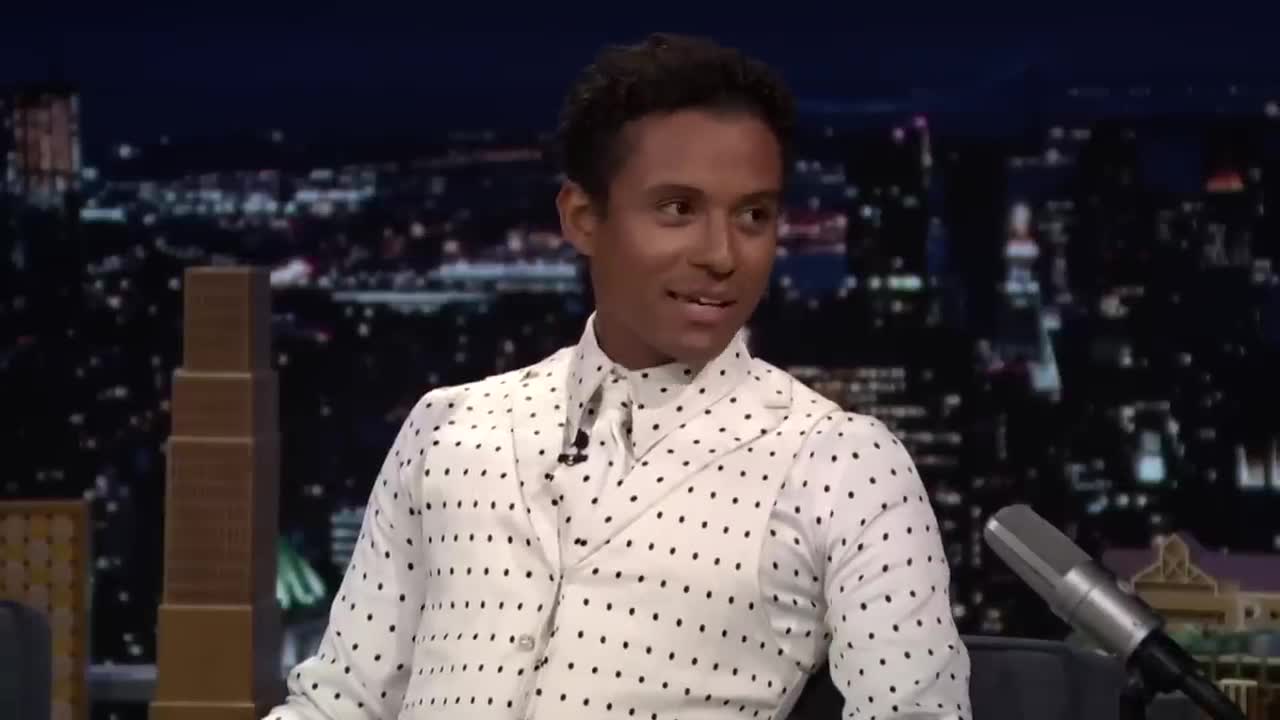
Rather than showing a scene from the movie Michael, I'm showing an interview with the star from the movie Michael, his nephew Jafar Jackson.
After the clip, we'll do a full pronunciation analysis of everything we hear to help you better understand the American accent.
I saw an article where it said that Graham King got the rights to tell Michael's story.
My first thought was, who are they gonna get to play Michael?
And honestly, I didn't think of myself.
I was like, this is gonna be really interesting.
So fast forward a couple of months, I get a call from Graham King.
And he's kind of looking at me, like he asked me, have you ever acted before?
I said, never, I've never wanted to be an actor.
I saw an article where...
I saw an article where, then a little, little break,
So, I saw an article.
All links together and we have pitch changes.
Smooth, gliding pitch changes.
So natural in American English.
I saw an article where R
The first syllable of a noun and saw, our verb, are the two stressed syllables here.
I saw an article where, I saw an article where,
I saw an article where... Generally, our stressed words are going to be nouns, verbs, adjectives, and adverbs, though not necessarily every single one of those.
So here we have, I saw an article.
You want that pitch change.
That's what makes English clear.
That pitch change on a stressed syllable.
With that pitch change, those words are also longer.
I should say those syllables are longer.
And also, they can be a little bit louder.
They have more vocal energy in them.
The word I just connects in to saw.
I saw.
By itself it would be I, I, I, I.
Quiet, not much to it.
I saw.
I saw an.
I saw an article.
All linking together.
I saw an article
So the AI diphthong right into the S, no break.
The AH vowel right into the schwa.
Son, son, I son, I sonar.
And then the N right into the beginning vowel.
Anar, nar, narticle.
And that's a flap T because it comes after an R before a vowel, so not but a single bounce against the roof of the mouth.
An article.
I saw an article.
If you like this kind of analysis, Rachel's English Academy is full of them, and they all come with audio training soundboards.
I would love to have you as a student.
It's a great way to transform your speaking confidence
And give you a truly natural sound speaking English, check it out at rachelsenglishacademy.com.
This is a dark L here.
It comes at the end of the word.
Make sure you're not lifting your tongue tip up.
Let the tongue tip stay down.
Uhl.
While you press the back part of your tongue down and back a little bit.
Uhl.
That gets that dark sound.
Article.
Uhl, uhl.
Not cal.
La la la.
In the front of the mouth.
Article.
Article.
Article were.
The word where, not stressed here, so it's pronounced were, were.
It sounds like this word.
Were.
I would write that
In phonetics, in IPA, with the schwa symbol, not the EH vowel like in where, but were, were, were.
And it's flat and it's short.
That's because it's unstressed.
Were, were, were.
This contrast between stressed and unstressed syllables are actually what makes American English clear and really easy to understand.
I'm going to play this three times.
Then there will be a break for you to repeat it.
Let's do that in a cycle of three.
So you'll hear it three times, then you repeat, then you'll hear it three times, then you repeat.
I saw an article where...
I saw an article where...
I saw an article where...
I saw an article where...
I saw an article where...
I saw an article where...
I saw an article where it said that Graham King got the
Okay, so a little bit longer here.
I do think there's a little bit of a lift here while he's thinking exactly of how to finish his sentence, but we've got a lot of words here.
Let's see.
Do they all link?
Do they glide together?
Where are pitch changes?
It said that Graham King got the rights to tell Michael's story.
It said that Graham King got the rights to tell Michael's story.
It said that Graham King got the rights to tell Michael's story.
It said that Graham King got the rights to.
So, I'm hearing Graham King, our proper noun, of course.
That makes sense that that would be really stressed.
Graham.
King.
Both of those words.
Longer, clearer, up-down shape of stress.
And then finally the word writes, a noun.
All the other words, a little bit flatter, maybe a little bit quieter, said more quickly.
To said simply to, to.
Rights to.
To.
Rights to.
Rights to.
Rights to.
We would write that in IPA with the schwa symbol.
So it's not the OO vowel.
It changes, it reduces.
So common in American English.
In order to get that contrast, stressed, and unstressed syllables, we have to change the unstressed syllables so we can make them so short.
So the word TO becomes Tuh.
Rights to.
Rights to.
Rights to.
Let's just look at our last three words.
The rights to becomes the rights to.
So a little dot, then our up-down shape of stress, then a little dot.
The rights to.
The qualities are really different between these stressed and unstressed syllables.
Now let's link it all together.
The rights to.
The rights to.
Let's look back here.
It said that.
It said that.
It said that.
It said that.
It said that.
It said that.
Now that I'm looking at just three words, I do think there's a little length on our verb.
It said that.
It said.
It said that.
It said that.
It said that.
It said that.
It said that.
It said that.
It said that.
It and that so fast.
They both have a stop T. It... That...
Where we don't hear the release, but the sound gets cut off.
That's how we pronounce a T when it's followed by a consonant.
Here it's followed by S. Here it's followed by G. So it, that, it, that.
Practice that.
Practice saying that so quickly.
It said that.
It said that.
It said that.
So, let's do our repetition training, this time with the words, it said that, Graham King.
Listen to it three times, feel the smoothness, feel the up-down shape of stress, and then repeat it.
And we'll do that three times.
It said that Graham King It said that Graham King It said that Graham King It said that Graham King It said that Graham King It said that Graham King
It said that Graham King.
It said that Graham King.
It said that Graham King.
It's said that Graham Kean got the rights to tell Michael's story.
Got the rights to.
Got the rights to.
So, we have another stop T here.
The next word begins with the voiced TH.
This is how we write it in the International Phonetic Alphabet.
Got the.
Got the.
Got the.
So, there's no T. T release.
Got
The, got the, got the, got the, got the, got the rights to, got the rights to.
This is the only word that really has length there.
Now you do the repetition training.
Make sure you're actually practicing out loud.
That's how to make real change happen and feel the smoothness.
Got the rights to.
Got the rights to.
Got the rights to.
Got the rights to tell Michael's story.
Tell Michael's story.
Okay, what do you think is the most stressed word there?
Tell Michael's story.
Tell Michael's story.
Tell Michael's story.
I think it's story.
The noun, tell Michael's, so we have some there, tell Michael's story.
But our noun has the most change.
Tell Michael's story.
Tell Michael's story.
Tell Michael's story.
The word tell begins with a true T, so we do get that release right into the EH vowel.
Teh, teh, teh.
Now here's another dark L. Written with two letters this time, still just one sound.
Oh, oh, oh.
Made with the back of the tongue, not the tip.
Tell, tell, tell.
Oh, oh, oh, oh, oh.
Tell Michael's story.
Tell Michael's story.
Tell Michael's story.
Tell Michael's story.
My-cles.
We would write this second syllable in IPA, K, schwa, L, and again, that is a dark L. Do not lift your tongue tip for it.
The apostrophe S here possessive after an L is a Z sound.
Michael's story.
Michael's story.
Michael's story.
Michael's...
But when a Z links into an S, guess what?
The S wins.
So it's really just Michael's story.
Linking these two words with the single S sound, forget the Z sound exists.
Michael's story.
Michael's story.
Michael's story.
Michael's story.
Michael's story.
To tell Michael's story to tell Michael's story to tell Michael's story to tell Michael's story to tell Michael's story to tell Michael's story to tell Michael's story to tell Michael's story
To tell Michael's story.
Yeah.
My first thought was... Then the host, Jimmy Fallon, says, yeah.
He's listening.
He's showing that he's listening by saying, yeah, yeah.
Little up-down shape of stress.
Yeah.
Yeah.
Yeah.
My first thought was...
My first thought was, and then a break.
What was his first thought?
Okay, so my first thought was, we have an ST cluster followed by a consonant.
Here it's TH, but it's different than the word the up here.
Here it's unvoiced.
F, f, f.
But when we have an ST clustered followed by a consonant, we usually drop that T and he does that here.
He's actually holding out the S a little bit, but there is no T, T released sound.
My first thought was, my first thought was,
My first thought was... My first thought was... My first thought was... My first...
So we have some stress in first and it's held out a little bit.
Thought was...
Then we have the up-down shape of stress for the AH vowel.
That's a stop T because the next sound is a consonant.
We don't hear that release.
The word was, just like the word to up here, it's unstressed.
In order to make it really fast for contrast,
It's what we call reduced, where the vowel changes from uh to uh.
Was.
Was.
Was.
Thought was.
Thought was.
We don't want to hear was, but was.
My first thought was.
My first thought was.
My first thought was.
My first that was my first that was my first that was my first that was my first that was my first that was
My first thought was, who are they gonna get to play Michael?
Who are they gonna?
Who are they gonna?
And then he does a little break here.
Everything else linked together.
Going to, of course, so common, becomes gonna.
Who are they gonna?
Let's get rid of our two down here.
Who are they gonna?
So when we have a question that begins with a question word, like who, what, when, where, those almost always have quite a bit of stress.
Who?
Who?
Who are they gonna— Who are they gonna— Who are they gonna— The word who, WH, it's very common for that to be pronounced like a W, like in the word what.
Or up here in the word where.
But in this word, WH makes the H sound.
Who.
Who.
Who.
There's no W in it.
Who.
Who are they gonna— Who are they gonna— Who are they gonna— Who are they gonna— Who are they gonna— So all of the rest of these words are unstressed.
They're just falling down from that one peak of stress.
Who are they gonna?
Who are they gonna?
Are they going to becomes, are they gonna?
Are they gonna?
Are they gonna?
So fast, quiet, not a lot of vocal energy.
The word are reduces.
It's said just like earth.
Who-er.
Who-er.
The word they is they, they, they, they.
Flat.
Not a lot of energy.
Going to becomes gonna, gonna, gonna.
Who are they gonna... Who are they gonna...
Who are they gonna?
Gonna, gonna, gonna.
They both feel unstressed to me, really, both of those syllables.
I think I'm going to write them both with the schwa.
The schwa is the most common sound in American English because so many sounds change to the schwa when they're reduced.
Who are they gonna?
Who are they gonna?
Who are they gonna eat?
Who are they gonna eat?
Who are they gonna get to play Michael?
Get to play Michael.
Okay, so now we have a couple more up-down shapes of stress.
Get to play.
Get to play Michael.
And then the proper noun has, of course, an up-down shape of stress on the stressed syllable.
Get to play.
Notice we have two Ts here.
Those words link together with a single true T. Get to, get to.
And just like here, where the word to reduced, it reduces here also.
We don't say to, we say to.
Get to, get to.
Get to play.
If you like this kind of analysis, Rachel's English Academy is full of them and they all come with audio training soundboards.
I would love to have you as a student.
It's a great way to transform your speaking confidence
And give you a truly natural sound speaking English, check it out at rachelsenglishacademy.com.
Get to play.
So stress on get.
Get to play.
Then the pitch comes down, the voice falls off as you put in the rest of that phrase.
Get to play.
And then another smooth up down for Michael.
Michael.
And again, K, sound, schwa, dark L, these mixed together, they make a dark L. You don't need to try to make a separate schwa sound, it's just ul, ul.
Or with the K, cull, cull, cull.
Michael.
Get to play Michael get to play Michael get to play Michael get to play Michael get to play Michael get to play Michael
Get to play Michael.
And honestly, I didn't think of myself.
And I will say I didn't think of myself.
Okay.
Honestly, this is pretty unclear.
And I will say I didn't think of myself.
Two up-down shapes of stress.
I'm sorry, three.
And even though I put one here, it's so unclear the other sounds here that I'm not 100% sure if he said, I will say, or if he said, honestly.
I'm pretty sure he said, I will say, but it's so mumbly.
If someone told me they thought he was saying honestly, I could believe it.
The word and reduces, and there's no D there.
And the vowel changes, it's not and, but it's n, n, schwa n, and I, and I, and the n links into the I sound, and I, and I will say, and I will say, and I will say.
And I will say.
And I will say.
And I will say.
An ounce.
An ounce.
An ounce.
An ounce.
An ounce.
And honestly, I didn't think of myself.
I didn't think of myself.
I didn't, I didn't, I didn't, I didn't.
Linking together smoothly, the N apostrophe T. This can be pronounced a couple of different ways.
It's really common in spoken English to use contractions.
Let's look at how he's saying it.
I would say that's a stop T. I didn't.
Just a little separation from the TH of think.
I didn't.
Because it's with the N sound, it's nasally, it's in the nose.
I didn't.
But there's that abrupt stop of air very quick before moving into the TH.
I didn't think.
I didn't think.
I didn't think.
I didn't think.
I didn't think of myself.
Think of myself.
The ending K of think.
Think of.
Think of.
Links really lightly into the schwa, the word of, pronounced with a V sound, think of, think of.
I didn't think of myself.
My unstressed, self, up-down shape of stress.
I didn't think of myself.
I didn't think of myself.
I didn't think of myself.
I didn't think of myself.
I was like, this is going to be...
He does a little break here after be...
I repeats the word I, I, I, I, I was like, I was like, I was like, I was like, I was like, I was like, I was like, okay, a little bit of up down shape of stress on I, I was like, and then was like,
Just part of the continuation of that, not a movement in pitch.
The word was, I was like, I don't really hear the W. I hear that as the I diphthong, a quick I diphthong going into as, as, as, as like, as like, as like.
I was like, I was like, I was like,
I was like, I was like, I was like, I was like, I was like, I was like, I was like, I was like, this is gonna be this is gonna be this is gonna be two really clear
Stressed syllables, this is gonna be.
The first and the last there, going to, again becomes gonna, gonna, gonna, gonna.
So is going to is, is gonna, is gonna, is gonna, is gonna.
This is gonna be da-da-da-da-da.
Feel that rhythm.
Feel everything smoothly linking together.
We don't have any skips.
The sound, the voice, either glides up or glides down.
This is gonna be.
This is gonna be.
This is gonna be.
This is gonna be.
This is gonna be...
This is gonna be...
This is gonna be...
This is gonna be...
This is gonna be...
This is gonna be... Really interesting.
Really interesting.
Really.
First syllable stress.
Really.
And then it glides right up into the next stressed syllable with no break.
Really interesting.
Ah.
Now let's look at the word interesting.
Interesting, interesting, interesting.
It's not four syllables.
It's much more common for native speakers to make this three syllables.
In-tra-sting.
So I would write that in the International Phonetic Alphabet with a stressed syllable.
In-tra.
Then it becomes a CH sound, which we write in IPA.
Like this.
I'll put this down here so it makes sense.
Why CH?
Because we drop this sound and the TR cluster often gets pronounced as CHR.
In-tre.
Another schwa.
In-tre-sting.
The IH vowel followed by the NG sound is more like EE, not like IH.
But the important thing is, make it three syllables, not four.
Interesting.
Interesting.
Interesting.
Really interesting.
Really interesting.
Really interesting.
Really interesting.
Really interesting.
Really interesting.
Really interesting.
Really interesting.
Really interesting.
So fast forward a couple of months, I get a call from Graham King.
So...
So... Do you hear how his voice tapers off at the end?
So...
So...
So...
So... That's really natural in American English.
Some of the energy comes out at the end of a phrase.
So...
So...
So...
So, fast forward a couple months, I get a call from Graham King.
Fast forward a couple months, I get a call from Graham King.
Now, I want to point out here, Graham, we have our up-down shape of stress, but then on King, King, the stress actually changes directions.
And that's because when our pitch goes up at the end of a phrase, it shows a couple things.
Here it shows that we're still talking.
He's not done.
He wants to talk about the conversation with Graham King, not just that Graham King and he talked.
Let's look at our other stressed words here.
Fast forward a couple months, I get a call from Graham King.
Fast forward a couple months, I get a call from Graham King.
Fast forward a couple months, I get a call from Graham King.
Fast forward a.
So we have fast forward a couple months.
I get a call.
And then again, our verb call.
I get a call from.
So, let's look at our ST ending here.
It's followed by a consonant now.
I've said that that T is usually dropped.
Let's see.
Is it?
Yeah, I'm not hearing .
I think we can consider that dropped.
Fast forward.
That means skip ahead.
Now a couple months later.
Fast forward a couple.
Everything linking together smoothly.
This is a dark L.
Don't lift your tongue tip.
Couple, couple, couple.
Fast forward a couple months.
Fast forward a couple months.
Fast forward a couple months.
A couple months.
Okay, I love his pronunciation of this word.
It's exactly what I do.
Months.
M consonant, UH as in butter vowel, N-T-S.
The TH sound gets changed into a T. Months, months, months.
It's just easier to pronounce.
I've noticed a lot of Americans do that.
Fast forward a couple months.
Fast forward a couple months.
Fast forward a couple months.
Fast forward a couple months.
Fast forward a couple months.
Fast forward a couple months.
Fast forward a couple months.
Fast forward a couple months.
Fast forward a couple months.
Fast forward a couple of months, I get a call from Graham King.
If you like this kind of analysis, Rachel's English Academy is full of them, and they all come with audio training soundboards.
I would love to have you as a student.
It's a great way to transform your speaking confidence
And give you a truly natural sound speaking English, check it out at rachelsenglishacademy.com.
I get a, I get a, I get a, I get a. Unstressed, pretty flat, said very quickly, all linked together.
The T in GET becomes a flap T as it links the two words together so the tongue just bounces once against the roof of the mouth.
Get a, get a, get a, I get a, I get a. I get a call from.
The word from becomes from, from.
I would write that with a schwa, no full vowel there, not fully pronounced.
I get a call from.
Now look at our L here.
Comes after the vowel, that's another dark L.
Call from you don't need to lift your tongue tip for that call from call from i get a call from
I get a call from graham king i get a call from graham king i get a call from graham king
I get a call from graham king i get a call from graham king
I get a call from Graham King.
I get a call from Graham King.
I get a call from Graham King.
I get a call from Graham King.
I get a call from Graham King.
And he's kind of looking at me like he asked me.
And he's kind of looking at me and he's kind of.
And he's kinda.
So one stressed syllable there.
And he's kinda.
Everything else goes up to it or away from it.
And he's kinda.
Then we have another stressed syllable.
Lookin' at me.
So, and he's.
How are those two words pronounced?
Annie's, Annie's, Annie's.
So we already know it's common to drop the D in and.
Did you know it's also common to drop the H in he?
So we have Annie's, Annie's, Annie's.
No D, no H. He's just becomes the
E vowel with a weak Z at the end.
Es, es, es, enes, enes, enes, enes.
We really want that to have contrast with our stressed syllables because remember, it's the contrast that makes the language clear.
Therefore, parts of the language, like and, he's, become very unclear to provide overall clarity.
And he's kind of looking at me.
Looking at me.
Looking at me.
So instead of looking with the NG ending, he makes it looking with an N ending.
Looking at me.
At.
Me
There's another stop t
It's not at me but it's at me
At me looking at me
Looking at me
Looking at me looking at me like like like like this little filler word said very unclearly looking at me like looking at me like
Looking at me like he asked me
He asked me.
He asked me.
Just one peak of stress there, he goes up, me comes down.
He, yeah.
The EE vowel links into the AA vowel.
You can think of that being a Y consonant that helps you link yeah, yeah, he, yeah, he, yeah.
So here we have three consonant sounds in a row.
S, K, and the ED ending makes T, but then we have another consonant because it links into the next word.
So we have S, K, T, M consonant sounds all in a row.
That's a lot.
Native speakers don't usually pronounce all of those.
Let's see how he links them together.
He asked me.
He asked me.
He asked me.
He asked me.
He asked me.
I'm hearing it with just the S and the M.
I'm hearing it so the K and T aren't really there.
Ask me.
He asked me.
He asked me.
He asked me.
He asked me.
He asked me.
He asked me.
He asked me.
He asked me.
He asked me.
He asked me, he asked me, he asked me, have you ever acted before?
So he says do, but it's not really part of his sentence.
He immediately changes exactly grammatically how he's going to put it together.
Have you ever acted before?
Have you ever acted before?
Have you ever acted before?
Have you ever acted before?
We have two stressed syllables there and they both have the a vowel.
Have you ever acted before?
Have you ever acted before?
Have you ever acted before?
Have you ever acted before?
So you ever becomes you ever, you ever, you ever.
Not you, but you.
You.
Lower in pitch, less energy, less volume.
Have you.
Have you ever.
Have you ever.
Really, really smoothly linked together.
You-ever.
To help you link the OO vowel to the EH vowel, you might want to think of a W. That is a glide consonant that can help you link.
You-ever, you-ew-ew-ew-ew-ew, you-ever, you-ever, you-ever.
And then the R links right into the AH.
Erected, erected.
Now the ED ending here is different than here.
Here it was a T. Here it's I as in sit D. I have three videos on
The different pronunciations of the ED endings, be sure to check it out.
They do actually follow rules.
Have you ever acted before?
Have you ever acted before?
Have you ever acted before?
Before.
So I usually pronounce this with an I vowel, bi, bi, before.
But I'm hearing him do something more of an E vowel, bi, bi, before.
Have you ever acted before?
Have you ever acted before?
Have you ever acted before?
Have you ever acted before?
I said, never.
I've never wanted to be an actor.
I said, I said, I said.
Pretty flat, a little bit mumbly, not very stressed.
I said, I said, I said.
I said, I said, I said.
I said… I said… I said… I said never.
I've never wanted to be an actor.
Never.
Pretty dramatic pitch change there.
Never.
Holding on to the N a little bit brings more stress there.
Never.
Never.
Never never never never never
Never.
I've never wanted to be an actor.
I've never wanted to be an actor.
So I've never wanted to, all said pretty quickly, I've never wanted to.
I never wanted to.
Be an actor.
And then we have much more stress on the verb be and a little bit also on actor.
Be an actor.
O-R ending here is schwa-R.
It's not actor, but actor.
Being.
The EE vowel there linking into the schwa.
Being an actor.
The N linking into the AA vowel.
It might help you to think of the glide consonant Y here.
Being, being, being, being, being an actor.
I've never wanted to be an actor.
I've never wanted to be an actor.
I've never wanted to be an actor.
I've never wanted to.
I've never wanted to.
I've never wanted to.
I've never wanted to.
All said really quickly, two is the schwa.
To, to, to, wanted to.
Let's look at the word wanted.
That T is dropped.
Wanted, wanted.
The ED ending here is the IH as in sit vowel D. Wanted, wanted.
No T. I've never wanted to, I've never wanted to, I've never wanted to
I've never wanted to, I've never wanted to, I've never wanted to, I've never wanted to, I've never wanted to, I've never wanted to, I've never wanted to be an actor.
Never wanted to.
Then a light true tea.
I've, I've, not I've, but I've, I've, I've, not a whole lot of jaw drop, not a whole lot going on, a little bit mumbly.
I've, I've, I've, I've never wanted to, I've never wanted to, I've never wanted to be an actor.
And that really brings more clarity to the word be.
I've never wanted to be an actor.
I've never wanted to be an actor.
I've never wanted to be an actor.
I've never wanted to be an actor.
I've never wanted to be an actor.
I've never wanted to be an actor.
Let's listen to the whole conversation one more time.
I saw an article where it said that Graham King got the rights to tell Michael's story.
My first thought was, who are they going to get to play Michael?
And honestly, I didn't think of myself.
I was like, this is going to be really interesting.
So fast forward a couple of months, I get a call from Graham King.
And he's kind of looking at me like he asked me, have you ever acted before?
I said, never.
I've never wanted to be an actor.
Keep your learning going now with this video.
And don't forget to subscribe with notifications on.
I love being your English teacher.
That's it.
And thanks so much for using Rachel's English.