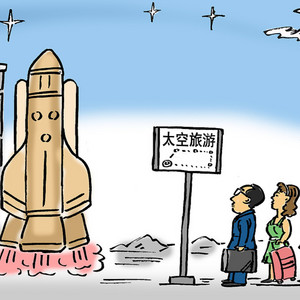
You've probably heard Elon's SpaceX can take you to space for millions of US dollars.
Now a Chinese company promises suborbital rides for a sliver of the cost – 1 million Chinese Yuan.
The stars seem closer than ever.
But how safe are these space flights for aspiring adventurers?
And feeling those Monday blues not on motivational Monday?
Tune in our special segment for a boost that will have you saying, Bring it on, weak!
Coming to you live from Beijing, this is Roundtable.
I'm He Young, for today's program I'm joined by Steve Hatherly and Yu Shan in the studio.
First, on today's show, move over billionaire space flights.
While Elon Musk's SpaceX and Jeff Bezos' Blue Origin charge millions of dollars for their suborbital flights, Chinese companies such as Deep Blue Aerospace are shaking things up.
Starting in 2027, they're offering space joy rides for just 1 .5 million Yuan.
Or 1 million Yuan if you snag a discount.
Talk about a fraction of the cost.
But still, a giant leap for your wallet.
So how soon before we're packing our bags for a trip to the Cospos?
I mean, for this company, Deep Blue Aerospace, they're about to launch their 12 -minute suborbital flights that's expected to take off in 2027.
So in three, four years' time, it's happening here in China as well.
And what you're offered during that 12 minutes is basically a drop tower experience like in the amusement park.
Have you guys ever take drop towers before?
Is that where you sit in the chair on the ground and then it slowly goes up?
Which is terrifying.
I mean, even the slow ride up, because the anxiety just builds, and then you sit there for what feels like a year, and then all of a sudden, it just drops.
Is that what you're talking about?
Something like that.
But instead of sitting on a chair and being elevated by a machine in an amusement park, this time we're sitting in a space rocket, and it's going to take you all the way up to a certain level and then send you back down on Earth.
That's what that 12 minutes is about.
And apparently, this Chinese company is using something new as a way to sell those two tickets that they aim to attract the general public, because this time they opened their sales on a Taobao livestream.
So Taobao, which is a Chinese shopping platform, is better known for its e -commerce and online retailing services.
And usually the products you see are just daily commodities, and this time we see this Chinese aerospace company selling their space travel tickets via Taobao livestreams, just like that.
Yeah, you don't usually see that for sale on Taobao.
Other things like blankets and pillows and laundry detergent and t -shirts and shoes, yes, but tickets to space?
No, this is a first.
That was really popular too, that livestream, right?
3 million people tuned into that, and obviously there was a lot of interest there.
The ticket for the round trip, and thankfully it is a round trip.
They don't leave you up there.
Not cheap. In the opening, Huyang, you said, oh, it's affordable now.
Relatively speaking, I guess it is, but still, you have to have deep pockets if you want to do this.
The round trip was priced at 1 .5 million yuan.
They did have a special livestream price for a million yuan.
That's about $140 ,000.
You also had to put a deposit down of 50 ,000 yuan, which, by the way, I think was a smart thing for them to do because people would say, oh, yeah, sure, I'm going to go.
Oh, wait, how much is it?
So yeah, 50 ,000 yuan was required for the pre -orders.
And really popular.
Tickets sold out. And only two tickets, though.
Well, yeah. Well, bring your friend.
Bring your mom with you.
Well, actually maybe have second thoughts about that.
Two available for the public to buy.
But I would assume there are more people on, say, one rocket as per one trip.
But anyways, this is according to reports by Global Times that this price, 1 million yuan, is actually less than half of that same cost of the similar products or services provided by other western companies, such as Virgin.
Virgin Atlantic. No, no, not Virgin Atlantic.
That's the airplane company.
Virgin Galactic. Yeah, which is such a cool name, I think.
Yeah, I was watching their 2023 livestream of their rocket sending just usual passengers up to the space and doing this 90 minute journey up there.
You see people after getting to a certain height, they start to unbutton their seat bells and they just flow inside the rocket and their hair, especially for the girls, their hairs are as if they've been electrified.
Like hairs growing everywhere.
It's quite a scene.
And apparently that's quite an experience that worth a ticket price at, well, roughly $450 ,000 US dollars for that 90 minutes journey.
And that's about what, 3 point something, 3 .2 million yuan, right?
So really, really expensive.
Yeah, so you're right when you say this was a drop in the bucket compared to that price.
Especially in the earlier days, which is just a few years back, Elon Musk, I can't remember whether he went to space himself or not.
But definitely SpaceX was one of the first to advertise, oh, now if you have a deep enough pocket, join us on our space ride.
And funny about, you know, you guys mentioned Virgin Galactic, because the owner, Richard Branson, right?
Yes. And he's been to space while probably also advertising this company at the same time.
And Jeff Bezos, he's been there and back.
And I suppose it's no coincidence that these are the ultra rich people in the world who fund these space travel companies or rocket ship blasting companies or whatever you call it.
This is the type of thing I want it to be expensive.
It's not that I can afford to go, but I don't want this to be cheap.
If they were on Taobao saying, oh, you can go to space for 1 ,400 yuan, I would think, really?
When they charge that much money, makes it makes it seem safe and makes it seem credible and which it is, by the way, I'm not saying it's not, but just the high price tag makes you feel more comfortable, I think.
Well, that's interesting.
And let's get into it in a sec, though.
And we mentioned suborbital flights and also there's the orbital flight.
Could you also help us to understand what kind of trip are we talking about?
How further in space are these trips going?
So basically suborbital flight, like the drop tower metaphor I was using previously, it's just a vertical ascent to the highest point.
And then it's followed by a gradual descent back to Earth.
It's just an up and then a down process.
And so this makes it be seen as the first step for a lot of people to just explore the feeling of getting closer to the space and which offers you like a chance to experience this weightlessness of the space.
And sorry to interrupt.
Yeah. In suborbital flights, the spacecraft itself, it gets to the edge of space, but it doesn't go fast enough or high enough required to orbit the Earth.
So that's kind of the definition of suborbital.
Oh, yeah. And then like the deep blue aerospace is offering here during their 12 minutes, say return travel, there are only five minutes left for the passengers to stay weightlessness in the space near the space.
So that's what makes suborbital flights, well, kind of less challenging compared with the other type of flight.
That's the orbital flights, which is that they only reaches the edge of the space, but does not achieve the speed or altitude required to orbit the Earth.
So it only gives you like a limited time near the space or well, around that height that you can feel the weightlessness, but don't stay there for a very long time before you get back on Earth.
Orbital space travel is similar to what you would experience in your traditional manned space mission if you were an astronaut.
This allows tourists to reach space and even the space station.
I don't know. You want to go to the would you go to the space station if given the like if roundtable, you know, if the bosses came and said, we want to do an episode of Roundtable from the ISS.
Are you going the ISS?
Well, International Space Station.
There's a Chinese one, which is also interesting.
Let's say what about five million yuan?
Straight to my bank account.
Here's the account number.
Yeah, I'm going. You're going then, right?
Anyway, yeah, a little more on orbital space travel.
So this requires passengers to stay in space for a longer period of time.
The spacecraft itself is able to achieve orbital conditions, meaning it has to orbit the Earth, something that you don't do in suborbital flights.
And then you've got speeds that are faster exceeding 300 kilometers an hour, an altitude that's higher as well.
So it's it's a different experience.
It's more like a real astronaut experience.
I guess that's the main difference.
And this is according to China Youth Daily that currently there's only the Space X company that's the that's able to provide such orbital space travel for you as a commercial aerospace company.
And well, this is the trip to the International Space Station like we discussed earlier.
So I guess if you want to pay that 5 million, we're paying that to Space X for now.
But in the future, maybe other companies or even like Chinese companies they're developing similar trips as well.
Yeah. And also suborbital flights, because of the differences we just talked about, they're a lot less expensive and they're less technically challenging to to pull off as well, which makes it more accessible for people on Earth who are not astronauts to have the experience.
And what does the space travel package include?
What can the prospective traveler expect?
Well, here, according to the reports, this domestic suborbital flight mission basically used a combination of a reusable rocket and a manned spacecraft capsule.
So the rocket will carry the spacecraft to the designated altitude and then the two parts will separate.
And to wrap up this trip, the rocket will decelerate and land vertically while the spacecraft with the passengers sitting inside will return back to the land via parachute like how you see it done on the TV, actually.
So the entire 12 minutes flight is featured with a maximum altitude ranging from 100 to 150 kilometers.
And this type of subordinate suborbital flights has been successfully conducted multiple times abroad.
So this is not really exclusively to Chinese companies, of course.
And two major commercial companies offering similar services are the one we talked about earlier, the UK Virgin Galactic and the US Blue Origin companies.
The Virgin Galactic one, I was looking it up.
So that went to you said it could go to about from about 100 to 150 kilometers.
The Virgin Galactic one.
This is a story from CNN from summertime last year.
About 80 kilometers from the Earth's surface, which is quite a distance.
If you think about it, it doesn't seem that far.
When we when we think about driving a car, you know, 80 kilometers doesn't seem that far away.
But if you're talking vertically up from the Earth's surface, it is it is quite the distance.
Yeah, they consider that at least the United States government considers that the edge of outer space, which is kind of a cool thing.
I was also looking up because I was curious to know the passengers perspective.
What did they feel when they came back and talked about it?
And a couple of things I thought were really, really interesting.
One of the passengers said that they felt a sense of melancholy looking down at the Earth from that perspective from the very for for the very first time.
Just totally kind of messes with all your human emotions that you are comfortable experiencing because you're not used to seeing that.
I found that to be a bit surprising, though.
Melancholy, a sense of sadness somehow.
Maybe how how small the Earth was.
That was one report.
Then there was another response saying that they somehow felt a real closeness to every other person on planet Earth because suddenly they got that perspective of, oh, yeah, right.
We are all from the same place.
I thought that was kind of an interesting thought, too.
Yeah. So you're so these guys, they managed to, well, pay a hefty amount, go into space and look at Mother Earth from afar and just see it like a like a dot, a blue dot, a blue dot, a blue ball, that kind of thing.
And also one thing just sort of stroke struck me just now.
Steve, so you're kind of saying that it's not just a handful of uber rich billionaire dudes that have been up there and back.
You're saying that maybe not everyday people, but but there are quite a few other people who are not, you know, in the same kind of rich club, but they've gone there and come back.
Yeah. And that seems to be the direction that we're going to.
Right. We're talking about, of course, it is still really, really expensive and it's far out of reach for the average person to pay this much money for what is a 12 minute experience.
But yet it's a lot cheaper than it used to be.
So how cheap is it going to be in the future?
And is it going to be something that the average person can experience?
I don't know about that just yet.
So for the guys that you just mentioned, they paid something along the lines of four hundred and fifty thousand US dollars to go there.
Well, will that be enough for, you know, down payment to get a house or get an apartment here in Beijing?
Yeah, absolutely I would.
All right. So what about here turning back to Earth and in China?
We've seen that in recent years, there's a lot more discussion about commercial space travel and what is the progress been made in China's commercial space tourism industry?
Oh, well, I just feel wowed by the fact that it is now a tourism industry, you know, because when we think about the manned spacecraft, at least as a Chinese, I grew up watching the 2003 incident where the successful launch of the Shenzhou 5 mission was implicated.
And that's when China see the first Chinese scientist, his name is Yang Liwei, being sent to space and returned back alive in 21 hours.
And I remember back then I was just a second year primary school student and all of this entire building of our school were kind of encouraged for all students to sit in the classroom and watch the TV while it was demonstrated like lively, like seeing him ascending to the universe and everything.
And I remember there were teachers crying.
It was such a such a phenomenal incident in the space travel history of China.
And now that was early 2000.
Yeah, that was in 2003.
So since then, apparently, China has accumulated decades of experience on manned space flights, which has, you know, gradually expanded to what we see nowadays, a commercialized service that's provided by the aerospace companies nowadays.
And well, this is according to Huo Liang, founder of Deep Blue Aerospace, who explained that while suborbital flights can be carried out with conventionally expandable rockets, one key factors for them is remains to be the cost because the problem with expandable rockets is still rather high for them.
And also it's a high cost products for a lot of the day to day consumers nowadays as well.
Yeah. And if the ticket price is super high, well, then your market is very niche, right?
Your market becomes very, very small.
And then what could be tremendous potential for commercialization kind of gets undermined because of those two factors, the high costs for the companies who are putting this on and then the high costs for the people who want to do this as well.
So it really does limit the potential when we're talking about the cost.
Right. And one of the ways to keep the cost down is use reusable rockets.
Yeah. I still remember a few years back.
That was seen as such an avant -garde idea, but now it's kind of expected in the space industry.
Yeah. And they land them back vertically on the ground.
That's so every time I see that, I feel like I'm watching some sort of sci -fi movie from the year like 2800 or something.
And I really admire the fact that the domestic, the Chinese companies, they're following this standard of doing it in a reusable rocket as well, because well, according to my knowledge, I think SpaceX launched the world's first reusable rocket in a way.
And nowadays it's becoming like, say, an industry standard because the reusability allows the company to refly the most expensive parts of the rocket, which in turn could drive down the cost of the entire space travel likewise.
So it's really a good idea if you think about it.
Speaking of brilliant ideas, how safe is this?
Well, they came back.
So I think when we're talking safety, it's something that's a, it's a work in progress.
You know, obviously it's safe enough to be to be sending people at this point, but there is a development that's still ongoing and the progress of the development for commercial space companies for their tourism projects is something that they're they're continuously working on.
The technology is still generally in the stage of spacecraft development and testing.
And there are safety concerns.
And because of that, there's still a long road ahead before actual regular space tourism can be a daily thing if it ever becomes that.
Or for it to become sort of like an air travel thing.
Yeah, yeah, exactly.
Right. Now we don't even, you know, bat our eyelids just thinking about booking a ticket for a flight to go somewhere.
So could space travel really become available to the average person?
While astronauts enjoy rigorous training and selection, what would it take for ordinary individuals to qualify for a trip to space?
I mean, it is kind of labeled by many companies that's selling this space travel tickets that, quote unquote, passengers must ensure their physical condition is suitable for space travel and are advised to undergo a professional health check in advance.
So which means that, you know, as a regular passenger who don't necessarily have the experience of receiving such abundant training prior to taking the space travel, then it's kind of a must that you follow the company's protocol and do such evaluations on your health status in order to better know
if you're fully qualified to sit on that rocket.
And in the meantime, before participating in such a suborbital flight, tourists, well, you attend safety training one month prior to the trip happening.
So on the one hand, you kind of need to go through simulations of weightlessness and overload environments to just help you to build this physical and mental memory and the familiarity to what you might experience after you are ascended to space.
And then in the meantime, it's also very important for all of the tourists to know the necessary emergency evacuation procedures and anything that's, you know, could cause potential hazards.
Yeah, you ask about safety.
There's safety from two sides, right?
There's safety from the spacecraft's side.
And of course, there's very strict technical standards and really strict specifications that need to be followed to ensure the reliability and and the safety of the craft that they are flying in.
But yes, also from the tourist point of view, they have to go through some pretty rigorous training.
I think physical fitness and adaptation.
That's a core component for for people who are aspiring to do this.
They want to make sure that your body is capable of going through something like this.
There is exposure to microgravity and the forces experienced during launch and reentry.
Going back to that reaction story that I read, that was one of the interesting things because they have to prepare you mentally, too.
It's not just your physical body.
They have to prepare you to make sure that you're strong enough mentally.
And one of the responses was I forget whether it was upon take off or reentry, but I guess they didn't know that the craft would shake as much as it did.
Oh, it was on reentry.
And they said it was quite dramatic because of the shaking of the craft.
And at one point, they thought, is this supposed to be shaking as much as it is right now?
So I guess with that type of you know, everything that they could potentially go through, they have to prepare them as best they can before they even leave the ground.
Right. And maybe buy a new insurance policy as well.
I don't know what the policy cost would be if you told you told your insurance company you were going to space.
Yeah. And the deep blue aerospace founder, that Chinese company, Chinese startup that we've been talking about, it's spokesperson or hulang, explained that multiple measures will be taken to ensure safety, first, during the design, manufacturing and testing a phase of the manned spacecraft, strict technical
standards and specifications will follow to ensure the reliability and safety.
And he said a whole bunch of quite technical language to try to sort of ensure that this is going to be safe because, you know, this is still relatively new, very new here in China.
And and there are some questions to be cleared before people can actually get on board.
Would you go? I mean, Austin, somebody's paying you.
OK, you, Sean, would you go if somebody is paying?
Yes. I don't know if that would be enough for me or not.
OK, we'll talk. And for your average Joe and Jane, don't we have enough earthly matters to deal with like rent taxes and climate change?
Maybe space can wait.
Well, that's just my opinion.