Once again, there's a conspiracy in Zootopia, and it's up to Judy Hopps and Nick Wilde to uncover the truth.
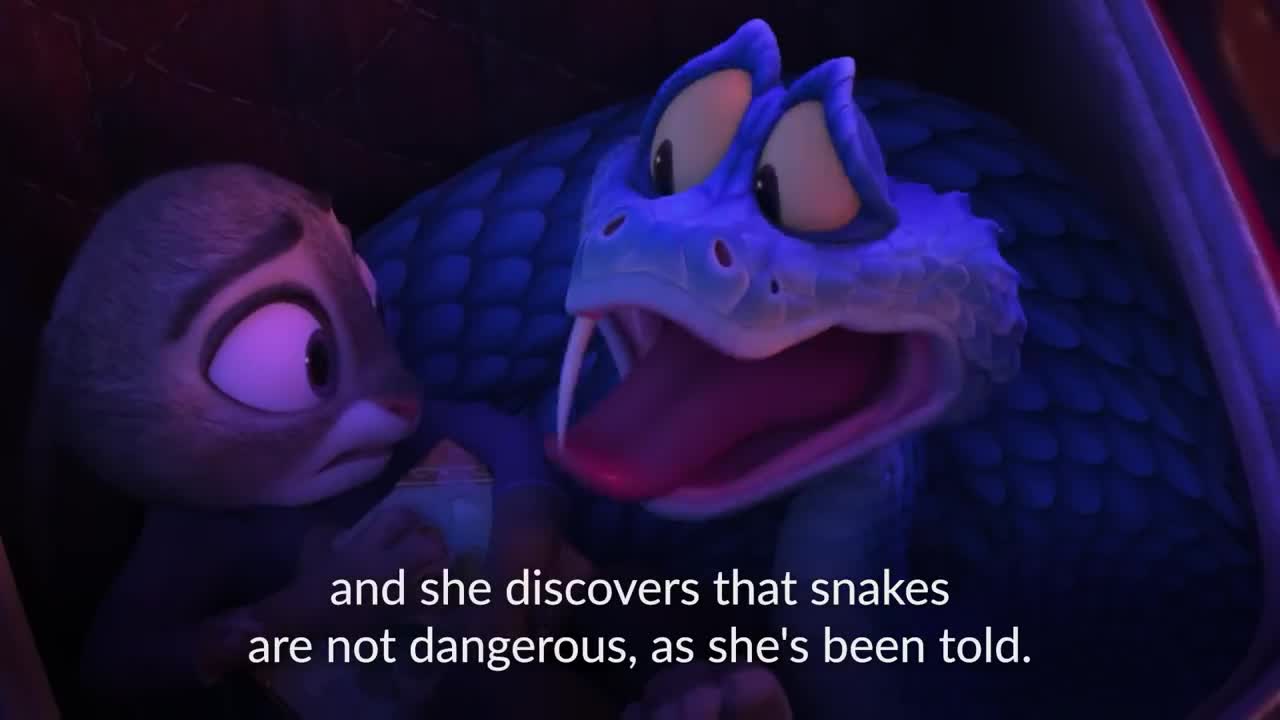
In today's lesson we'll learn, with some scenes where Judy meets Gary the Snake, the first snake to be seen in Zootopia in a century.
And she discovers that snakes are not dangerous, as she's been told.
And here's the best part to help you not only learn all of the expressions we'll cover in today's scenes, but also never forget them, we want to give you all the smart flashcards for today's lesson for free.
You can practice them in our app by clicking the link below.
Thousands of learners just like you are becoming more fluent every day and having fun while doing it.
If that sounds like something that you'd like, be sure to try our method.
You only need a few minutes a day to see real progress.
Now let's see Judy's first encounter with Gary.
Please, you don't have to hurt him.
Hurt him?
Snakes never hurt anyone.
We aren't the bad guys.
They are.
And this journal holds the secret that will.
So Gary is immediately trying to convince Judy that snakes have been misunderstood all along.
Let's break down the language he uses to make his case.
Snakes never hurt anyone.
You might recognize this from Billie Eilish's hit song, Bad Guy.
Here, Billie playfully flips the whole idea.
She's the one claiming to be the bad guy.
And then, Gary reveals that the Linksley's journal is the key to Zootopia's biggest mystery.
And this journal holds the secret that will prove it.
When something holds a secret, it means that it contains hidden or crucial information that others don't know about.
We use the verb hold because the object is keeping something inside, like a container.
You could say, this old letter holds the answer.
Or, her expression held a secret.
Listen to these other examples.
Use this magic to get your father back.
I can't.
Not yet.
I don't understand.
This holds a power no human can access.
And I mentioned the RealLife app earlier.
It really holds the secret for you to be able to speak confident, natural English.
Why am I so sure?
Well, I've personally learned six languages and we've taught millions of English learners, just like you, over the last 15 years.
We used our experience to build the only English app you'll ever need.
If you feel too busy to dedicate enough time to studying or you feel like you've been stuck at the same level forever, let me share with you a method to go from being a lost, insecure English learner to being a confident, natural English speaker, even if you only have 10 to 15 minutes per day.
Watch a short lesson like this one with Zootopia 2.
Practice the new words with smart flashcards which use science to help you remember new words forever.
And speak the new words in a real conversation so you feel confident using them in any situation, and practice pronunciation.
The great thing is we make it super easy for you to do this on the RealLife app.
And, in fact, you can use the new words you're learning in a guided speaking conversation based on this exact lesson with Zootopia 2 right now.
Stop just recognizing and forgetting new words and start being able to actually speak them naturally.
So try it for free.
Just click the link in the description.
Now, I bet you get frustrated when natives speak fast and you can't understand them, right?
Well, actually, the problem isn't usually about speed.
It's about connected speech.
That's how we natives cut, reduce, and link our words together when speaking fluently.
Listen again to how Gary says prove it.
So, connected speech usually happens when we have content words and function words together.
Function words link to content words or other functional words, and sometimes even reduce or morph.
This is a simple example.
Instead of saying prove and it as two separate words, we say a smooth prove it.
Your speaking will only improve with lots of practice.
So listen to Gary again and try to say that just like him.
And we have another great instance of connected speech that we can practice in the clip where Gary first appears.
Mayor Windancer's exclamation almost sounds like just one word.
First, the article A usually just reduces to what's called a schwa sound.
It then links to theirs.
Let's put it all together.
Now you try.
Say that just like Windancer.
There's a snake!
There's a snake!
So apparently something went very wrong and that's why Gary needs a secret inside the journal.
What do you think it means to set things right?
To fix a mistake or correct an unfair situation?
To move things to the correct position?
To tell the truth about something?
Nice.
This expression is about restoring justice after something has gone wrong.
Think about the movie Encanto.
Bruno spent years in the walls of the house because everyone blamed him for bad things happening.
His whole journey, and honestly the whole family's journey, is about setting things right.
Here are a couple other examples.
Gotta go back and set things right.
We'll set things right.
Good job up to this point.
Let's fast forward in the movie.
Gary escapes and Judy discovers that snakes are innocent and the Linksleys are the real villains.
As Nick and Judy get closer to uncovering the mystery of how snakes were banished from Zootopia, the Linksleys have Nick thrown in jail.
However, Paubert and Gary are able to rescue Judy just in time.
This character Pawbert, is also a Lynxly, but he's the black sheep of his family and has agreed to help Gary.
A black sheep is a family member who does not fit in with the behavior and values of the rest of their family, just like Elphaba from Wicked.
Now let's check out the scene where Judy wakes up after being saved by this duo.
You're not dead!
She's not dead!
What?
Sorry, sorry.
I just got my motorcycle license.
But out here, no one's gonna catch us.
Almost to me hideout.
You shall succeed, Judy Hopps.
Or stop the Lynxleys and save your partner.
I'm sorry, you are... Oh, Gary.
Gary the Snake.
Welcome to my oasis!
Away from my evil family.
I like to come here, just kind of veg out.
Get with all my cat stuff.
Oh!
That's actually vintage.
You could just not... Oh!
No, no, please don't.
Wow, Mamos gets the best stuff.
No, that's... Turn it off, turn it off, turn it off, turn it off, turn it off.
A license is an official document that gives you legal permission to do something.
A driver's license lets you drive a car.
A pilot's license lets you fly a plane.
A fishing license lets you fish.
Pawbert isn't a great motorcycle driver yet because he just got his license.
Pawbert is a silly character, so he playfully says this next line.
Okay, did you catch that?
Gary says me hideout instead of my hideout.
It's pirate speech.
A bit like how Captain Jack Sparrow would speak.
Pirates replace my with me.
Me ship.
Me treasure.
Me hideout.
And pirates often have a hideout, a secret place to hide from people who are after them or to find tranquility.
Just like Batman's Batcave.
Now let's check out some interesting grammar that Gary used.
The school of wrong.
And next, Judy uses a really useful social expression.
So this is a very polite, smooth way to ask someone's name.
The I'm sorry at the start isn't a real apology.
It's more like a way of saying excuse me or forgive me for not knowing.
It signals politeness before asking something slightly awkward.
For example, imagine you're lost in a new city.
You might ask a local, I'm sorry, but do you know where the train station is?
Welcome to my oasis!
Literally, an oasis is a green, fertile spot in the middle of a desert, but we use it figuratively all the time to mean any peaceful place that exists within a stressful situation.
And I love the phrasal verb that Paubert used next.
What do you think veg out means?
To eat lots of vegetables and be healthy?
To completely relax and do absolutely nothing?
To redecorate your space?
Yes, this is a very casual, informal expression.
When you veg out, you usually do something mindless like watching TV, scrolling on your phone or staring at the ceiling.
Veg comes from vegetable because when you veg out you're about as active as a vegetable on the couch.
Similarly, we can call a lazy person a couch potato.
Next, Gary goes a little crazy with all of Paubert's cool objects.
When something is vintage, it's old, but in a good, desirable way.
It refers to things from the past that are now considered stylish, special, or collectible.
Vintage clothing, vintage cars, vintage furniture. it's the opposite of old junk.
This word actually comes from wine making.
A vintage wine is one from a particularly great year.
The older and better the year, the more valuable the bottle.
Gary is a snake, which means he's a reptile, not a mammal.
So what exactly are mammals?
They're warm-blooded animals that feed their young with milk.
Humans, dogs, cats, rabbits, all mammals.
Reptiles, like snakes on the other hand, are cold-blooded.
Gary is just a little envious here of Paubert's toys.
And let's wrap up with a final bit of connected speech.
Turn it off, turn it off, turn it off, turn it off, turn it off!
You'll almost always see connected speech with phrasal verbs like this.
The T in it is between two vowels.
So we convert it to a tap T and connect it to off.
It off.
It off.
And then all three words flow together as if they were just one.
Turn it off.
Turn it off.
Listen again and try to say it just like Pawbert.
Awesome work today.
Now comes the most important part of the lesson, your test.
You'll watch all the scenes again, this time without subtitles, and answer some quiz questions.
Ready?
Stop!
Please, you don't have to hurt him.
Hurt him?
Snakes never hurt anyone.
We aren't the bad guys.
They are.
And this journal holds the secret that will prove it.
I have to prove it.
Please.
Fill in the blank.
After years of rivalry, the two brothers finally sat down to talk and decided, and decided to set things right.
This is our only chance to set things right, and when I do, my family will finally be able to come home.
You're not dead!
She's not dead!
Sorry, sorry.
I just got my motorcycle license.
But out here, no one's gonna catch us.
Almost to me hideout.
Gary says, Which sentence has the most similar feeling to this one?
We will get there soon.
We are going to try our best.
We will overcome this.
You've just been introduced to someone at a networking event, but you missed their name.
Which is the most polite and natural way to ask?
Wait, who are you again?
I'm sorry, you are?
What did you say your name was?
True or false?
To veg out means to spend your free time doing something healthy.
False.
It means to relax completely and do nothing.
Aw yeah!
If you haven't seen Zootopia 2 yet, I'd say you're pretty prepared to watch it in English and uncover Gary's secret.
And if you want to be able to understand fast-speaking natives without getting lost, without missing the jokes and without subtitles.
Every single week we make two new lessons, like this one with your favorite series movies, celebrities and more.
So just hit that subscribe button and the bell down below to join over 11 million learners who are doing this every single week.
And if you're ready to really take your English to the next level with this lesson, then your best experience is on the RealLife app.
You can try it for free with the link down in the description.
Or if you're sticking with us here on YouTube, then you might want to check out this lesson next.
Here you go.
Either leg.
Or both.
I don't care.
Maybe put a doodle on it.
Doesn't need to be perfect.
He's also legally blind.
I put a little train there because I know you like trains.
Come on, come on, come on.