You're listening to Brains On, where we're serious about being curious.
Brains On is supported in part by a grant from the National Science Foundation.
Tom Gasco has loved vacuums ever since he was a little kid.
What my mother would go visit her friends from high school.
We would go and after about 20 minutes, the lady whose home we were in, would notice that I wasn't in the room anymore and she would ask my mother, where is Tom?
Well, my mother would say, where do you keep your vacuum cleaner?
Because that's where Tom is.
Trust me, what he's done with it.
He's going to take the hair off of the brush roll.
He's going to clean the filter.
He'll put a clean bag in and maybe even wipe it off.
And then they might let me run it.
That was a treat. I was very little, so this was, you know, a thrill.
Tom loves vacuum so much that to him, the sounds they make are music.
Vacuum cleaners all hit different notes.
The pitch of a motor is a musical note.
So some of them are very loud and some of them are very muffled and quiet.
And so it was always interesting to plug it in and push that button for the first time to see what that monster sounded like.
For Tom, the shape of every vacuum is a beautiful sculpture.
And the way the dirt moves as it gets sucked in is like dancing.
As a vacuum cleaner's rotating brush rotates, it taps a carpet and makes the sand and grit in the debris kind of move a little bit.
So right before you come up to it, you'll see that the stuff is moving.
My thrill was to watch that stuff move, but never quite get the vacuum far enough toward and hailed it.
Today, Tom runs a vacuum repair shop in Missouri.
But it's also a museum dedicated to his personal collection of vacuums.
He has 600 of them. The oldest is from 1879 and he even has one he designed himself.
Today, we're going to get a peek inside Tom's collection.
And inside the vacuums themselves.
This episode is guaranteed to suck you in.
Sing it vacuums! You're listening to Rainzon from APM Studios.
I'm Molly Bloom and my co-host today is Baker from Snow Qualmye, Washington.
Hi Baker! Hi Molly! You sent us this question last year and it was very hard to resist.
Hello Rainzon, I was wondering about the history vacuum cleaners, how they work, what is a vacuum anyways, and just vacuums.
So I would really like it if you could help me out.
Thank you. So Baker, how did you first get interested in vacuums?
I saw this like TV advertisement and I thought it was cool.
Do you remember what it was about that advertisement that really made you interested?
I think something about having multiple tools that you could switch out.
I made it super cool to my young Rain.
So within different tools, do you mean there's different attachments you can use?
Yeah, there's this stick one that helps clean up in all the corners.
And there's like the carpet one, the hardwood one, like just a lot of them.
And you're like that can do so many things, that's so cool.
Yeah. So do you have a favorite vacuum?
My favorite vacuum is a stick wireless vacuum.
Okay, please describe that more to me.
So it's wireless meaning you don't have to plug it in?
Yeah, and has like a battery.
And what makes it a stick?
There's one part that has the motor in it and the rest is just a long stick with the like two at the bottom.
Gotcha, so it's almost like a broom.
Yeah. So what is your favorite thing about vacuums?
When I'm sweeping, I get usually very annoyed with how hard it is to get all the places.
And then like sweep it all up and then put it in the dust pan.
Vacuums, it basically does that all in half the time and effort.
I understand that you love vacuum so much that you even asked for one for a Christmas present.
Can you tell us about that?
It's this Dyson cordless stick vacuum with the different attachments that I saw in that ad.
And did you get it? Yes, I did.
It's now our main vacuum.
We also have a bissow at home, but we usually use the Dyson.
How old were you when you asked for the Christmas vacuum?
Six. So do you still like vacuums as much as you did when you were six?
No, I enjoy vacuuming because it's a bit of one of those things that is calming.
But I prefer reading and doing video games.
Okay, so you're like, I'll still appreciate the vacuum, but it's not like your favorite thing I could use to be.
Yeah. Brains, brains, brains.
Before we get into the history of vacuums, let's look at how these magnificent machines work.
And to do that, we're going to hop into one of our special vehicles, the Adam.
Ooh, that stands for the amazing truck of minimization.
I've always wanted to go inside a truck that can trick me down and take me inside of things.
Way to dream big Baker or small hop in.
Can you please push the big blue shrink button on it?
Oops, you've made a squirrel size and now Penelope the poodle is headed this way.
Ah, what should I do? Don't panic, this is easy.
See that dial over there?
Just move it from squirrel size, past tennis ball size, past dog treat.
Did a dog build this thing?
No, but it did go through a thorough multi-step review process from our brains on dog advisory council.
Penelope is getting closer.
Turn the dial to fleecized and then press the shrink button again.
Ah, perfect. Now we're too small for her to see and we're the perfect size to get sucked up by a vacuum.
I hear it coming out. Yes, hear that musical roar, that's the sound of the vacuum's motor and air moving through the machine.
That's why modern vacuums need to be plugged in or have a battery to make the motor go.
And the motor is making a fan move that blows air back out of the vacuum.
Blows out? Excuse me, I think you mean sucks in.
It's actually both. I know, it's kind of mind blowing.
Here's how it works. Even though air is invisible, it's made up of stuff called air molecules.
Molecules are teeny tiny so we can't see them with our eyes or even microscopes.
We're going to have to get even smaller to see how the vacuum works, Baker, switch the dial to molecule size and push shrink.
Okay, now we're the same size as the molecules that make up the air.
Whoa, those dust bunnies are huge and I can see the air molecules.
Wild, right? Here's the thing about air molecules.
They want to be spread out evenly.
So if something causes the molecules to be blown away, new ones will want to move in to take their place.
The vacuum is getting closer.
See how the air molecules closer to the vacuum are going inside?
That's because the vacuum's fan has blown out the air molecules that were inside of it.
So now there's a spot inside the vacuum where those air molecules used to be.
It's empty. And remember, these little molecules want to be spread out evenly.
So the air molecules nearby swoop in to balance it out.
And as they swoop in, they take with them the nearby dirt and sand and...
...uh! And now we're getting blown out the other side of the vacuum with the air.
Wow, what a ride. But what happened to all the dirt and dust?
If we were still as big as a flea, we would have gotten pulled up into the part of the vacuum that collects the dirt and other little particles.
It can trap those things because they're bigger than air.
But since we're air-sized, we're too small to get trapped by the vacuum.
So the vacuum's fan blew us right back out.
Okay, you can on Shrinkinatus, turn the dial to human-sized and then press the blue button again.
What an adventure! And an educational one at that!
I didn't know that to suck stuff up, vacuums have to blow air out.
Here's another cool thing.
Before the vacuum was invented, some people were trying to make machines that would blow dirt into a container rather than suck it in.
Turns out that didn't work.
Sounds messy, so you finally figured out vacuums.
It was the early 1900s in England.
Oh yeah, back then people mostly got around using horses and carriages.
They were just starting to put telephones in their homes, but they didn't have a neat TV or radio.
You really know your history?
Well, I listened to Forever Go, the exoantisserie podcast hosted by Joy Dullo.
That is a great podcast.
But back to vacuums. Remember how I mentioned that the first vacuums blew dirt into containers?
Well, in 1901, an inventor named Hubert Cecil Booth saw this blowing cleaning machine on display in London and thought he could do better.
Hubert thought it would make more sense to have a machine that sucked dirt in.
That does make more sense?
Yes, other engineers told Hubert that it was impossible to make a machine that could suck in dirt.
But Hubert had designed bridges and ferris wheels, so he was pretty sure he could tackle this too.
And he did. Where'd you go, Hubert?
The first vacuum he created was not like the ones we have in our homes today.
In fact, this vacuum was so big, it couldn't even fit in a house.
It was as big as a minivan and was pulled from house to house by horses.
It was nicknamed Puffin Billy.
I love that. Me too. So, Baker, have you given any of your vacuums nicknames?
No, but as soon as I get home, I'm planning to.
Nice. Do you have any ideas?
Um, maybe... Dust Striker.
Because it strikes the dust bunnies in the face.
Nice. I love that name. It's action packed.
So, Puffin Billy would go house to house.
And because it was too big to fit inside, a worker would put a hose in through the window and suck up dirt through a big tube.
Even though it was noisy and clunky, the machine did the job incredibly well and was very popular.
At least for the people who could afford it.
One visit from the vacuum could cost the same as someone might pay a maid to clean their house for a whole year.
It was really only something the very rich could afford.
What do you think about that, Baker?
I think that we're lucky that in our day, vacuums cost a lot less.
But back then, these very rich and fancy people loved this new technology.
They would even host vacuuming parties where they would have their friends over to eat fancy sandwiches, cut into little triangles, and watch the vacuums suck out all their dead skin cells, caviar crumbs, and the fur from their purebred exotic cats.
Okay, I love vacuums and I love parties.
How have I not thought of this?
Baker, can you imagine a huge horse-drawn vacuum going door to door?
I can imagine that if it's in olden times.
Right now, I think it would most likely be driven by a car.
Good point. Do you think people would like this kind of service today, like if it just came door to door and put a giant hose in your window?
No, I think people would just go out and say, get out my yard and just use their own vacuum.
Fair, fair. So you do have vacuums and you do have parties, and what do you want to go to a vacuum party?
If it was a party for vacuums like birthday, but I don't want to emit food and just enjoy myself while there's a huge vacuum going on and I can't talk to anyone because it's so loud.
That's a great point that I did not think of.
Yeah, it must be so loud at the vacuum party that would be very hard to socialize, but I love your idea of it being a party for vacuums to attend.
That's brilliant. Okay.
So does striker have to have a birthday party coming up, I think?
I think it's fifth birthday is around Christmas, maybe like January 1st.
I think that would just be inappropriate time because that's when we started really using the vacuum every day.
Absolutely. I can't wait for you to throw this birthday party.
Please take pictures and send it to us.
Understood. Well, we're going to hear how vacuums finally got small enough to come inside, but first I have something that's small enough to fit in your earbaker.
It's the... Master's...
Are you ready? Yeah. Okay, here it is.
Hmm. Let's hear it again.
What do you think, Baker?
It sounds mysteriously like a ping pong ball hitting a wooden table.
I may or may not have tried to play table tennis, but just did not work out.
That's a really good guess.
And to be honest with you, I don't know what this is either.
And I also heard that ping pong ball sound.
That's what I was thinking.
Okay, so we're on the same page.
We're going to hear it again, get another chance to guess, and hear the answer after the credits.
So, stick around. We love hearing from you.
We love getting your questions, mystery sounds, and high fives.
You're all so curious and smart.
And something that we find extra super-duper delightful is when you send us your artwork inspired by the show.
Maybe you want to draw a picture of me and Baker in the atom, shrinking down to the size of a molecule.
Maybe Penelope Poodle, or maybe a collection of vacuums, whatever you want to draw.
We would love to see it. You can send us your drawings at brainson.org slash contact.
And while you're there, you can send us mystery sounds, drawings, and questions.
Like this one, when did people forced start having pets?
You can find answers to questions like these on the Moment of Amma podcast.
It's a daily dose of facts and fun every weekday.
You can find it wherever you listen to brainson, just search for a moment of um.
So keep listening! Brainson Universe is a family of podcasts for kids and their adults.
And since you're a fan of brainson, we know you'll love the other shows in our universe.
Come on, let's explore!
And to bring brainson Universe.
Oh, so many podcast brainson.
Smash Boom Best forever ago.
Oh, picking up signal. Forever ago, a history podcast starring Joy Dolo.
Flier's gum was so sticky when the bubble popped.
It was so hard to get off your skin.
You'd have to scrub it off with harsh chemicals.
Me loves sticky facts. Sorp.
Signal down. Quick need for forever ago.
No! Search for forever ago wherever you get your podcasts.
Brainson Universe. Brainson.
You listening to brainson, I'm Baker.
And I'm Molly. And today we're talking about vacuums.
Before the break, we learned that vacuums work by blowing air out using a fan and a motor.
That makes new air molecules rush to fill the space, bringing with them the dirt and dust from our floors.
The first vacuums were as big as many vans and people would pull them from house to house using horse drawn carriages.
But over time, vacuum technology has changed a lot.
About a hundred years ago, lots of tools and household appliances started to be made much more cheaply.
And they shrunk down to personal size so you could actually fit them in your house.
Okay, Molly. Hey Baker.
Brainson, editor, Shayla Farzon.
I heard you were talking about one of my favorite appliances, vacuums.
And I just had to stop by.
I actually just got back from a trip to a vacuum cleaner museum.
Seriously? That's so cool.
Oh, it was cooler than cool.
The museum is inside this vacuum repair shop in Missouri.
And it's run by a guy named Tom Gasco.
We know Tom. He's the guy we heard at the very beginning of the show.
He loves vacuums. He does.
And I got to see Tom's vacuum collection in person.
Some of them are super old, like more than a hundred years old.
And the earliest ones didn't even use electricity or motors.
Tom showed me one with a really rad name.
Here is the dust killer.
Is that what it's actually called?
Yeah, that's what it's called.
Wow. So the dust killer has got bellows.
The kids would stand right there and move that lever back and forth.
The dust killer? That is a great name.
It had something called bellows, which is sort of like an air pump that you move by hand.
And that would help suck up the dirt.
What about the first electric vacuum?
Did Tom have any of those in his collection?
Yeah, he had this really old one from 1910.
It had a long handle with a bag hanging off of it.
And here's what it worked.
The dust and dirt got vacuumed up inside using the electric motor.
And then it was trapped in a bag.
Oh, yeah. There's still vacuums like that today.
Once the dirt's inside the bag, you empty it or you place it with a new one.
Right. Tom said vacuum started changing pretty fast after this point.
By the 1920s, the first canister vacuum made its debut.
Those are the kind that have a long hose attached to a body or a canister that moves around the floor.
One of my favorite things about looking through Tom's collection was seeing just how much vacuum style has changed over the years.
Based on what people thought looked good, he showed me one vacuum that looked just like R2D2 from Star Wars.
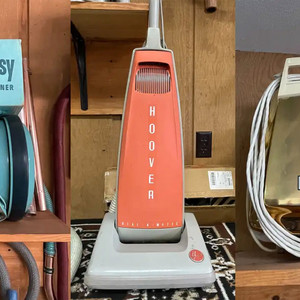
And another one called the Hoover Floating Vacuum.
It floated? Kind of. It used air to hover just over the floor.
Here, listen to this. The Hoover has no wheels or runners.
When you turn it on, the air comes out the saucer on the bottom and it floats.
It lifts the vacuum up off of the floor and it floats behind you on a cushion of air.
It's the coolest thing.
Is this from like the sixties or?
Oh, you can tell us the sixties because not only the color, but it's designed to look like the planet Saturn.
In the sixties, we were trying to get to the moon.
And the Jetsons Star Trek, these were new TV shows, science fiction TV shows were all the rage.
And so vacuum players, which followed what was happening in the world, just became very much like planets or spacecrafts.
Tom even had a vacuum in his collection that he designed himself.
It was purple and silver with all kinds of special features, like big wheels, so it could go up and down stairs.
But I think one of the best things about Tom's collection is that every single vacuum still works.
Wow, that's pretty amazing.
You know, vacuums used to be very expensive.
Buying one was a big deal.
Yeah, if you're spending a lot of money, you want to make a good choice.
Right. You'd pick out the perfect vacuum for your house, depending on its size, layout, what kind of floor you had.
And if your vacuum stopped working, you wouldn't just throw it out.
You'd take it to get fixed.
Tom still has the vacuum his mom bought just before he was born back in 1962.
It cost $250 back then, which today would be more than $2,000.
But that vacuum still works.
You know, if you buy a good vacuum, you can have it your whole life, literally by mother about one vacuum clear her entire life and there it is.
I have it and I still use it and it still works.
It's quiet, it's efficient.
Whoa, that's so cool. I can't wait to buy my forever vacuum.
Diddo, thanks for telling us about your vacuum adventure, Shela.
Oh, you bet. Bye, Molly.
See ya, Baker. See ya. Vincent!
Vacuums have changed a lot over the past 100 years and they don't just look different.
There have been lots of developments in vacuum technology.
Yeah, robot vacuums that can clean your house on their own have been around for almost 30 years and they've gotten so advanced.
Today, scientists are working on robot vacuums that can memorize the layout of a room, avoid a sleeping dog, and take voice directions from their owners.
And today, vacuums do more than just clean homes and schools and offices.
There are these huge vacuum trucks that look remarkably similar to the early vacuums we talked about.
They've got long attachments mounted onto big semi-trucks.
But instead of going door to door to suck the dirt out of expensive carpets in rich neighborhoods, these are used to help clean up after natural disasters.
These giant vacuum trucks can suck up debris, flood water, and even hazardous chemicals that are dangerous for humans to touch.
Natural disasters like hurricanes and wildfires are happening more often because of climate change, and so these trucks are being used more and more often.
Luckily, vacuum technology might also be able to help us slow down climate change.
Climate change is happening because humans are putting more greenhouse gases into the atmosphere, like carbon dioxide.
It's released by burning fossil fuels like the gasoline in our cars.
Yeah, but some companies are developing giant vacuum stack and suck carbon dioxide of the air and trap it in special containers.
And then, that carbon dioxide can be used to make bubbles in drinks, like soda and seltzer.
Some of these vacuum companies are even starting to sell the carbon dioxide to beverage companies.
Refreshing. Vacuums keep our homes clean and might also one day help keep our planet clean.
Cheers to that! Air molecules want to be spread out evenly.
So, vacuums work by creating a space inside the vacuum where they aren't air molecules.
Air molecules want to go inside the vacuum to even things out, and that air takes dirt and dust with it.
The dirty stuff is trapped by the vacuum and the air blows back out.
So, first vacuums were invented more than a hundred years ago.
There was big as a minivan and were super expensive to use.
But, over time, they got smaller.
Inventors started coming up with vacuums in all different shapes, colors and designs.
And their designs, like technology, are still changing today.
That's it for this episode of Brain Zone.
This episode was written by Molly Bloom and Nico Gonzalez Whistler.
It's produced by Rosie DuPont.
Our editors are Shayla Farzon and Sandin Totten.
Fact checking by Ruby Guthrie.
We had engineering help from Tim Minig, Robert Jacobspringer and Derek Ramirez, with sound design by Rachel Breve.
Original theme music by Mark Sanchez.
We had production help from the rest of the Brain Zone University.
Anna Goldfield, Lauren Humbert, Joshua Ray, Mark Sanchez, Charlotte Traver, Anna Weggel, and Aron Waldo Salassi.
Beth Broman is our executive producer and the executives in charge of APM studios are Chandra Cavati and Joanne Griffith.
Special thanks to Janine Saltman, Lucas Saltman and Delta.
Brain Zone is a non-profit public radio program.
There are lots of ways to support the show.
Subscribe to Brain Zone University on YouTube where you can watch animated versions of some of your favorite episodes or head to brainson.org.
While you're there, you can send us mystery sounds, drawings and questions.
Okay, Baker, are you ready to hear the mystery sound again?
Yeah. Alright, here it is.
What do you think now? Well, maybe it...
I'm still kind of going with my first answer, but also that kind of reminded me of that toy where there's a ping pong ball on a string attached to a paddle.
So ping pong ball hitting something.
I'm gonna guess... A person playing ping pong but like very slowly, so like maybe in lesser gravity.
So maybe they're playing ping pong on the moon.
I don't understand how the person was able to get us that sound if they're on Earth.
Fair point. Alright, well, should we hear the answer?
Yes. Alright, here it is.
Hi, I'm Noah from New South Wales, Australia.
And that was the sound of me playing dogs on a dog board.
Oh! Darts on a dart board.
I can't say I've heard that before.
Well, you know, I think you were close because we were thinking like playing a game of some sort, right?
Yeah, like what's stuff hitting stuff, so...
Exactly. We were not that far off.
So yeah, so darts, that's where the game where there's a board hanging on the wall, it's like a circle.
And then you throw these things at it and the closer you get to the center, the more points you get.
Exactly. Yeah, and those are called darts.
I guess we have to play darts now.
Yeah. Now it's time for the brains on Earth roll.
These are the kids who keep the show going with their questions, ideas, mystery sounds, drawings, and high fives.
Mercy from Los Angeles, Anthony from San Jose, California, Javier and Tomas from Lake Filminasota, Nathan from Durham, UK, Kenzie from Meridian, Ohio, Hannah from San Juan, Puerto Rico, Pepper from Austin, Texas, Henry from Westland, Oregon, Yuki from Oakland, California, Cole from Wadale, Arizona, Emma and Merritt from Lake Aswigo, Oregon, Hayes from Minneapolis, Jonah from Lisburn, Northern Ireland, Jesse and Ray from Bloomington, Indiana, Julia from San Antonio, Texas, Lucas from Florida, Amelia and Adeline from Toronto, Juliana from Piedmont, South Carolina, Connor, Lily and Elliott from Parker, Vern, North Dakota, Isabella from Berlin, Connecticut, Sutton and Tucker from Bradyville, Tennessee, Ever from Los Angeles, Yee from Carrying North Carolina, Evelyn and Conrad from Carthage and North Carolina, Emerson from North Carolina, Ellis and Desmond from Baltimore, Alex from Bernabé, British Columbia, Melody and Max from Bellevue, Washington, Effie from Seattle, Irene from Acton, Massachusetts, Losen from Thompson, Station, Tennessee, Marik from Wandship, Utah, Mayan from Oak Park, Michigan, Luke from Athal, Massachusetts, Bali from Erit, Canada, Alberta, Miles from Maple Valley, Washington, Emerson from Louisville, Texas, Ezra from Richmond, Virginia, Oscar from Whitehorse, Yukon, Jackson from Sarnea, Ontario, Becca from Omaha, Arthur from Montrose, Colorado, Matthew and Hadley from Bullberry, Texas, Vega from Salt Lake City, Mia from Hamilton, Ontario, Cyrus and Lucas from Coulson, Maryland, Parker from Austin, Texas, Azaren from Bottle, Washington, Amity from Gold Coast, Australia, Adavick from Calgary, Alberta, Darrell from Shaw, Alam, Malaysia, Kelvin and Silas from South Portland, Maine, Ashkan from Tehran, Iran, and Cole from Carrying North Carolina.
We'll be back next week with an episode all about body temperature.
Thanks for listening.