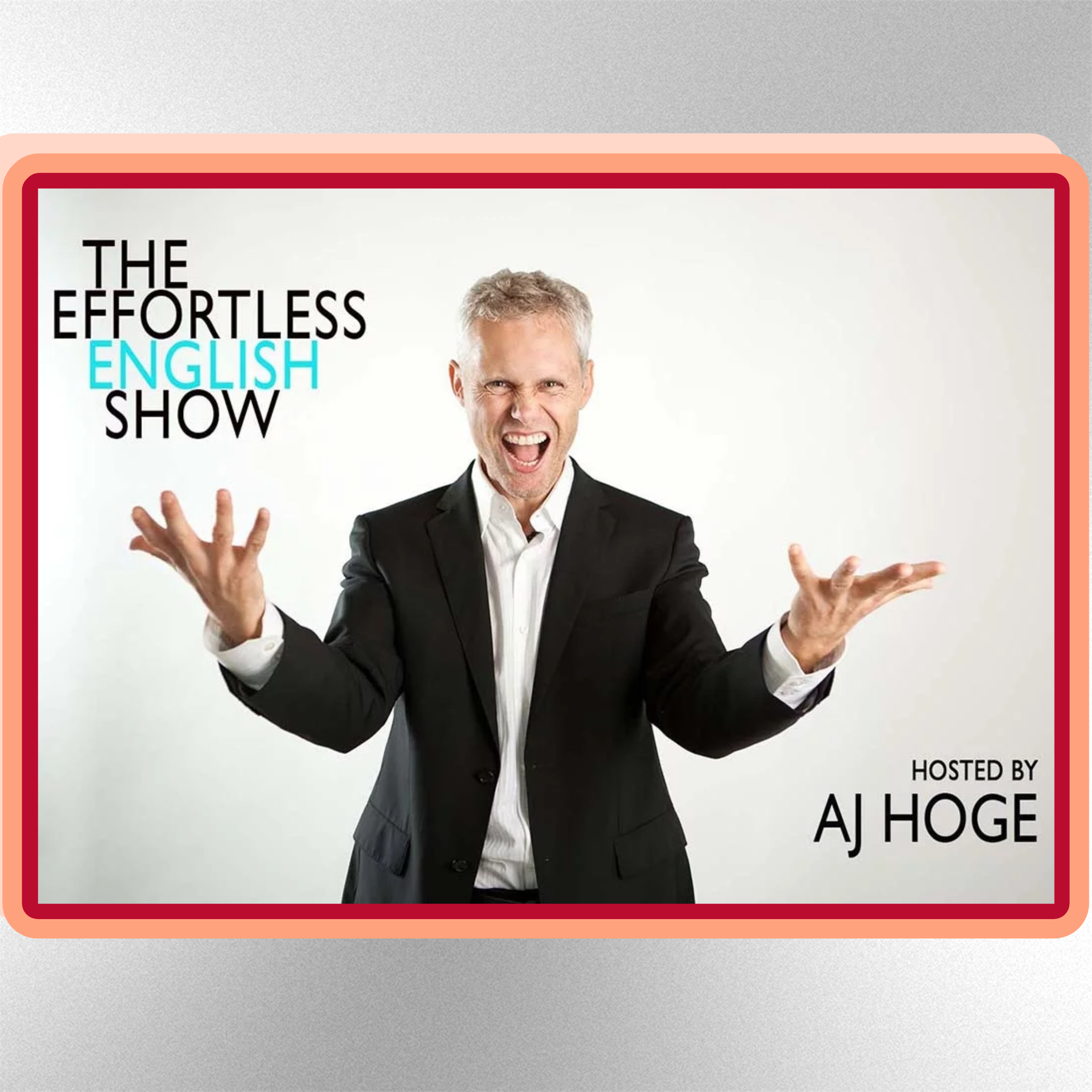
Why grammar is destroying your charisma.
What people really see when you stop to think about grammar rules.
That's today's topic.
I will tell you why grammar not only destroys your fluency, but also destroys your charisma.
The respect you get when you communicate.
This is the Effortless English Show.
Okay, so here's what nobody tells you.
When you pause to think about grammar, people don't think you're being careful.
They don't respect your good or perfect grammar.
They think you're being uncertain, weak, that you're not leadership material.
Now, this happens unconsciously.
People aren't consciously thinking it, but it's the underlying message that you sent, because you look uncertain weak right, low confidence, all that happens.
So I'll show you what they see.
Right, you're talking, you're speaking English and you're maybe you're in a meeting, maybe you're in a job interview, maybe you're just having a conversation with somebody, but In your mind, you're constantly analyzing your speaking while you are trying to communicate.
And so you start looking up or even worse, you start looking down.
You're making these sounds, too many filler sounds, too many filler words.
All that sends a message of weakness, of uncertainty.
It kills your charisma.
Now, what is charisma?
Charisma is your ability to communicate in a way that is effective, that is confident, that is strong, that people respect.
People respect you.
They want to listen to you.
Right?
That's charisma.
And all this grammar obsession and grammar focus and also even worrying about perfect pronunciation all the time, all that pride kills your charisma.
So I'm going to show you the three charisma killing signs.
What is actually being communicated when you do this, and why good, strong communicators sound good.
What is it?
What is it that makes someone a good, strong communicator?
They're respected.
They have charisma.
Compared to someone who doesn't, even in your own language, right?
Even with native speakers, right?
Some native speakers they're you know they come across as uncertain, weak.
You know there's a lot of things that happen.
Some of is verbal it's what you say and how you say it, and a lot of it's non-verbal it's the look on your face, it's the way you you look down, it's your body posture right.
And then i'm going to give you a fix, a 30-day fix, to improve your effectiveness when communicating in english.
And then, at the end, I'm going to give you the number one.
I mean, absolutely the number one secret for much stronger charisma.
And this secret will work in English.
It will work in your language.
It will work in any language.
All right, let's go.
So point number one is called the freeze.
You all know the freeze.
Freeze is like frozen, right?
Not moving.
Everything stops, right?
Over pausing, pausing too much.
Now, sometimes pauses can be effective, right?
When you're going to deliver, you're going to communicate an important point.
A pause before can be effective.
But it's the kind of over pausing and the weak pausing that destroys your charisma over pausing me.
You're pausing too much, you're pausing in strange places and and that is goes with your non-verbal communication That while you pause you're looking down, you're looking up and away, you're breaking your eye contact, your shoulders maybe slump down a little bit, your voice maybe gets weaker, right?
You become a mouse.
You become a mouse in English.
You're communicating that you're a mouse.
You're small and you're weak and you're uncertain.
So this freeze is the worst.
Of course, the very very, very worst situation is when you are in a high-pressure, high-stress situation, like giving a speech in public, public speaking presentations, even in a meeting, in a job interview or on a date right.
Those are all high-pressure, high-stress.
And when you start freezing, in those moments Everything becomes bigger and worse and your stress gets higher and higher and higher.
So your charisma just disappears.
You can imagine you're standing in front of a group giving a presentation and then your mind just freezes.
Because you're so worried about English that you start forgetting what you were going to talk about.
You forget what comes next in the presentation.
I've seen people do this.
I've seen native speakers do this in English, right?
Americans.
I've been to a lot of seminars.
I've been to a lot of conferences and things.
And I've seen people stand up in front of a group and then just kind of freeze and wander.
And, you know, their whole body changes when they do it.
You can just, everybody knows, you can see it that they're overwhelmed, right?
There's too much worry and stress.
They start freezing up.
Their brain just sort of locks.
They can't think clearly.
And then the audience, the listener, loses all respect for them.
Not in a mean way, like, oh, this person's a jerk, right?
They're not sitting back doing that usually.
But just unconsciously, you just feel like this person doesn't know what they're talking about.
This person has no confidence.
So you lose respect for them.
It can't be helped.
This is human nature.
This is just communication.
It's how it works.
This is just the truth.
So the phrase is the worst.
It's probably the scariest, right?
It's what people have nightmares about before they give a speech.
They imagine what's the worst thing that could happen.
Often, this is number one, right?
Just totally freezing and forgetting your speech, forgetting your presentation, forgetting what to say next, and everybody's looking and waiting and then your body language gets all weak and it's a disaster.
But this can happen in smaller ways too, even just in normal conversations or in something a little more casual like just a business meeting.
So you're still chatting.
It's your turn to give an idea.
And maybe your freezes are small and you're just pausing a lot.
And you become that mouse again in English.
And guess what?
Other people's ideas, other people, they get the respect.
They get the promotions.
They get the credit.
It's just a charisma problem.
All right.
Next.
Problem number two that kills your charisma is the robot voice.
So maybe you don't freeze, but your voice becomes flat, right?
All the emotion comes out of it.
You're so focused on English, the English language grammar pronunciation, the perfect phrase or vocab, that You just become kind of flat right.
Your energy drops because you're using so much mental energy to think about English.
You're not putting any energy into your communication, your nonverbal communication, the emotion.
It's better to speak English naturally and confidently, but not perfectly.
That's much better than perfect English that sounds like an AI robot.
And again, the same thing happens.
Just your charisma, maybe it's not destroyed like with the freeze, but it drops.
Again, unconsciously, subconsciously, people respect you less when you just talk like a robot.
You're still a mouse.
Okay, and you know, schools taught you wrong because schools taught you to do this.
They taught you to focus on grammar, grammar, grammar, perfection, perfection, perfection, right?
Take tests.
Oh, you got a 70 on your test.
That's not very good.
You want to get 100%.
If you don't get 100%, oh, you're not good, right?
So you start getting this fear of mistakes, which... weakens or destroys your charisma.
So, you know, the other problem is that you start to focus inward.
This is point number three.
Your focus is inward instead of outward.
Right?
When you're thinking about the language when you're thinking about it, Doesn't matter if it's grammar vocabulary pronunciation, whatever.
You're focusing inward instead of on the audience, the listener or the listeners.
And when you do this, guess what?
People feel it.
Because when you do that, all these little small nonverbal changes happen, right?
So it might not be as big as you know.
Oh you, just You freeze and you collapse and you look down and that's obviously a very extreme example, right?
It does happen though.
But when you focus inward, naturally just your eye contact.
For example, when you focus inward you tend to look up or down, right.
You don't continue looking at a person with good eye contact when you're focusing inward, thinking about the language, analyzing it, worrying. right so when you do that inward focus you you break connection you break connection with the other person or the other people this lowers your charisma it makes you look less confident even if you do feel confident it makes you look less confident right so this is a big problem my son keep breaking in he tries to break in when i'm doing shows okay so anyway so you start focusing inward and it creates all these these little subtle things so these can be subtle that's s-u-b-t-l-e subtle means small but they add up and with charisma with good communication subtlety is so important so it can just be little things just not not looking at them very much a little a small look downwards a small change in your body posture instead of here it's here if you're watching me on video right it's just a small change to my shoulders a small change to my eye contact that little bit kills your charisma and it comes from focusing inward too much and why are you focusing inward because you're you're examining, analyzing, thinking about the language, grammar primarily, but other things too.
And then that causes these shifts and people see it.
People see it.
They might not tell you they see it.
They probably won't say anything.
But they do see it.
And, at the very least unconsciously, they will change how they see you, change what they think about you, change how they feel about you, and that kills your charisma.
Okay, so here's what i want you to do for 30 days.
You can change this around pretty quickly.
Stop thinking about grammar rules.
That's number one.
When you find yourself thinking about grammar rules, When you find yourself thinking about English while you are communicating, stop.
Break that thought right away.
Just say, nope, I'm not going to communicate.
I'm just going to talk.
I'm not going to think about it.
You can think about it at other times if you want to.
When you're reading English, you can kind of.
You know, think about it.
You can say, oh, that's a new word.
What's that?
Write it down.
That's fine.
But when you're actually talking, when you're actually communicating or even when you're just listening to audios, don't analyze.
Just let it come into your ears.
Let your brain figure it out.
Your brain is pretty smart, actually.
We are created for language and just let your brain figure it out.
You will improve gradually just by doing that.
And that's step two for this 30-day plan is to focus on listening.
I recommend two hours a day.
Two hours a day listening to real natural English.
Now, this could be something like mini stories and point of view stories.
If you're really trying to work on your fluency and natural grammar learning.
Or it could be more advanced things like listening to this show, this podcast, listening to other podcasts, listening to other audios.
At an even more advanced level, you could be listening to movies and TV shows in English.
But don't analyze.
Just listen.
If you want, you can use the movie technique.
I've got a nice video about that.
It's a great technique.
And what you'll do there, you will learn new phrases.
You can write them down if you want to.
You're not going to analyze the grammar.
You're not going to try to figure out which grammar rule is this person using in this situation.
It doesn't help you at all in communication, okay?
Just copy how native speakers speak.
Just use phrases they use.
Commit, don't quit.
And this is how you become a lion in English right where you have that confidence, that charisma, even when you're not perfect.
You'll never be perfect.
Let go of it.
So I promised you the number one key to charisma.
And, you know, this is important.
It's very important.
The number one key to charisma is a change in your attitude, a change in your mindset.
And just changing this will have a huge effect On your charisma, on how people see you, on the respect you get, on the effectiveness of your communication.
This one thing.
What is it?
You want to shift means change from seeking approval, which is what all this is about.
Is pride, right.
Why are you worried about grammar mistakes?
Why are you worried about pronunciation mistakes?
Because you want the other person to approve of you.
You're trying to get the other person to say, oh, you're good or you're not foolish.
You want to look good or sound good.
That's that kind of prideful mindset most of us get stuck in in the beginning.
Change this one thing, it's going to change.
This will change everything.
English speaking and your charisma and effectiveness in English communicating.
It'll also work in your native language.
It'll affect every part of your life.
So you change from trying to get approval, trying to look good, and you shift to creating a positive experience for others.
Creating positive experiences for others.
What does that mean?
It means you, instead of looking at yourself and focusing on me me me me, you focus on them them them, them.
This is huge.
I'll give you an example from public speaking.
So in the beginning, when I would do speeches and I was trying to improve public speaking, you know I made.
I was super nervous all that.
But even as I got better, I, You know, I still had that focus in my mind.
I'm thinking I want to look good.
Right.
I want to do a good job.
It was me, me, me.
I was so focused on my own performance, how people would see me, how good I was.
And this limited me.
It actually created more stress and more nervousness, which I then had to try to overcome.
And when I discovered this, I changed.
I said, okay, I'm not going to focus on myself.
I'm going to focus on the audience.
My focus is on creating a great experience for them with my speech.
So, while I'm standing up there talking right, while I'm standing up there speaking, instead of focusing on myself, I would just I mean literally focus with my eyes.
I would just start focusing much more on audience members.
And if it was a big audience, I would pick one person look at them while I was talking and maybe pick a different person look at them.
And I would just notice, right?
Were they smiling?
Were they happy?
Were they excited?
Were they interested?
Or did they look kind of bored and tired?
And if they look bored and tired, I would need to adjust what I was doing.
Increase my energy right.
So my whole focus shifted from me, I want to look good, to them.
I want them to have a great experience.
So when I started doing this, what's interesting is that my nervousness just faded away because I wasn't focused on myself so much.
I was just trying to contribute to them, give to them, help them.
So if I saw they were tired, I would start being more energetic and jumping around.
Maybe I would ask the audience, stand up.
Everybody's looking a little tired.
Let's stretch a little bit.
Let's get back to our peak emotional state and play some exciting music.
And we jump around for two minutes, like a little jump around break.
And then I'd notice, I'd look and I'd be watching them, not focusing on myself and watching them.
I'd say, oh, well, look, everyone's smiling now.
They're happier.
They're more interested.
They're listening more.
They're having a better experience.
And I stopped focusing so much on, oh, I must say this and I must say this and I must say this.
I have this outline, this speech.
I plan this speech.
I must do it exactly.
I stopped doing that.
I would just adjust.
Because my focus was on them, them, them, not me, me, me.
This is true for, you know, any situation.
This would be true in just a casual chat with somebody.
You're just having a conversation.
Instead of focusing so much on what you want to say.
Oh, I want to tell them this.
I want to tell them that.
Me, me, me.
You focus on them.
Number one, this makes you a much better listener.
That requires...
No extra fluency or grammar or vocabulary or anything.
When you're focusing on them, they feel it because you'll tend to lean in a little more.
You're really listening.
You're looking at them while they speak.
You're not just trying to think what you're going to say next.
No, you're just trying to understand them more.
Maybe you ask them more questions instead of just talking all the time.
You can actually have great conversations without saying a lot just by getting the other person to talk and talk and talk and asking good questions and really focusing on them and caring about them and trying to understand them and their ideas or their thoughts or their feelings.
By having that mindset at the end of the conversation they walk away thinking wow, that was a great conversation.
You have charisma.
You're a great communicator, but you might not have actually spoken a lot.
And then, when you do speak again, you focus on oh, I want my speaking to create a great experience for them.
Not just me, me, me.
I want them to understand me.
I want them to do what I want them to do.
Right?
I want them to think I'm great.
I don't want them to laugh at me.
I don't want them to think I'm foolish.
All these thoughts in the back of our heads.
No, no, no, no.
You focus on them.
So you try to, let's say you tell a story.
Well, instead of just telling a story, you think well, how can I make the story more interesting for them?
How can I make this story a better experience for them so they enjoy it?
So you start learning storytelling techniques.
Now, there are thousands of techniques for doing all this, okay?
You can learn how to tell stories better.
You can learn techniques for listening, you know, and active listening and asking questions.
You can learn body language techniques.
I'll teach you these, okay?
I'm going to talk more about these in a future show or shows.
But the core of it, the foundation, the most important thing is this shift, this change in your focus from yourself to them.
And that's the key idea that you must always remember.
Okay, so the key thing, focus on them.
Focus on contributing to the other person.
Focus on caring about them, really wanting to understand them.
Focus on wanting them, to give them, to help them have more positive feelings, more positive emotions.
That's the key.
When you do that, a lot of good things will naturally happen in English and in your own language too.
This is the heart of having great charisma.
And it really comes down to really just caring right caring about the other person and letting go of your own pride and your own ego, and the focus on yourself.
Now, of course, yes, you're going to continue learning grammar.
You're going to continue learning vocabulary.
Your accent will improve.
You're doing all these things to improve your English.
It's all good, but when it's time to communicate, let go of your pride.
Don't think about yourself.
Don't think about the English language.
Just focus on the other person or people, if it's a group.
And that's all.
And when you're focusing on them, like use your eyes, look at them.
Now, some different cultures have different ideas about what's good eye contact, right?
So in some cultures, a lot of strong eye contact is good.
Like American, we like that.
And others, like in Japanese, too much eye contact is uncomfortable for them.
They don't stare at each other's eyes for long periods of time.
But if you're not looking at their eyes, you can still be looking at their face.
You can notice little small changes.
You can look at their body posture.
You can learn a lot about how they're feeling, how they're reacting.
You can also.
If it's a group of people, you can make short eye contact with one person, talk to them directly and then shift to another.
This is what you should do when you give speeches and presentations.
Don't just vaguely look at the back of the wall with no focus.
You want to just pick one person.
Let's say you're giving a presentation at a job and there are 10 people in the room.
Well, you want to pick one person.
And talk to them for a bit with some eye contact.
And then after a while, you don't want to just stare at the same person the whole time, right?
You'll shift to another person.
And you look at them in the eyes and you continue your presentation.
And then you shift to another person and to another person.
And you're just doing this through your whole speech.
Even if it's a thousand people, you're just picking people in the audience and you're talking to one person at a time.
And you're noticing their body language.
Are they smiling?
Are they frowning?
Do they look tired?
Do they look interested?
And then you can adjust.
You just naturally will adjust as you do this.
Because you're getting out of your own ego, you're letting go of your pride and by doing that naturally, your communication is going to improve tremendously in English and in your own language.
See, when you do that, guess what?
You're not thinking about grammar anymore.
You're just focused on the other person and letting those words come out, communicating.
You're not worrying about all that stuff.
And so your shoulders are going to get a little back more.
Your chin's going to be up more.
You're going to smile more.
You'll have more energy.
So this is the heart of it.
And then later, as you get better, you can also start practicing other techniques.
So that's it.
Very simple.
Very, very, very simple.
If you remember one thing from this whole video, remember that.
When you communicate, when you talk to someone one person or more you focus on the other person, giving them a good experience.
You do not focus on yourself.
All right, that's it.
Lots of love to you, and I will see you next time.
Bye for now.
Just speaking.