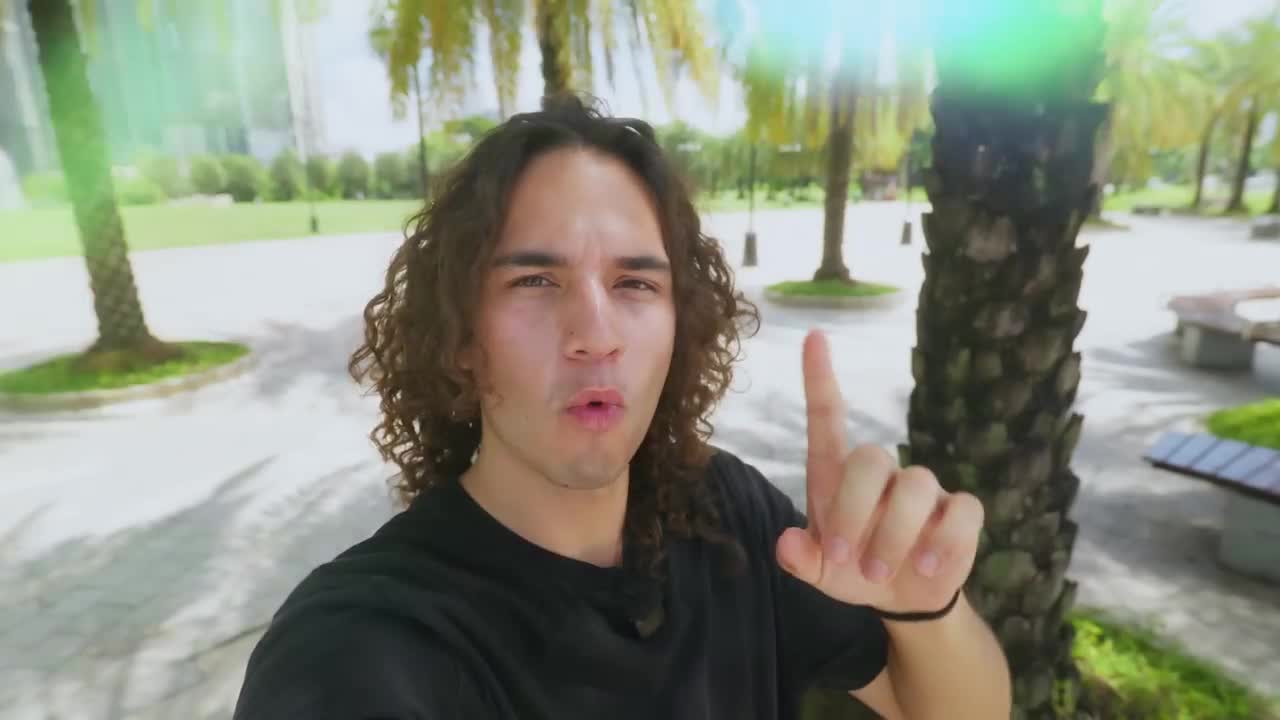
Do you actually know your English level?
Today, I'll be testing your English listening from A1 to C2.
Each level will become more difficult.
The vocabulary will become more advanced.
The sentences will become longer and the ideas will become more complex.
And I will slowly start speaking more naturally
And like a native English speaker.
So watch until the end, answer all the questions and watch until the very end of the video because that is where I will explain each English level in detail and what it means if you passed a certain level.
So here are the rules.
Rule one, do not use subtitles the first time you watch this video.
Rule two, listen to each section.
And at the end of each section, I will ask you three questions.
Do your best to answer these questions and put your answers in the comments.
If you get two or three correct, you probably understand that level.
If you get zero or one correct, then that level is probably too difficult for you right now.
This is not an official English listening exam, but it'll give you a good idea where your English listening level is at.
So if you're ready, let's get started with A1.
This is A1 English.
Listen carefully.
Hello.
My name is Volca.
I'm at home.
I am in my room.
I am in my living room.
I have a phone.
I have a chair.
I have a desk.
Today I am making a video.
I am speaking English.
I am speaking slowly.
I like English.
I like teaching English.
I want to help you.
English is not easy, but you can learn.
Listen every day.
Speak every day.
Little by little your English gets better.
Now answer these three questions to test your listening comprehension.
First question.
Where am I?
Question two, what am I making?
Question three, what language am I speaking?
Here are the answers to these three questions.
If you got two or more correct, your English level is probably A1 or higher.
Remember to stick around to the very end to see what your English level means.
Now let's do the A2 listening test.
This is A2 English, so listen carefully.
Yesterday morning, I woke up at eight o'clock.
I was a little tired so I made a cup of coffee.
After that, I checked my phone and answered some messages.
Then I went outside to buy food.
There is a small supermarket near my apartment.
I bought eggs, rice, chicken, and some fruit.
The supermarket was busy because many people were shopping before lunch.
When I came home, I cooked a simple meal.
It was not amazing but it was healthy.
Later, I cleaned my room, worked on a video and called a friend.
It was a normal day but I felt happy because I finished everything I needed to do.
That was A2.
Now answer these three questions.
Question one.
What time did I wake up?
Remember to leave your answers in the comments.
Question two.
Where did I go?
Question three.
Did I feel happy?
Here are the answers.
Question one, the answer was B, 8 o'clock.
Question two, the answer was A, to a supermarket.
Question three, the answer was B, because I finished everything I needed to do.
So if you got two or three correct, then you probably understand this level.
And let's go on to the next one now.
3000, that is the amount of words you need to understand up to 95% of spoken English.
But if you wanna keep improving after that, I've now added the next 2000 most common English words.
So you can build the full 5000 word set
And understand up to 98% of spoken English.
So now you can start with the 3000 word PDF, continue with the next 2000 word PDF, or get both together as the full 5000 most common English words PDF that will allow you to understand up to 98%
Spoken English and in these new versions there are now images as well to help you learn even faster
Each PDF includes clear definitions real examples and simple organization to help you stop studying random words and focus on the vocabulary that actually
Last year, I took a train to visit a city I had never been to before.
At first, everything was fine.
I bought my ticket, found the right platform, and got on the train without any problems.
But when I arrived, I realized I had made a small mistake.
I got off at the wrong station.
The names of the two stations were similar and I had not checked carefully.
For a few minutes, I felt stressed because my phone battery was almost dead.
I needed to meet my friend at a cafe, but I did not know where it was.
So I went into a small shop and asked the owner for help.
He was very kind.
He showed me the correct station on a map and told me which bus to take.
I was 30 minutes late, but my friend was not angry.
Actually, she laughed and said, at least now you have a good travel story.
In the end, the mistake was annoying, but it taught me to check station names more carefully.
Question one.
What mistake did I make?
Question two, why did I feel stressed?
Question three, how did the shop owner help me?
Remember, you can pause the video if you need more time to answer these questions.
Here are the answers to the three questions.
Remember, if you got two or three correct, you probably understand this level.
Now let's move on to B2 English.
And remember guys to tell me what level you are at in the comments once this whole test is finished.
Let's go.
Now B2 English.
Remember to listen carefully and to tell me what your English level is at the end.
A few months ago, I planned to go hiking with two friends.
The weather forecast said there might be light rain in the afternoon, but the morning looked clear, so we decided to go anyway.
At first, the hike was beautiful.
The sky was gray, but the air was fresh and the trail was quiet.
After about an hour, however, the weather started to change.
The wind became stronger
The clouds got darker and we heard thunder in the distance.
One of my friends wanted to keep going because we were already close to the viewpoint.
But my other friend said it was better to turn back before the storm got worse.
At first, I was disappointed because I really wanted to reach the top.
But after a few minutes, the rain became extremely heavy and the trail became slippery.
That was when I realized turning back was the right decision.
If we had continued, we might have been stuck on the mountain during a storm.
Later, we found a small restaurant near the trail and had lunch there instead.
The day did not go as planned, but it was still a good day because we made a safe choice.
Sometimes changing your plan is not failure.
Sometimes it's just common sense.
Now time for the three questions.
Why did we decide to go hiking at first?
Question two, why did one friend want to continue?
Question three, what is the main lesson of the story?
Here are the answers to all the questions.
If you got two or more correct, you most likely understand this level.
Now let's go to the advanced levels, C1 and C2.
This is C1 English.
Social media is strange because it gives people the feeling of connection while often making them feel more alone.
You can open your phone and immediately see what hundreds of people are doing.
Someone is traveling, someone is getting married, someone is starting a business, someone is posting a perfect breakfast that probably took 40 minutes to arrange and five seconds to eat.
At first, this can feel entertaining, but over time, it can quietly change the way you see your own life.
Normal moments start to feel boring.
Rest starts to feel lazy.
Privacy starts to feel like invisibility.
And instead of asking, did I enjoy this?
People start asking, can I post this?
The problem is not that social media is evil.
That would be too simple.
The real problem is that these platforms are usually designed to keep your attention, not necessarily to make you happier, wiser, or more peaceful.
And when your attention becomes the product, your emotions become part of the business model.
That does not mean everyone should delete every app and go live in a forest.
Although honestly, some people on the internet could probably use a weekend outside.
It means we need to be more aware of how these platforms shape our habits, our confidence, and even our idea of what a successful life looks like.
First question, according to the passage, why is social media strange?
Question two, what do I mean by when your attention becomes the product?
Question three, what is my attitude towards social media?
Here are the answers to those three questions.
If you got two or more right, let's go on to the final level, C2, the most advanced English level.
Don't just watch this lesson and forget it.
Get the workbook for this video on my website and practice everything from the lesson more
Deeply.
Inside you'll review the grammar, vocabulary, tenses, sentence patterns, comprehension questions, and real English from this video with clear explanations and
Exercises.
Watching helps you understand, but practicing helps you remember.
And when you buy five or more workbooks, you automatically get 30% off at checkout.
The link is in the description or at volcaenglish.com.
Now, C2 English.
Most English learners do not need this level, so if you don't understand it completely or at all, don't worry.
But if you do, then your listening comprehension is extremely strong.
This is C2 English.
Listen carefully.
Whenever a new technology changes the way information moves, people tend to have two opposite reactions.
One group says it will destroy society, the other says it will solve almost everything.
History suggests that both sides are usually exaggerating.
When books become easier to produce more people could access knowledge but that did not magically make everyone wise.
When television became popular people could see the world from their living rooms but they could also be influenced by whoever controlled the screen.
Now we are living through a similar shift with algorithms, artificial intelligence, and personalized feeds.
The issue is not simply that information is available.
The issue is that information is selected, ranked, shortened, framed, and delivered to us before we even realize a choice has been made.
That creates a strange situation.
People feel more informed because they see more content, but they may actually be seeing a narrower version of reality.
Not because someone is always lying to them, but because the system learns what keeps them watching.
Over time, that can make public conversation more emotional, more reactive, and less patient.
Complicated problems start to look simple, opponents start to look evil, and uncertainty starts to look like weakness.
The real danger is not that technology thinks for us.
The real danger is that it trains us to stop thinking slowly.
And slow thinking is where judgment, humility, and real understanding usually begin.
First question, what does the speaker suggest about people's reactions to new technology?
Question two, what is the main concern about algorithms and personalized feeds?
Question three, what does the speaker mean by technology trains us to stop thinking slowly?
Here are the answers to those three questions.
If you got two or more correct, then your English comprehension is very good.
That means you could understand fast, complex, and abstract English with layered ideas, implied meaning, and native style phrasing.
Again guys, all the levels are only an estimate.
It's not exact, but it gives you a good idea where your English level is currently at.
Now guys, time for your results.
If you pass level A1, you can understand very basic English when it's slow and clear.
If you pass level A2, you can understand simple everyday English about familiar topics.
If you pass level B1, then you can understand clear stories and the main points of familiar situations.
If you pass level B2, you can understand longer explanations, reasons, consequences, and opinions when the topic is not familiar.
If you pass C1, you can understand abstract ideas, implied meaning,
Tone, attitude and natural humor.
And if you pass C2, then your comprehension is extremely strong.
You can understand complex, fast and native style English with little difficulty.
Now i want you guys to comment your results are you an a1 a2 b1 b2 c1 or c2 english learner
And if you want to improve your english comprehension more make sure to check out all my comprehensible input videos
I have over a hundred and they teach you english naturally and there are no boring lessons or classes
So
Make sure you check out all my videos on my channel.
And if you guys want to have a native English test to see if your English is at a native level, let me know in the comments by typing native English test and I'll make that video for you guys as well.
And remember guys, you will become fluent in English.
Bye guys.
Yo, what are you working on?
Yo, I'm working on my channel right now.
I just started.
I'm going to be posting once a week if you guys want to check it out.
I'll be posting my shadowing stories on my second channel, Volca.
And I've also started posting these videos as podcasts.
Do you understand English but feel nervous when you speak?
Join my Patreon for my speaking, pronunciation, and shadowing course with over 90 video lessons.
You'll practice pronunciation, accent, rhythm, and natural speaking with step-by-step video lessons, plus new lessons every week.
Get it in the description.