Discussion keeps the world turning.
This is Roundtable.
You're listening to Roundtable.
I'm Niu Honglin, joined by Steve and Xinyu.
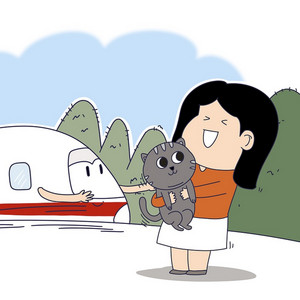
This year, China's high-speed rail system added a new kind of passenger, one that barks or purrs.
The country's pet consignment pilot, launched in April, has expanded to 40 stations and 50 trains, now allowing pets to travel on their own.
So you ready to plan a great trip for your furry friend?
And in every culture the middle of the day once carried meaning a pause between effort and renewal.
But somewhere along the way we traded that pause for productivity.
The desk became our dining table, the screen our companion.
Do you also have what kids today call sad desk lunch?
Join us for the discussion.
But now Good news for China's pet owners.
Your furry friends just leveled up their travel game.
China's high-speed rail pet shipping pilot program has officially expanded.
Since the pilot operation of this service was launched in April, nearly 5000 travelers have tried this novel service.
Now, the service is also receiving some upgrades.
So what exactly is new?
More importantly, is China's high-speed rail now the ultimate pet taxi, and would you trust your best friend on their own to do their first solo train adventure?
China's national railway system has definitely become more pet-friendly.
Recently, it has upgraded its high-speed rail pet consignment service, allowing pets to travel on specific routes.
Now, when you go to this official 12306 online ticketing platform, there will be this green tag with the Chinese character Chong, which means pet on it.
On some of the routes train routes
So if I choose those, it means I can carry my pet with me and even buy just a ticket for my pet.
Yeah, you have two options.
And they've rolled this out pretty quickly, because it was launched and it was a pilot back in April 2017, this year, but at that time there were only five stations and ten trains along the Beijing-Shanghai line.
But now it's been increased to include 40 stations and 50 train trips in total.
Still the popular ones include the ones from Beijing to Shanghai and Hangzhou and Nanjing and those places Shenzhen.
But yeah, they've expanded it quite quickly.
So that tells me two things.
Number one, that they had the ability to do it, and number two, that the demand was there.
It must have been quite popular if they've expanded it so quickly.
So if I purchase the ticket for me and my pet, for example for those kind of trips that are not solo by the pet, am I taking my cat with me to my seat?
Not the same carriage.
Yeah, the pets are stored in a space, designated cargo space.
So you and your pet, you are going.
We're separating yeah, but you're separate for just a few hours, okay.
Okay, can i visit them?
Um, i don't think so, but there will be a staff there are there to look after your pets and they will give them water every uh, two hours, i think.
Yes, so you are not be able to go to the pet box and open the box and to interact.
Kind of makes sense, because i do not want strangers to go visit my cat when they're looking at theirs as well.
So yeah, it kind of makes sense.
It's not like they're put in a recliner seat, in like first class or something.
They're Probably in a crate with the other animals.
And the way that they break down the price is kind of a tiered structure and a tiered system.
Well, first of all, regardless of the fee, it includes a basic insurance of about 2000 yuan, but the pricing tiers themselves are differentiated based on whether the owner has a ticket for the same train or if the pet is traveling solo.
So you don't even have to be on the train.
You can be sending your animal alone.
So here's how it goes.
So the travelers who purchase a ticket for the same train receive a specific discount.
That's a 30% discount from the standard price.
There's a price range in there from about 360 yuan up to 860 yuan.
That's about $50 to $120 to depending on the distance.
But then the distance is how they tier it.
So up to 1,000 kilometers, the fee is 360 yuan per pet.
For 1,000 to 1,500 kilometers, it's 460 yuan per pet.
1,500 to 2,000 kilometers is 660.
And anything over 2,000, it's 860.
So it makes sense.
The further you go, the more you pay that bad, because I think it's just a little bit slightly higher than a second-class seat for a person.
So it kind of makes sense because it takes up the space.
It requires people to visit them constantly, every two hours at least.
And the designated carriage, the designated area requires disinfectant.
The boxes where the container can be ventilated and also can be cleaned.
And I do not even have to bring my own carriage.
Well, I kind of still have to, because I will take my pet to the places from the train station after we arrive.
But the transportation process would provide me with a designated container which is easier to be taken care of, to maintain during the trip.
So that means I can take my cat, my dog, my lion.
Stop there.
Stop there.
Stop at cat and dog.
Because only household domesticated cats and dogs are allowed so if you have a lizard i guess you're out of luck a lion i've never heard of anyone having no that's not true i have heard of that before lion i was kidding but yeah but no no lion um there's all there's more rules too the single pet weight must not exceed 15 kilograms oh not my fattest cat the is it over 15 kilograms maybe no think you live with a lion the pet's shoulder height must not exceed 40 centimeters so they'll not huge huge dogs and then you have to have a valid animal quarantine qualification certificate that is also required oh that's good so that Because all of the pets being shipped or enjoying the trip are together.
So you want to make sure that they are healthy.
And also in the past, you can only bring one of your pet on the train.
But nowadays, if you are traveling with your pet, then you can carry up to two pets with you.
But if your pet is going solo travel, then it has to be just one pet.
And in the past, you have to order this ticket two days in advance.
But nowadays, if you are placing the order before 12 pm, then you can just buy the ticket for the next day.
So it's closer time arrangement for you.
One day in advance, yeah.
And for the pets that are going solo.
Actually, those who are at the arrival can get the pet based on a text message or a telephone number and they go to designated places to receive and to welcome their pet into the destination.
Yeah, I'm thinking, well, this isn't for vacation purposes, right?
Nobody's you know, sending their dog on a holiday for a few days.
I'm thinking this might be really useful for adoption services, right?
If you adopt a cat or a dog from the Beijing area but you live in I don't know Shenzhen, for example, well then, how do you get that pet down there?
So it just kind of broadens that market.
That's the example that came to mind for me.
And also for those who are moving.
They're relocating to a different city.
They want to take their pet.
Previously, the only option is to drive, no matter how far away you can drive with your pet, but now the service is open to those people as well.
So how are people reacting to this new policy?
Because i remember in the very beginning, when we started talking about bringing your pet onto the train, a lot of people were complaining because they thought, as i thought initially, that the pet would go along with the person, and they were Worrying about oh what if I'm allergic to cat hair?
What if they bark or purr all the time in the carriage?
But that worry has been removed.
And for pet owners, of course we welcome the service.
You never know, save it for a rainy day.
Maybe you need to take your cat to travel.
Yeah, the the overall feedback has been pretty positive thus far and people talk about its convenience.
But you know, convenience is a relative term.
Some people might see this as being really convenient, but some people might see it as being something that's too complex, and that seems to be the two groups.
Not all of the feedback is entirely positive.
There was one comment online that said, too troublesome.
I think for first-time users, when you carry your pet on this first train trip, then it can be a little bit troublesome for you to you know how to purchase the ticket, how to dial the number and then how to provide all of these materials to the certain staff.
You know the trip can be troublesome.
But I have read one of these reports a pet owner from Beijing.
He traveled with his pet to Tianjin and he had a quite smooth travel experience, I think.
So for first-time users, it can be a little bit troublesome.
Yeah, of course, because you have to figure out how to do it properly.
But once you get how to...
Yeah, then you know.
And then each time you do it.
After that it's going to be really easy and you'll have all the numbers saved and you'll know where to go on the app and what buttons to click and things like that.
So people are just spoiled, right?
And for those of you who are worried a little bit about your patch traveling solo over the past several months over the pilot period.
For more than 4000 or 5000 passengers who booked the service.
Their pads were all intact, very healthy, after the trip.
Intact.
I just want to make sure that because, Pardon me my cat's arm is dislodged from the rest of its body.
Intact.
They're healthy and they're happy and they're being taken care of.
So, well, I think it's a legitimate service.
I might try someday.
And you're listening to Roundtable.
Coming up next is desk lunch in the office, a sad thing to you.
Don't go away.
Looking for passion?
How about fiery debate?
Want to hear about current events in China from different perspectives?
Then tune in to Roundtable, where East meets West and understanding is the goal.
It's Roundtable with myself, Niu Honglin, Steve Hatherly and Xin Yu.
The image is familiar to almost everyone working today a hastily prepared lunchbox from home or a plastic container from some local order out joint, eaten with one hand while the others roll through emails.
It's what many call a sad desk lunch, and it's become less of a choice and more of a cultural expectation.
The midday break, once a scarce ritual for well, a secret ritual for restoration and socialization, has largely disappeared from the Western lunch break, and the shift is deeply concerning, not just for our waistline, but also for our cognitive health, our productivity and our overall overall well-being.
What is happening to our lunchtime?
Well, first of all, I want to stipulate that this is from a Western point of view, right?
The sad desk lunch.
That's my question initially.
We might encounter a bit of a culture difference here, but we'll talk about that in just a sec.
First, some statistics for you.
Less than half of employed Americans take a full hour of lunch.
They did some surveys and they found that 40 of employed US workers say that they rarely or never take a proper lunch break, and that indicates that the majority are either compressing the lunch break, making it shorter or just skipping it altogether.
And that means that the afternoon starts without kind of a proper mental reset.
More than half roughly half spend their lunch break doing work-related activities like answering messages or checking emails or taking calls.
Like you said, sandwich in one hand, scrolling with the other hand.
And that shows that it's not really a true...
This was written about in the New York Post and other media outlets as well, where they're having a look at some of these statistics and seeing how they feel.
Just one last little bit for you here.
About one third of employees reported feeling guilty when they took their lunch break.
And this suggests that work culture has changed dramatically, where you feel like you're punishing yourself for taking an entitled break.
And we talked about this before, but when we talked about it before on Roundtable, we were talking about holidays or days off.
Taking days off.
But this is much more specific.
This is talking about the lunch break specifically.
I didn't know Americans are so hardworking.
But based on the recent surveys, it really says that.
But I don't think we have such a kind of culture in China because...
I think many Chinese companies, they have their own canteens provided by the company.
So during lunchtime, workers just go to have their lunch at the canteen.
I am going to disagree with you based upon my vast 15 months in China.
I see it all the time.
I see people eating lunch at their desk all the time.
But the difference.
When I said culture difference and again it's just what I've seen on a limited basis, but the culture difference, I think, is that I don't see anybody feeling bad about that.
These stories are saying like, oh, this is tragic.
American workers are eating lunch at their desk.
I see it all the time here within our company and people seem to be quite happy to do so.
They choose to do it.
And that's the thing.
I think it has a lot to do with the situation, with choices, with personal preferences.
To start with, like Xinyu said, it depends on whether or not this company has a canteen.
When you say many companies in China have, I don't think it's the majority, but yes, there are the kind of companies, companies who would provide a canteen, so you can go.
And also the companies that are really near commercial circles or commercial shopping malls and areas, so that employees would go to the shopping mall to have lunch.
And that's the kind of situation where you do not see many people having their lunch at their desk.
But people do it by choice in the sense that they do not like what's provided in the canteen today.
Some of them would like to bring food or bring dish from their home because their on a special diet and they can bring food, so it's healthier, so they can lose some weight, so they can have a bit more time walking around the office, taking a walking break during their lunch break.
And also there's the situation of people who wanted to, you know, order for something a little bit different, because and also it has something to do with whether or not the company has a lunch break policy, because technically speaking, some companies would say you have an hour, or an hour, one and a half hour of lunch break.
And whether or not you have lunch or you leave the office or you do your own things, it's your choice.
It's your time.
And it's something significant because when I was browsing the internet, I realized that there have been several news stories about certain companies saying that their employee would have to have lunch at their desk, and the companies were sued.
It's a new story.
So it is again also considered something unacceptable if your lunch break is being deprived completely, even in China.
Well, there are downsides to it, I guess, whether you're choosing to do so or not.
When you are eating at your desk and you're scrolling through work emails and things like that, then the experts suggest that you are eating under stress and that could disrupt your digestive system.
Also, when you don't have that true break, it creates something called attention residue.
And that happens when thoughts related to the morning's tasks linger in your mind and it prevents them from being fully cleared and consolidated in terms of information.
So you're hanging on to your morning information, combining it together with your afternoon information, and it reduces your capacity to process new information in the afternoon effectively.
They also say that it's a missed opportunity for mental processing.
They also say that it's just better or not as good, excuse me for your social.
You know, stepping away from your desk to have lunch often means that you'll go out and eat with other people and have a chat with other people, and you're missing out on that opportunity too.
I've also read reports saying that if your work requires creative thinking, you might want even need a pause in the middle of the day, a bit more than those who are working, for example, for the entire day.
They have assigned themselves at paperwork or the kind of process that does not require that much of a creative thinking.
But is there any any benefit at all, eating at your desk in the office or in a workplace?
Work longer?
Yeah, there are silver linings.
You get a jump start on your afternoon, right?
Yeah.
You can get ahead of those emails a little bit if you want to.
It can help create a little bit more efficiency in your day if you don't mind.
And as much as it can, combine the morning's work with the afternoon's work.
Maybe you need that time to really finish your morning work before you get a start on your afternoon.
Or if you're okay with eating your lunch and doing a little bit of work.
That will create a less busy afternoon for you, perhaps as well.
But I actually, I have tried that.
I mean, I had lunch in the canteen and then I, came back straight to my desk and I started working.
So I did work uh, work longer, but I feel like in the afternoon I feel exhausted quicker than yeah.
It's quite cultural.
Um they, they.
They say they found this from research that North American and UK culture.
It views lunchtime as a disposable personal time because in the U?
S and the UK it's considered your lunch hour is considered um time belonging to the employer.
That's how the employees kind of see it.
But if you look at other countries where they enforce your lunch break or your break in general, like France and Spain and Brazil, they have longstanding labor laws or at least strong cultural traditions that mandate a break.
And sometimes those breaks include a nap, siesta. which is a nice long break.
Whereas in Korea, so that's in Europe.
And in Korea, I saw a survey result from a couple of years ago.
In Korean culture, you often go to eat lunch with your coworkers, right?
It's just kind of an accepted part of office culture.
They did a survey in 2023, and they found that nobody likes eating lunch with their coworkers.
Which is, it's part of the culture, but everybody's like, I don't want to do this, but I have to.
And from someone's point of view, someone from Shanxi province who has the stereotype of having really long nap during daytime.
Uh I, which I fully support that stereotype, I find that sometimes taking a break definitely would help me process my afternoon a bit better.
Unless I'm allowed to, you know, leave work one hour in advance, then I'd be happy to work my lunch hour.
And that brings us to the end of today's Roundtable.
We'd love to hear your thoughts on today's topics.
Leave us a comment or send us an email to roundtablepodcast at qq.com.
Until next time, keep the conversations going and the I
I'm Neil Holland with Steve and Xinyu.
Thank you for listening.
Bye-bye.